
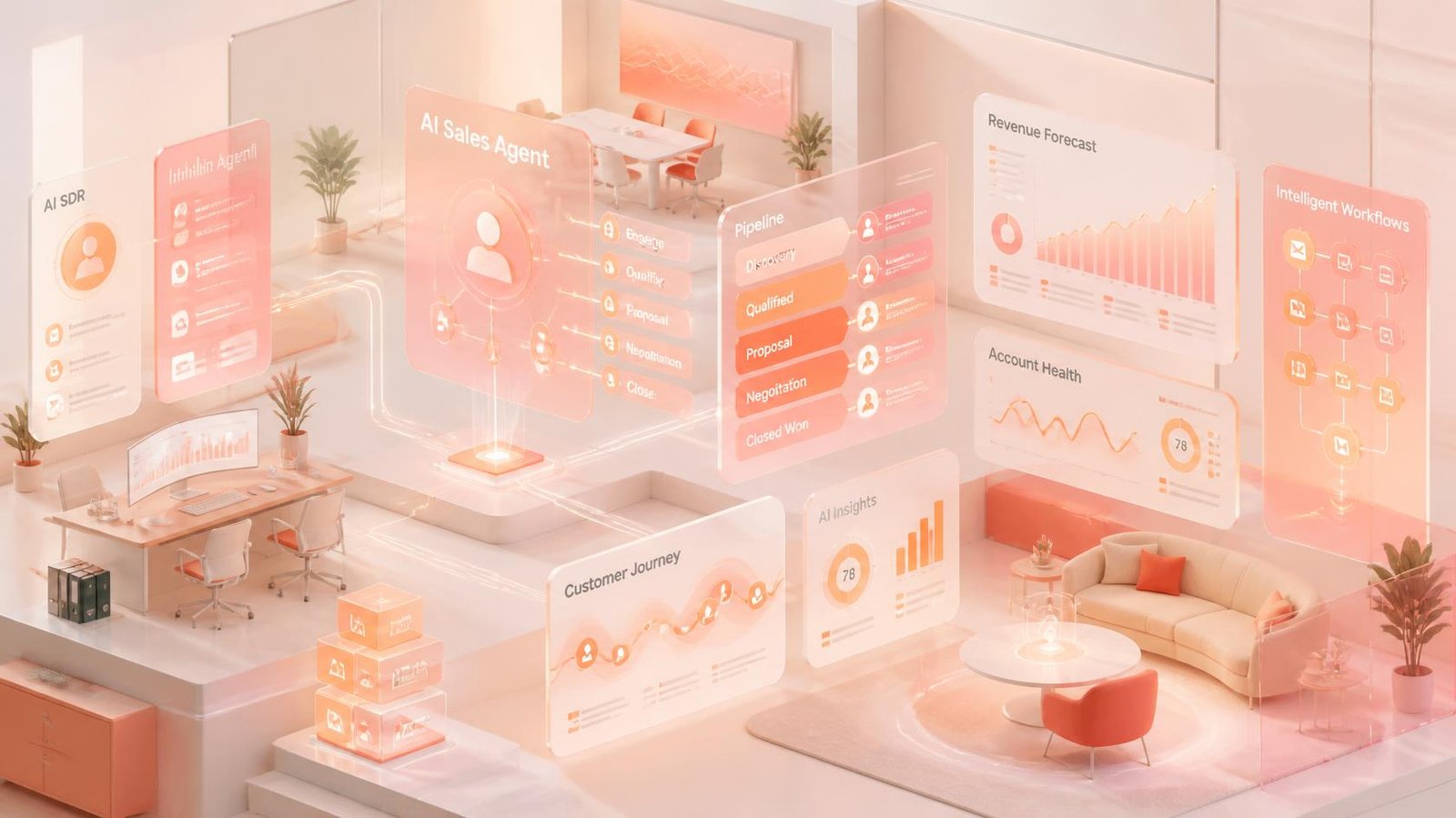
Artificial intelligence has become one of the biggest forces transforming modern sales. Organizations no longer rely solely on manual prospecting, repetitive follow-ups, and traditional CRM workflows to build a healthy sales pipeline. Instead, businesses are investing in intelligent automation that can identify prospects, personalize outreach, qualify leads, schedule meetings, and even assist throughout the sales cycle.
As a result, two terms have gained significant attention among sales leaders and revenue teams: AI Sales Agents and AI SDRs. While these technologies may appear similar at first glance, they are designed to solve different challenges within the sales process.
Understanding the difference between AI Sales Agents vs AI SDRs is essential for businesses planning to improve productivity, reduce operational costs, and create a scalable sales strategy. Choosing the right solution can help organizations increase response rates, shorten sales cycles, and enable sales representatives to spend more time closing deals rather than performing repetitive administrative tasks.
Today, companies across industries are using AI to improve customer engagement, predict buyer intent, automate prospecting, and generate personalized communications at scale. As AI technology continues to evolve, businesses are moving beyond simple automation toward intelligent systems capable of making contextual decisions and adapting to customer behavior in real time.
This guide explores everything enterprises need to know about AI Sales Agents and AI SDRs, including their differences, capabilities, benefits, implementation strategies, and real-world applications.

Why Artificial Intelligence Is Reshaping Modern Sales
Sales has always depended on relationships, timing, and personalized communication. However, today’s buyers conduct extensive research before speaking with a salesperson. They expect immediate responses, personalized experiences, and value-driven conversations from the very first interaction.
Meeting these expectations manually has become increasingly difficult.
Sales teams often spend a significant portion of their working hours on repetitive activities such as:
- Searching for prospects
- Updating CRM records
- Sending follow-up emails
- Scheduling meetings
- Qualifying inbound leads
- Preparing outreach sequences
- Tracking customer interactions
These administrative responsibilities reduce the amount of time available for meaningful customer conversations.
Artificial intelligence changes this equation by automating repetitive work while simultaneously improving decision-making through data analysis and predictive intelligence.
Instead of replacing sales professionals, AI enables them to become more productive, efficient, and customer-focused.
Evolution of AI in Sales
The development of AI in sales has occurred in several stages.
| Generation | Primary Capability | Business Impact |
|---|---|---|
| Manual Sales | Cold calling and spreadsheets | Time-consuming |
| CRM Automation | Contact management | Better organization |
| Sales Automation | Email sequences and workflows | Improved productivity |
| AI SDR | Automated prospecting | Faster lead qualification |
| AI Sales Agent | Intelligent sales execution | End-to-end automation |
Modern AI systems are capable of understanding customer behavior, analyzing conversations, generating personalized messages, and recommending next actions based on real-time information.
This represents a major shift from simple automation toward intelligent sales execution.
What Are AI Sales Agents?
An AI Sales Agent is an intelligent software system capable of performing multiple sales activities with minimal human intervention.
Unlike traditional automation tools, AI Sales Agents continuously learn from customer interactions, historical sales data, CRM records, purchasing behavior, and engagement patterns.
Their objective is not simply to automate tasks but to actively assist throughout the buyer journey.
AI Sales Agents can:
- Research prospects
- Analyze buying intent
- Personalize outreach
- Recommend sales strategies
- Draft emails
- Respond to customer questions
- Schedule meetings
- Update CRM systems
- Predict deal outcomes
- Suggest next-best actions
- Generate follow-up communications
- Analyze pipeline health
Many enterprise organizations now integrate AI Sales Agents directly into their CRM platforms to improve operational efficiency and sales performance.
Core Capabilities of AI Sales Agents
AI Sales Agents combine several advanced technologies into one intelligent platform.
| Capability | Business Value |
|---|---|
| Natural Language Processing | Understand customer conversations |
| Machine Learning | Improve recommendations over time |
| Predictive Analytics | Forecast sales outcomes |
| Intent Analysis | Identify high-converting prospects |
| CRM Intelligence | Keep records updated automatically |
| Conversation Analysis | Recommend next actions |
| Workflow Automation | Reduce repetitive work |
| Personalized Messaging | Increase engagement |
Unlike rule-based automation, AI Sales Agents continuously improve their recommendations by learning from every interaction.
What Is an AI SDR?
An AI SDR (Artificial Intelligence Sales Development Representative) focuses primarily on the early stages of the sales funnel.
Its primary objective is to identify potential customers, engage with them, qualify leads, and schedule meetings for human sales representatives.
An AI SDR automates many of the responsibilities traditionally handled by Sales Development Representatives.
These responsibilities include:
- Prospect research
- Cold outreach
- Email personalization
- LinkedIn messaging
- Lead qualification
- Meeting scheduling
- Initial customer conversations
- Follow-up reminders
Rather than managing the complete sales process, AI SDRs specialize in generating qualified opportunities.
This allows Account Executives and sales managers to focus on closing revenue rather than prospecting.
Primary Responsibilities of AI SDRs
| Activity | AI SDR Performance |
|---|---|
| Prospect Identification | Excellent |
| Email Outreach | Excellent |
| Lead Qualification | Excellent |
| Meeting Scheduling | Excellent |
| Proposal Creation | Limited |
| Sales Negotiation | Human Required |
| Deal Closing | Human Required |
| Pipeline Forecasting | Basic |
AI SDRs are particularly valuable for organizations handling thousands of outbound prospects every month.
How AI Sales Agents Work
AI Sales Agents combine multiple AI technologies into one intelligent workflow.
A typical process looks like this:
Step 1: Collect Customer Data
The AI gathers information from:
- CRM systems
- Marketing automation platforms
- Website activity
- Email interactions
- LinkedIn engagement
- Intent data providers
- Sales history
- Support conversations
Step 2: Analyze Buying Intent
Using machine learning, the AI identifies signals such as:
- Product page visits
- Pricing page engagement
- Webinar attendance
- Content downloads
- Multiple website sessions
- Email opens
- Previous purchases
These indicators help determine whether a prospect is ready for outreach.
Step 3: Prioritize Prospects
Rather than contacting every lead equally, AI ranks prospects based on:
- Purchase likelihood
- Company size
- Industry fit
- Engagement level
- Revenue potential
- Historical conversion patterns
This helps sales representatives focus on the highest-value opportunities first.
Step 4: Generate Personalized Communication
The AI creates customized emails using customer-specific information.
Instead of generic templates, it references:
- Company challenges
- Industry trends
- Previous interactions
- Customer interests
- Business objectives
Personalized communication generally produces significantly higher response rates than mass outreach.
Benefits of AI Sales Agents
Organizations implementing AI Sales Agents often experience measurable improvements across sales operations.
Some of the most notable benefits include:
Increased Productivity
Sales representatives spend less time on repetitive administrative work and more time engaging with qualified prospects.
Faster Lead Response
AI can respond to inquiries within seconds, ensuring potential customers receive timely engagement.
Better Personalization
AI analyzes customer data to create messages tailored to individual needs, industries, and buying stages.
Higher Conversion Rates
Prioritizing high-intent leads helps sales teams focus their efforts where they are most likely to succeed.
Improved Forecast Accuracy
Predictive analytics provide more reliable sales forecasts, supporting better planning and resource allocation.
Consistent Customer Experience
AI maintains consistent messaging and follow-up across all customer interactions, reducing the risk of missed opportunities.

AI Sales Agents vs AI SDRs: Detaile Comparison
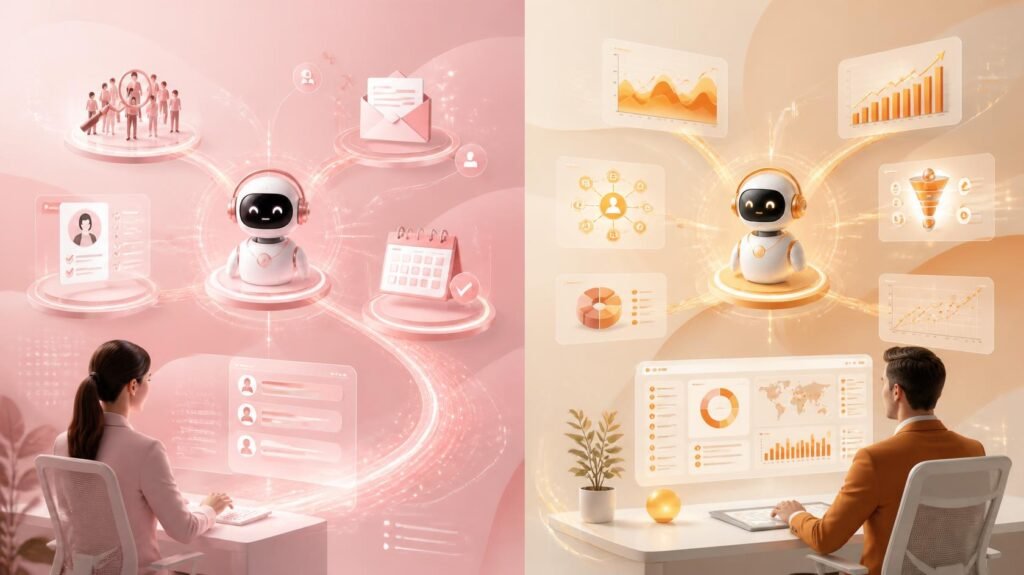
While both AI Sales Agents and AI SDRs use artificial intelligence to improve sales performance, they are designed for different responsibilities. An AI SDR focuses on filling the top of the sales funnel by finding, engaging, and qualifying prospects. An AI Sales Agent goes much further by supporting or automating activities throughout the entire customer journey, from the first interaction to post-sale engagement.
Understanding these differences helps organizations invest in the right technology based on their sales maturity, business goals, and operational complexity.
AI Sales Agents vs AI SDRs: Feature Comparison
| Feature | AI Sales Agent | AI SDR |
|---|---|---|
| Primary Purpose | End-to-end sales assistance | Lead generation and qualification |
| Sales Funnel Coverage | Entire sales cycle | Top of the funnel |
| Prospect Research | ✔ Advanced | ✔ Advanced |
| Lead Qualification | ✔ | ✔ |
| Personalized Outreach | ✔ Dynamic and contextual | ✔ Template-driven with AI personalization |
| Meeting Scheduling | ✔ | ✔ |
| CRM Updates | ✔ Automatic | ✔ Basic |
| Pipeline Analysis | ✔ Advanced | Limited |
| Sales Forecasting | ✔ | No |
| Deal Risk Detection | ✔ | No |
| Proposal Assistance | ✔ | No |
| Negotiation Support | ✔ AI recommendations | No |
| Post-Sales Engagement | ✔ | No |
| Continuous Learning | ✔ | Limited |
| Revenue Intelligence | ✔ | No |
The table clearly shows that AI SDRs excel at prospecting and early-stage engagement, while AI Sales Agents provide much broader intelligence across the sales lifecycle.
AI Sales Agents vs AI SDRs: Key Differences
Scope of Work
The biggest distinction lies in the scope of responsibility.
An AI SDR is designed to perform tasks traditionally handled by a Sales Development Representative. Its mission is to generate qualified opportunities by identifying prospects, initiating conversations, and booking meetings.
An AI Sales Agent, however, acts as an intelligent digital teammate. It supports prospecting but also assists with opportunity management, customer communication, pipeline optimization, forecasting, and sales execution.
For organizations seeking complete sales automation, AI Sales Agents provide a more comprehensive solution.
Intelligence Level
AI SDRs are highly effective at executing predefined workflows. They personalize outreach, qualify leads based on rules, and respond to common questions.
AI Sales Agents operate with a much deeper level of intelligence. They analyze historical sales data, customer behavior, buying intent, CRM activity, and conversation history to recommend the best next action.
Rather than simply following workflows, they adapt their decisions based on changing customer behavior.
Customer Interaction
AI SDRs usually interact with prospects during the early stages of the buying journey.
AI Sales Agents remain involved throughout the relationship by helping account executives prepare for meetings, suggesting follow-up actions, identifying cross-selling opportunities, and monitoring customer health.
Decision Support
AI SDRs execute tasks efficiently.
AI Sales Agents actively support decision-making by answering questions such as:
- Which opportunities are most likely to close?
- Which accounts require immediate attention?
- Which deals are at risk?
- What messaging has historically produced the highest response rate?
- Which customers are ready for expansion?
This intelligence helps sales leaders improve overall revenue performance.
Advantages of AI Sales Agents
Organizations adopting AI Sales Agents often gain benefits beyond simple automation.
Complete Sales Visibility
AI Sales Agents consolidate information from CRM systems, emails, calendars, customer interactions, marketing platforms, and communication tools into a unified view.
Sales representatives no longer waste time switching between multiple applications.
Intelligent Recommendations
Instead of merely automating emails, AI Sales Agents recommend:
- Best time to contact prospects
- Most effective communication channel
- Highest-value opportunities
- Personalized messaging suggestions
- Follow-up priorities
- Next-best actions
This helps improve sales productivity and customer engagement.
Better Forecast Accuracy
Forecasting often depends on subjective opinions.
AI Sales Agents evaluate:
- Historical win rates
- Deal velocity
- Customer engagement
- Buying signals
- Pipeline movement
- Sales activity
The result is a more accurate prediction of future revenue.
Increased Sales Productivity
Sales professionals spend more time building relationships and closing deals while AI manages repetitive operational work.
Advantages of AI SDRs
Although AI SDRs have a narrower focus, they deliver exceptional value in outbound sales.
Faster Prospecting
AI SDRs can identify thousands of qualified prospects in a fraction of the time required for manual research.
Consistent Outreach
Every prospect receives timely, personalized communication without delays caused by manual workloads.
Higher Meeting Volume
By automatically qualifying leads and scheduling meetings, AI SDRs enable account executives to spend more time selling.
Lower Operational Costs
Organizations reduce the need for repetitive manual prospecting while maintaining high outreach volumes.
Limitations of AI Sales Agents
Despite their advanced capabilities, AI Sales Agents are not a complete replacement for human expertise.
Some limitations include:
| Challenge | Explanation |
|---|---|
| Initial Setup | Requires integration with CRM, communication, and data platforms |
| Data Quality | Performance depends on clean and accurate data |
| Human Oversight | Strategic decisions still require human judgment |
| Enterprise Investment | Advanced platforms may involve higher implementation costs |
| Compliance | Organizations must ensure responsible use of customer data |
These challenges can be mitigated through proper planning, governance, and ongoing optimization.
Limitations of AI SDRs
AI SDRs also have certain constraints.
| Challenge | Business Impact |
|---|---|
| Limited Funnel Coverage | Focuses primarily on prospecting |
| Complex Negotiations | Cannot replace experienced salespeople |
| Emotional Intelligence | Limited understanding of nuanced conversations |
| Strategic Selling | Human involvement remains essential |
| Enterprise Account Management | Requires human relationship building |
Businesses should view AI SDRs as productivity enhancers rather than replacements for skilled sales professionals.
Enterprise Use Cases for AI Sales Agents
Large organizations are increasingly deploying AI Sales Agents across multiple departments.
Enterprise Software Companies
Software providers use AI Sales Agents to:
- Prioritize enterprise accounts
- Monitor buying intent
- Recommend cross-selling opportunities
- Predict renewal risks
- Generate personalized executive outreach
Financial Services
Banks and financial institutions leverage AI Sales Agents to:
- Identify high-value prospects
- Personalize financial product recommendations
- Improve advisor productivity
- Support relationship managers
- Enhance compliance through automated documentation
Healthcare Technology
Healthcare organizations use AI Sales Agents to:
- Manage long sales cycles
- Coordinate stakeholder communications
- Track engagement across multiple decision-makers
- Identify expansion opportunities
Manufacturing
Manufacturers employ AI Sales Agents to:
- Analyze distributor performance
- Recommend pricing strategies
- Forecast demand
- Improve customer retention
Enterprise Use Cases for AI SDRs
AI SDRs are particularly valuable for organizations with high outbound sales activity.
SaaS Companies
Software-as-a-Service businesses use AI SDRs to:
- Identify decision-makers
- Send personalized cold emails
- Book product demonstrations
- Qualify inbound trial users
B2B Technology Firms
Technology companies automate:
- Lead qualification
- Follow-up sequences
- Event outreach
- Webinar registrations
- Meeting scheduling
Marketing Agencies
Agencies use AI SDRs to maintain consistent outreach to prospective clients while reducing manual workload.
Consulting Firms
Consultancies leverage AI SDRs to identify organizations matching their ideal customer profile and initiate personalized engagement.
ROI Comparison
Choosing between AI Sales Agents and AI SDRs often depends on expected return on investment.
| Business Goal | AI Sales Agent | AI SDR |
|---|---|---|
| Generate More Leads | High | Excellent |
| Increase Meeting Bookings | High | Excellent |
| Improve Forecast Accuracy | Excellent | Low |
| Reduce Administrative Work | Excellent | High |
| Enhance Customer Relationships | Excellent | Moderate |
| Optimize Sales Pipeline | Excellent | Moderate |
| End-to-End Automation | Excellent | Limited |
| Cost Efficiency for Prospecting | Moderate | Excellent |
Organizations focused on top-of-funnel growth may realize faster ROI with AI SDRs, while enterprises seeking end-to-end revenue optimization often benefit more from AI Sales Agents.
Which Solution Is Right for Your Business?
The choice depends on your sales objectives.
Choose an AI SDR if your organization wants to:
- Increase outbound prospecting
- Qualify more leads
- Book more sales meetings
- Automate repetitive outreach
- Support a growing SDR team
Choose an AI Sales Agent if your organization wants to:
- Optimize the entire sales process
- Improve forecasting accuracy
- Enhance customer engagement
- Reduce administrative workload across teams
- Gain deeper revenue intelligence
- Support account executives throughout the sales cycle
Many organizations ultimately combine both technologies using AI SDRs to generate qualified opportunities and AI Sales Agents to help convert those opportunities into long-term customers. This integrated approach creates a more efficient, data-driven sales organization capable of scaling revenue while maintaining personalized customer experiences.
Best AI Sales Agent and AI SDR Platforms
The rapid adoption of artificial intelligence has led to the emergence of dozens of AI-powered sales platforms. Some solutions specialize in outbound prospecting and lead qualification, while others provide comprehensive sales intelligence, forecasting, pipeline management, and conversational AI capabilities.
Choosing the right platform depends on several factors, including company size, sales process complexity, CRM ecosystem, budget, and long-term growth strategy.
Below are some of the most widely adopted categories of AI sales technology.
AI Sales Agent Platform Capabilities
An enterprise-grade AI Sales Agent typically includes the following capabilities.
| Capability | Business Benefit |
|---|---|
| Sales Forecasting | More accurate revenue predictions |
| Pipeline Intelligence | Identify stalled or high-risk deals |
| CRM Automation | Eliminate manual data entry |
| Conversation Analysis | Improve customer interactions |
| Email Generation | Personalized communication at scale |
| Meeting Preparation | AI-generated account summaries |
| Opportunity Scoring | Prioritize high-value deals |
| Deal Risk Alerts | Prevent pipeline leakage |
| Revenue Intelligence | Better executive decision-making |
| Workflow Automation | Reduce repetitive tasks |
Instead of acting like a chatbot, AI Sales Agents function as intelligent assistants that continuously analyze sales activity and recommend actions to maximize conversions.
Features to Look for in an AI SDR Platform
Since AI SDRs focus on prospecting and lead qualification, businesses should evaluate platforms based on their outbound capabilities.
Important features include:
- AI-powered prospect research
- Automated email sequences
- LinkedIn outreach automation
- Lead qualification
- Buyer intent detection
- Meeting scheduling
- CRM synchronization
- Personalization engine
- Follow-up automation
- Analytics dashboard
- Multi-channel engagement
- Response sentiment analysis
Organizations handling thousands of outbound prospects every month benefit most from these capabilities.
AI Sales Agents vs AI SDRs: Cost Comparison
Budget often plays a major role when selecting an AI sales solution.
Although pricing varies significantly by vendor, implementation complexity generally follows this pattern.
| Business Size | AI SDR Investment | AI Sales Agent Investment |
|---|---|---|
| Startup | Low | Medium |
| Small Business | Low | Medium |
| Mid-Market | Medium | Medium to High |
| Enterprise | High | High |
| Global Enterprise | High | Enterprise-Level |
AI SDRs are generally easier and less expensive to deploy because they focus on a smaller set of responsibilities.
AI Sales Agents require broader integrations with CRM systems, marketing platforms, communication tools, customer support systems, and business intelligence software.
How to Implement AI Sales Agents Successfully
Successful AI adoption is not just about purchasing software. Organizations need a clear implementation strategy to ensure the technology delivers measurable business value.
Step 1: Evaluate Your Current Sales Process
Before introducing AI, document the existing workflow.
Consider questions such as:
- Where do sales representatives spend most of their time?
- Which tasks are repetitive?
- Where are prospects dropping out?
- Which stages have the lowest conversion rates?
- Which activities could be automated?
Understanding these pain points helps identify where AI will have the greatest impact.
Step 2: Clean and Organize Customer Data
Artificial intelligence performs best when trained on accurate and complete information.
Organizations should:
- Remove duplicate records
- Standardize CRM fields
- Update contact information
- Verify customer histories
- Eliminate outdated accounts
- Maintain consistent data governance
Poor-quality data often leads to inaccurate recommendations and reduced AI effectiveness.
Step 3: Integrate Core Business Systems
AI Sales Agents should connect with key platforms, including:
- CRM
- Marketing automation
- Calendar
- Customer support
- Website analytics
- Product usage data
- Revenue platforms
A unified data environment enables the AI to generate richer insights and better recommendations.
Step 4: Start with High-Impact Workflows
Rather than automating everything immediately, begin with workflows that provide quick wins.
Examples include:
- Lead prioritization
- Follow-up reminders
- Email generation
- Meeting scheduling
- CRM updates
- Pipeline summaries
This phased approach builds confidence and allows teams to adapt gradually.
Step 5: Measure Business Outcomes
Track key performance indicators before and after implementation.
Important metrics include:
| KPI | Why It Matters |
|---|---|
| Lead Response Time | Faster engagement |
| Meeting Conversion Rate | Better qualification |
| Opportunity Creation | Pipeline growth |
| Sales Cycle Length | Faster revenue generation |
| Win Rate | Improved effectiveness |
| Revenue per Sales Representative | Productivity measurement |
| Forecast Accuracy | Better planning |
| Customer Retention | Long-term value |
Continuous monitoring ensures that AI initiatives remain aligned with business objectives.
Common Mistakes Organizations Should Avoid
Despite the advantages of AI, implementation challenges can limit success if organizations overlook key best practices.
Expecting AI to Replace Salespeople
AI is designed to enhance human performance, not replace experienced professionals.
Complex negotiations, relationship building, and strategic decision-making still require human expertise.
The most successful organizations use AI to eliminate repetitive work while allowing sales teams to focus on high-value customer interactions.
Ignoring Data Quality
Artificial intelligence depends heavily on accurate data.
Incomplete CRM records, inconsistent customer information, and outdated contact details reduce recommendation quality.
Investing in data governance significantly improves AI performance.
Automating Poor Processes
AI should improve existing workflows—not automate inefficient ones.
Organizations should first simplify and optimize their sales processes before introducing automation.
Focusing Only on Cost Savings
Although automation reduces operational costs, the biggest value often comes from:
- Higher conversion rates
- Better customer experiences
- Faster deal cycles
- Increased revenue
- Improved forecasting
Businesses should evaluate AI based on overall business outcomes rather than labor savings alone.
Real-World Enterprise Use Cases
The following examples illustrate how organizations use AI Sales Agents and AI SDRs across industries.
SaaS Company
Challenge:
The sales team struggled to respond quickly to inbound product trials.
Solution:
An AI SDR qualified trial users based on product activity, company size, industry, and engagement level before automatically scheduling product demonstrations.
Result:
- Faster lead response
- Higher meeting volume
- Better-qualified opportunities
- Increased SDR productivity
Enterprise Technology Provider
Challenge:
Account executives spent hours preparing for customer meetings.
Solution:
An AI Sales Agent generated executive summaries containing:
- Customer history
- Previous conversations
- Buying signals
- Recent engagement
- Recommended talking points
Result:
Sales representatives entered meetings fully prepared while reducing administrative work.
Manufacturing Company
Challenge:
Long sales cycles made forecasting difficult.
Solution:
An AI Sales Agent analyzed historical opportunities, customer behavior, pricing trends, and engagement signals to predict deal outcomes.
Result:
Leadership gained more accurate revenue forecasts and improved production planning.
Financial Services Organization
Challenge:
Relationship managers handled thousands of customer interactions every month.
Solution:
AI Sales Agents prioritized customers based on financial activity and suggested personalized product recommendations.
Result:
- Better customer engagement
- Higher cross-selling opportunities
- Improved advisor productivity
Future Trends in AI-Powered Sales
Artificial intelligence continues to evolve rapidly, and the next generation of sales technology will be even more intelligent.
Several emerging trends are expected to shape the future of enterprise sales.
Agentic AI
Rather than responding to instructions, Agentic AI systems will proactively perform complex sales tasks independently.
Examples include:
- Building prospect lists
- Executing outreach campaigns
- Monitoring pipeline health
- Scheduling follow-ups
- Recommending pricing strategies
- Managing customer engagement
Hyper-Personalization
Future AI systems will generate highly personalized communications based on:
- Real-time customer behavior
- Company news
- Industry trends
- Website activity
- Purchase history
- Social engagement
This level of personalization is expected to significantly improve conversion rates.
Predictive Revenue Intelligence
AI will increasingly help executives answer questions such as:
- Which deals are most likely to close this quarter?
- Which accounts are at risk?
- Which territories require attention?
- Which sales representatives need coaching?
Predictive analytics will become a standard component of revenue operations.
Voice-Based AI Sales Assistants
Voice AI is rapidly becoming part of the sales workflow.
Future capabilities may include:
- Live meeting assistance
- Automatic objection handling suggestions
- Real-time competitor insights
- Conversation summaries
- Follow-up email generation
- CRM updates through voice commands
Autonomous Sales Workflows
Instead of completing isolated tasks, future AI systems will coordinate entire workflows automatically.
Examples include:
- Prospect identification
- Personalized outreach
- Lead qualification
- Meeting scheduling
- Opportunity scoring
- Executive reporting
These workflows reduce manual effort while maintaining consistent customer engagement.
Best Practices for Successful AI Adoption
Organizations that achieve the highest return on AI investments typically follow these principles:
| Best Practice | Business Impact |
|---|---|
| Start with Clear Objectives | Better implementation outcomes |
| Maintain High-Quality Data | More accurate AI recommendations |
| Train Sales Teams | Higher user adoption |
| Measure Performance Continuously | Ongoing optimization |
| Combine AI with Human Expertise | Better customer relationships |
| Automate Repetitive Tasks First | Faster productivity gains |
| Review AI Recommendations Regularly | Continuous improvement |
Artificial intelligence delivers the greatest value when it supports people rather than replacing them. Businesses that combine AI-driven automation with experienced sales professionals are better positioned to improve productivity, strengthen customer relationships, and drive sustainable revenue growth.
Conclusion
The debate around AI Sales Agents vs AI SDRs is not about determining which technology is superior it is about understanding which solution best aligns with your organization’s sales objectives. Both technologies play important roles in modern B2B sales, but they address different stages of the customer journey.
AI SDRs excel at generating pipeline by automating prospecting, personalizing outreach, qualifying leads, and scheduling meetings. They enable sales teams to engage more prospects while reducing the time spent on repetitive outbound activities. Businesses focused on increasing lead volume and improving top-of-funnel efficiency can achieve significant productivity gains with AI SDRs.
AI Sales Agents, on the other hand, extend beyond lead generation. They provide intelligent recommendations throughout the sales cycle by analyzing customer interactions, identifying buying signals, forecasting revenue, highlighting deal risks, and automating administrative work. Their ability to support account executives and revenue leaders makes them particularly valuable for organizations managing complex B2B sales processes.
As artificial intelligence continues to advance, successful businesses will increasingly combine AI SDRs and AI Sales Agents into a unified sales ecosystem. AI SDRs can generate and qualify opportunities, while AI Sales Agents help convert those opportunities into long-term customers through intelligent insights and automation. This combination enables organizations to scale revenue without sacrificing personalization or customer experience.
However, technology alone is not enough. The highest-performing sales organizations will pair AI with skilled sales professionals, high-quality customer data, well-defined processes, and continuous performance measurement. AI should be viewed as an accelerator that empowers people—not a replacement for relationship building, strategic thinking, and consultative selling.
Companies that adopt AI thoughtfully today will be better positioned to respond to changing buyer expectations, improve forecasting accuracy, shorten sales cycles, and create a more efficient, data-driven sales organization. Whether you are a growing startup or a global enterprise, investing in the right AI sales technology can provide a lasting competitive advantage.
Frequently Asked Questions (FAQs)
1. What is the difference between AI Sales Agents and AI SDRs?
AI SDRs focus on prospecting, lead qualification, and meeting scheduling during the early stages of the sales funnel. AI Sales Agents support the entire sales cycle, including forecasting, pipeline management, customer engagement, and sales recommendations.
2. Can AI Sales Agents replace human sales representatives?
No. AI Sales Agents automate repetitive tasks and provide intelligent insights, but human sales professionals remain essential for negotiations, relationship building, and strategic decision-making.
3. Which businesses benefit most from AI SDRs?
Organizations with high outbound sales volumes—such as SaaS companies, technology providers, consulting firms, and B2B service businesses—benefit significantly from AI SDRs.
4. Are AI Sales Agents suitable for small businesses?
Yes. Many AI Sales Agent solutions are scalable and can help small businesses automate administrative work, improve customer engagement, and manage sales pipelines more effectively.
5. How do AI SDRs improve sales productivity?
They automate prospect research, personalize outreach, qualify leads, and schedule meetings, allowing sales representatives to focus on closing deals instead of repetitive tasks.
6. What data do AI Sales Agents use?
AI Sales Agents typically analyze CRM data, email interactions, calendar events, website behavior, conversation history, product usage, and customer engagement signals.