
There have been many changes in the world of marketing in the last decade. Companies are no longer using manual marketing campaigns, mass emails, or general ads to try to win customers. Consumers now need personalized services, immediate responses, and tailored information all through their customer experience. Delivering those needs through manual efforts has become very difficult, particularly for companies that deal with thousands of clients over different channels. That is how AI marketing automation will shape the future of digital marketing.
AI marketing automation has come a long way from simple chatbots and email sequences. Advanced AI-powered marketing automation systems can be used to monitor customer behavior, anticipate buying intents, personalize the marketing message, optimize ad campaigns, qualify leads, and even create content with little to no human input. In other words, AI is helping marketers to do what they do better without taking their jobs.
Businesses that adopt AI marketing automation often experience higher conversion rates, stronger customer relationships, increased operational efficiency, and better returns on marketing investments. From startups to global enterprises, organizations across industries are integrating AI into their marketing strategies to stay competitive in an increasingly digital marketplace.
In this comprehensive guide, you’ll learn what AI marketing automation is, how it works, its key components, major benefits, real-world applications, and why it has become one of the most valuable technologies for modern businesses.
What Is AI Marketing Automation?
AI marketing automation is the combination of artificial intelligence technologies and marketing automation software to automate, optimize, and personalize marketing activities throughout the customer journey. Traditional marketing automation follows predefined rules. For example, if a customer downloads an eBook, the system automatically sends a follow-up email. While this saves time, it still relies on manually created workflows.
Unlike rigid guidelines, artificial intelligence constantly monitors customer activity, adapts to every interaction, and takes smart decisions based on live data. This helps brands to provide extremely customized service without having to handle campaigns individually.
For instance, instead of sending the same email to all customers, the algorithm checks what their interests are, how they browse and purchase, how they engage, what means of communication they prefer, and even what they are willing to buy. Then, AI sends customized messages, which will be the most engaging and profitable for them.
How AI Marketing Automation Works
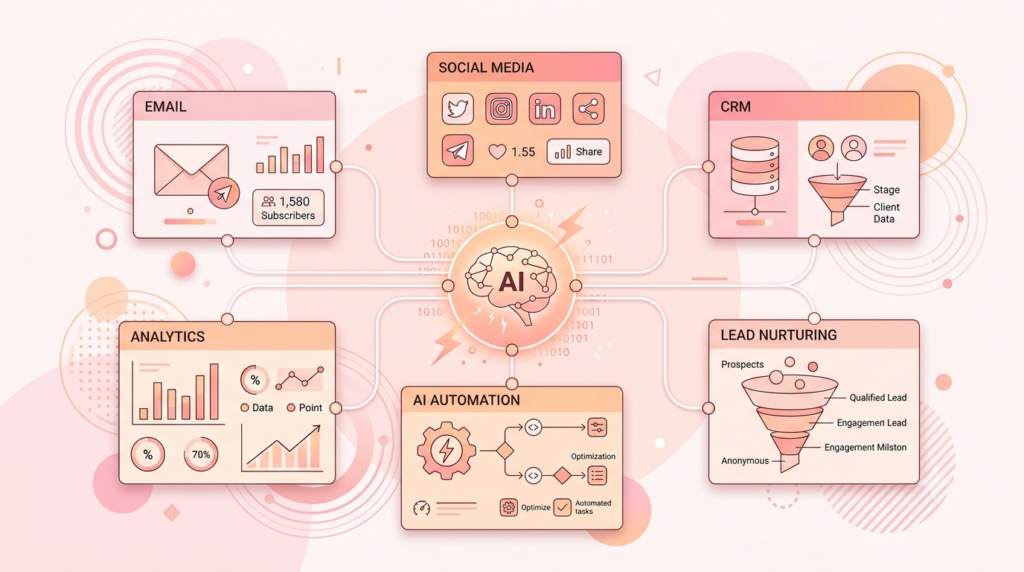
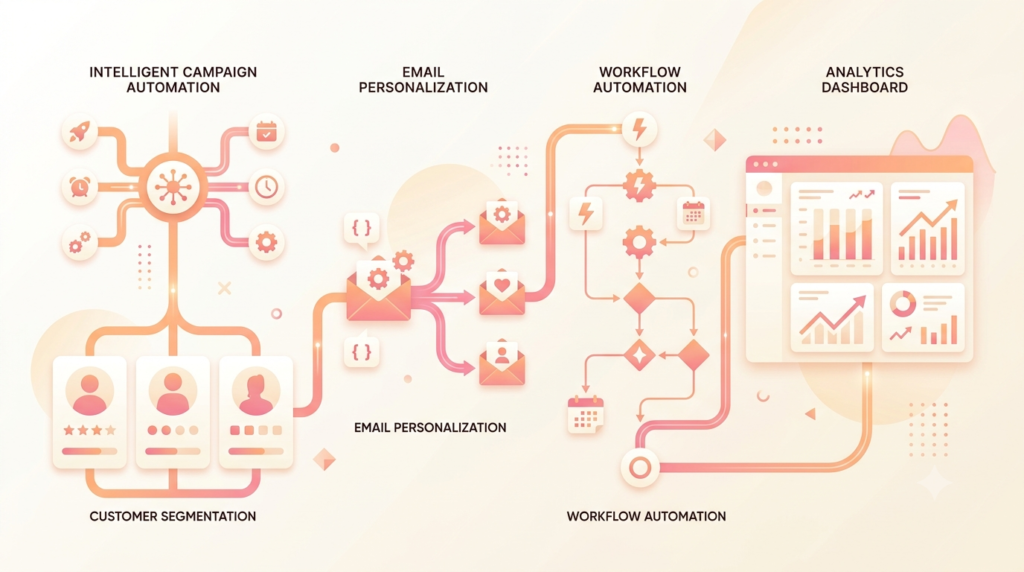
AI marketing automation involves a number of interconnected technologies. This process starts with gathering information about customers from different places such as websites, CRM software, e-mail marketing campaigns, social networking platforms, mobile apps, support calls, and ad campaigns.
Then, artificial intelligence looks for patterns in this data that may not be evident to people. Machine learning makes the results better as there are more customer engagements.
Based on these insights, AI can automatically:
- Segment audiences
- Predict customer behavior
- Personalize content
- Recommend products
- Optimize email timing
- Score sales leads
- Trigger marketing campaigns
- Improve advertising performance
- Forecast campaign results
Unlike traditional automation, AI constantly learns from campaign performance and adjusts recommendations without requiring marketers to rebuild workflows repeatedly.
Traditional Marketing Automation vs AI Marketing Automation
| Traditional Marketing Automation | AI Marketing Automation |
|---|---|
| Rule-based workflows | Self-learning intelligent automation |
| Static customer segments | Dynamic audience segmentation |
| Manual optimization | Continuous AI optimization |
| Generic personalization | Hyper-personalized experiences |
| Fixed email schedules | AI-optimized send times |
| Manual lead scoring | Predictive lead scoring |
| Historical reporting | Predictive analytics |
| Human decision-making | AI-assisted recommendations |
This shift allows marketing teams to focus more on creativity, strategy, and customer relationships while AI handles repetitive operational tasks.
Why Businesses Are Adopting AI Marketing Automation
Customer expectations have changed dramatically. Customers nowadays communicate with brands through websites, search engines, emails, social media, messaging platforms, webinars, online communities, and mobile applications. Controlling all touchpoints manually is inefficient and leads to inconsistencies in customer experience.
AI-based marketing automation resolves the issue of managing customer interactions by creating an integrated solution that is constantly adapting to customer behavior. There are several reasons why AI marketing automation is growing fast.
First, organizations create huge volumes of customer data on daily basis. AI allows analyzing millions of data points in seconds and revealing valuable insights. Second, personalization became a competitive factor. Nowadays customers demand that brands will know what they like instead of getting irrelevant promotional offers.
Third, marketing departments are under constant pressure to increase ROI while decreasing operating expenses. Using AI allows reaching both goals at once. Finally, thanks to cloud computing and SaaS solutions, AI marketing automation has become affordable for small and medium-size businesses.
Key Components of AI Marketing Automation
Successful AI marketing automation platforms combine several intelligent technologies.
Customer Data Intelligence
Every marketing move starts with numbers. AI gathers and categorizes customer data collected through different mediums into a single customer profile.
This encompasses demographic data, browsing history, buying history, email behavior, website behavior, searching habits, social media behavior, and customer support interactions. With all of this data, companies can offer very targeted marketing experiences.
Predictive Analytics
Predictive analytics employs machine learning algorithms to predict future customer behavior from their previous behavior. This allows businesses to anticipate customer moves rather than react to them.
Predictive analytics helps answer questions such as:
- Which leads are most likely to convert?
- Which customers may stop purchasing?
- Which products will customers likely buy next?
- Which campaigns will generate the highest ROI?
This allows marketers to allocate resources more effectively.
Intelligent Audience Segmentation
The traditional form of segmentation classifies clients based on their age, geographical location, or industry. Artificial Intelligence, on the other hand, is able to form much more complex segments of an audience based on numerous behavioral cues.
For instance, AI will be able to target users who have recently engaged with the cybersecurity content, looked at the pricing information many times, attended some webinars, and also opened emails about the product.
Personalized Content Recommendations
Every customer has different interests. AI automatically recommends content that matches individual preferences.
Examples include:
- Personalized blog recommendations
- Product suggestions
- Customized landing pages
- Dynamic website content
- Individual email messaging
- Personalized promotional offers
As customer behavior changes, recommendations evolve automatically.
AI Lead Scoring
Not every lead is ready to buy. Traditional lead scoring assigns fixed points for actions like downloading content or opening emails. AI lead scoring analyzes much deeper behavioral patterns.
It evaluates factors such as:
- Website visit frequency
- Product page engagement
- Search behavior
- Industry trends
- Company size
- Historical conversion data
- Email engagement
- Sales interactions
The result is a much more accurate prediction of which prospects are ready for sales engagement.
Automated Campaign Optimization
Campaign optimization traditionally required marketers to manually analyze reports and adjust campaigns. AI continuously monitors campaign performance in real time.
If one email subject line performs better, AI can recommend similar messaging. If one audience segment converts at a higher rate, budgets can automatically shift toward that audience. This creates continuous optimization instead of periodic manual improvements.
Core AI Technologies Behind Marketing Automation
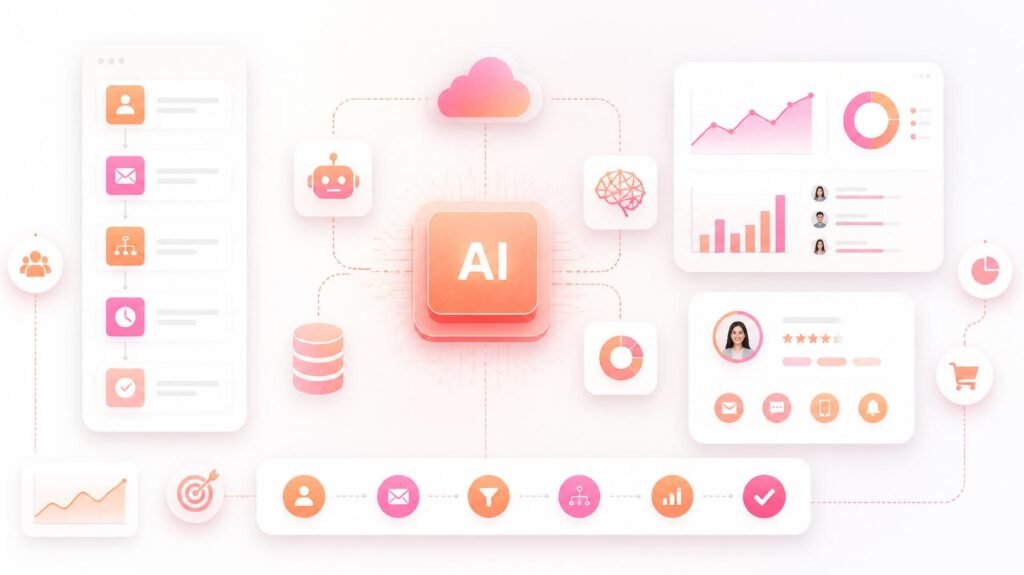
Several artificial intelligence technologies work together to power modern marketing automation.
Machine Learning
Machine learning allows systems to recognize patterns and improve predictions without being explicitly programmed for every situation.
As more customer data becomes available, machine learning models become increasingly accurate. This enables smarter recommendations, better personalization, and improved campaign performance over time.
Natural Language Processing (NLP)
Natural Language Processing enables AI to understand and generate human language.
Marketing teams use NLP for:
- Chatbots
- Email personalization
- Customer sentiment analysis
- Content recommendations
- Voice assistants
- Social listening
NLP helps businesses understand customer intent instead of simply matching keywords.
Generative AI
Generative AI has become one of the fastest-growing components of marketing automation.
It assists marketers by creating:
- Email drafts
- Product descriptions
- Blog outlines
- Social media posts
- Ad copy
- Landing page variations
- Personalized marketing messages
Rather than replacing human creativity, generative AI accelerates content production while allowing marketers to refine and optimize the final output.
Computer Vision
Although less common, computer vision is increasingly used in marketing. It can analyze visual content, recognize products in images, understand customer-generated content, and improve visual search experiences. Retail and eCommerce businesses particularly benefit from this technology.
The Customer Journey Powered by AI Marketing Automation
Modern customers rarely make purchasing decisions after a single interaction. Instead, they move through multiple stages before becoming loyal customers. AI marketing automation supports every stage of this journey. During the awareness stage, AI helps identify the most relevant audiences through behavioral analysis and intent data. It can automatically recommend the best channels for reaching potential customers, whether through search engines, social media, paid advertising, or email marketing.
As prospects move into the consideration stage, AI personalizes educational content based on their interests. Instead of showing identical resources to everyone, the system recommends articles, webinars, case studies, or product demonstrations that match each individual’s needs. When customers are ready to make a decision, predictive lead scoring alerts sales teams about high-intent prospects. Personalized offers, pricing recommendations, and automated follow-ups further increase the likelihood of conversion.
After a purchase, AI continues supporting customer success through onboarding emails, product recommendations, satisfaction surveys, renewal reminders, and loyalty campaigns. This ongoing engagement strengthens relationships and encourages repeat business. By optimizing every stage of the customer journey, AI marketing automation helps businesses deliver consistent, relevant, and timely experiences that improve both customer satisfaction and long-term growth.
Benefits of AI Marketing Automation for Modern Businesses
AI marketing automation is no longer just a competitive advantage it has become a necessity for businesses that want to scale efficiently while delivering exceptional customer experiences. Organizations across industries are using AI to reduce manual work, improve marketing performance, and create personalized interactions that build stronger relationships with customers.
Let’s explore the most significant benefits.
Delivers Personalized Customer Experiences at Scale
Modern consumers expect brands to understand their preferences. They want recommendations that match their interests, emails that address their needs, and offers that feel relevant rather than random. AI marketing automation makes this possible by analyzing customer behavior in real time.
Instead of grouping customers into broad segments, AI creates dynamic profiles based on browsing history, previous purchases, engagement patterns, demographics, and buying intent. Every interaction helps the system learn more about the customer, enabling increasingly personalized communication.
For example, two visitors may browse the same product page but receive different follow-up emails based on their interests, location, industry, or previous interactions with the business. This level of personalization improves customer satisfaction and increases the likelihood of conversion.
Saves Time by Automating Repetitive Tasks
Marketing teams often spend hours performing repetitive activities such as sending emails, scheduling campaigns, updating customer records, assigning leads, and generating reports. AI marketing automation handles these routine tasks automatically.
Instead of manually launching every campaign, marketers can create intelligent workflows that respond to customer behavior. AI continuously monitors these workflows and adjusts them based on performance. This automation allows marketing professionals to spend more time on strategic planning, creative campaigns, customer engagement, and business growth rather than administrative work.
Improves Lead Quality
Generating leads is important, but generating qualified leads is even more valuable. Many businesses waste time pursuing prospects who have little intention of making a purchase.
AI solves this challenge by analyzing hundreds of behavioral signals to determine which prospects are most likely to convert. Rather than relying solely on demographic information, AI considers factors such as website visits, content downloads, email engagement, pricing page activity, company size, previous purchases, and online behavior. Sales teams receive higher-quality leads, allowing them to focus their efforts where they are most likely to generate results.
Increases Marketing ROI
Every marketing campaign requires an investment of time and money. AI marketing automation helps businesses maximize returns by identifying which campaigns, channels, audiences, and content deliver the best results. Instead of relying on assumptions, marketers receive data-driven recommendations supported by predictive analytics. Campaign budgets can be optimized automatically, reducing wasted advertising spend while increasing conversions.
Over time, continuous optimization leads to stronger marketing performance and higher return on investment.
Enables Smarter Decision-Making
Marketing decisions become easier when supported by accurate data. AI analyzes millions of customer interactions, identifies emerging trends, detects unusual behavior, and provides actionable insights much faster than manual analysis.
Rather than simply reporting past performance, AI predicts future outcomes. Businesses can forecast campaign success, anticipate customer demand, identify potential churn, and recognize opportunities before competitors do. This proactive approach helps organizations stay ahead in competitive markets.
Real-World Applications of AI Marketing Automation
AI marketing automation is transforming virtually every aspect of digital marketing. Here are some of its most valuable applications.
Intelligent Email Marketing
Email remains one of the highest-performing digital marketing channels, and AI has made it even more effective. Instead of sending identical messages to an entire mailing list, AI creates personalized email experiences for every subscriber.
It determines the best sending time, recommends subject lines, personalizes product suggestions, and adapts content based on user behavior. If a customer abandons their shopping cart, AI can automatically send a reminder with relevant product recommendations or limited-time offers.
These intelligent campaigns significantly improve open rates, click-through rates, and conversions.
Predictive Lead Nurturing
Not every prospect is ready to buy immediately. AI identifies where each prospect is within the buying journey and delivers content accordingly.
Someone researching industry trends may receive educational blog articles, while another visitor comparing solutions may receive product demonstrations, customer success stories, or pricing information. This personalized nurturing keeps prospects engaged until they are ready to make a purchasing decision.
AI-Powered Chatbots and Virtual Assistants
Modern AI chatbots are far more advanced than traditional scripted bots. They understand customer questions, provide relevant answers, recommend products, schedule appointments, qualify leads, and even connect customers with sales representatives when needed.
Available around the clock, AI assistants improve customer experience while reducing support costs. Businesses also benefit from valuable customer insights collected during chatbot conversations.
Social Media Marketing Automation
Managing multiple social media platforms can be time-consuming. AI simplifies social media marketing by recommending posting schedules, generating captions, analyzing audience engagement, monitoring brand mentions, and identifying trending conversations.
Some platforms even recommend the most engaging content formats based on audience preferences. This helps businesses maintain a consistent online presence without increasing workload.
Personalized Website Experiences
Every website visitor has different interests. AI dynamically changes website content based on user behavior. Returning visitors may see personalized banners, recommended products, relevant articles, or customized landing pages.
First-time visitors may receive educational resources, while repeat customers see loyalty offers or product updates. This creates a more engaging experience that encourages longer visits and higher conversion rates.
AI Advertising Optimization
Paid advertising requires continuous optimization. AI monitors advertising campaigns across search engines and social media platforms to improve targeting, bidding strategies, audience selection, and creative performance.
Instead of manually adjusting every campaign, marketers receive automatic recommendations or allow AI to optimize campaigns in real time. This often leads to lower acquisition costs and better advertising performance.
AI Marketing Automation Across Industries
Although AI marketing automation is widely associated with digital marketing, its impact extends across numerous industries.
E-commerce
Online retailers use AI to personalize shopping experiences, recommend products, recover abandoned carts, optimize pricing, and increase repeat purchases.
Customers receive product suggestions tailored to their interests, resulting in higher average order values and stronger customer loyalty.
B2B Businesses
B2B organizations often have longer and more complex sales cycles.
AI marketing automation helps identify decision-makers, score leads, nurture prospects, personalize outreach, and align marketing with sales teams.
This improves pipeline quality and accelerates revenue growth.
Healthcare
Healthcare providers use AI to educate patients, automate appointment reminders, deliver personalized wellness content, and improve communication throughout the patient journey.
These automated interactions increase patient engagement while reducing administrative workload.
Financial Services
Banks, insurance companies, and financial institutions use AI to personalize financial recommendations, automate customer onboarding, identify cross-selling opportunities, and improve customer retention.
Predictive analytics also helps organizations identify customers who may require additional financial products or services.
Education
Educational institutions leverage AI marketing automation to engage prospective students, recommend programs, personalize communications, and improve enrollment campaigns.
Automated nurturing helps maintain relationships with prospective students throughout the admissions process.
Software as a Service (SaaS)
SaaS companies rely heavily on AI marketing automation to onboard users, increase product adoption, reduce customer churn, recommend premium features, and encourage subscription renewals.
Personalized onboarding experiences improve customer success while increasing long-term retention.
Common Features Found in AI Marketing Automation Platforms
Although platforms vary, most enterprise solutions include several powerful capabilities.
These typically include intelligent customer segmentation, predictive lead scoring, automated email marketing, campaign orchestration, behavioral analytics, CRM integration, chatbot automation, content recommendations, social media management, advertising optimization, customer journey mapping, real-time reporting, A/B testing, predictive forecasting, and AI-powered content generation.
When these features work together, businesses gain a unified marketing ecosystem capable of delivering highly personalized customer experiences.
Measuring the Success of AI Marketing Automation
Implementing AI marketing automation is only the beginning.
Businesses should continuously measure performance using key metrics such as:
- Lead conversion rate
- Customer acquisition cost (CAC)
- Customer lifetime value (CLV)
- Email open rate
- Click-through rate (CTR)
- Website engagement
- Marketing-qualified leads (MQLs)
- Sales-qualified leads (SQLs)
- Campaign ROI
- Customer retention rate
- Revenue generated from automated campaigns
Tracking these metrics helps organizations identify successful strategies while uncovering areas for improvement.
Instead of relying solely on historical reports, AI continuously analyzes performance and recommends optimizations that improve future campaigns.
As a result, marketing becomes an ongoing cycle of learning, testing, and refinement rather than a series of isolated campaigns.
Best Practices for Implementing AI Marketing Automation
Adopting AI marketing automation is not simply about purchasing software. Success depends on having a clear strategy, reliable data, and a customer-focused approach. Businesses that combine technology with thoughtful planning often achieve better results than those relying on automation alone.
Start with Clear Business Goals
Before implementing any AI marketing automation platform, define what you want to achieve. Your goals might include increasing qualified leads, improving email engagement, reducing customer acquisition costs, increasing conversions, or strengthening customer retention.
Clear objectives help you select the right tools, measure performance accurately, and ensure your marketing automation strategy supports broader business goals.
Build a Strong Data Foundation
Artificial intelligence performs best when it has access to clean, accurate, and organized data. Businesses should regularly update customer records, remove duplicate contacts, verify email addresses, and ensure CRM data remains current.
Poor-quality data can lead to inaccurate predictions, ineffective personalization, and wasted marketing efforts. Creating a centralized customer database also allows AI to generate more meaningful insights across every marketing channel.
Focus on Customer Value
Automation should make the customer experience better, not more complicated. Every automated email, recommendation, notification, or chatbot conversation should provide genuine value. Rather than overwhelming customers with promotional messages, businesses should focus on educational content, personalized recommendations, helpful resources, and timely support.
When customers feel understood instead of targeted, trust naturally grows.
Combine AI with Human Creativity
Artificial intelligence is excellent at analyzing data and automating repetitive tasks, but creativity, storytelling, empathy, and strategic thinking remain human strengths. The most successful marketing teams use AI to support not replace their creativity.
Marketers should review AI-generated content, adjust messaging to reflect their brand voice, and ensure campaigns remain authentic. This balance creates marketing that is both efficient and engaging.
Continuously Test and Optimize
Customer behavior changes over time, and marketing strategies should evolve accordingly. Businesses should regularly test subject lines, landing pages, advertisements, calls to action, email sequences, and personalization strategies. AI provides valuable recommendations, but continuous experimentation helps identify what resonates most with your audience.
Small improvements made consistently often produce significant long-term results.
Common Challenges of AI Marketing Automation
Although AI marketing automation offers many advantages, businesses should also understand the challenges involved. Being aware of these obstacles allows organizations to prepare effective solutions before implementation.
Data Privacy and Compliance
Consumers are becoming increasingly concerned about how businesses collect and use personal information. Organizations must comply with privacy regulations such as GDPR, CCPA, and other regional data protection laws.
Transparency is essential. Businesses should clearly explain how customer data is collected, stored, and used while providing customers with control over their information. Responsible data practices build trust and strengthen long-term customer relationships.
Integration with Existing Systems
Many organizations already use multiple marketing platforms, CRM systems, analytics tools, and customer databases. Integrating AI marketing automation with these existing technologies can sometimes be complex. Choosing platforms that support APIs and seamless integrations helps reduce implementation challenges while creating a unified marketing ecosystem.
Employee Training
Introducing AI changes how marketing teams work. Employees need training to understand automation workflows, predictive analytics, AI-generated insights, and campaign optimization. Organizations that invest in employee education typically see faster adoption and greater long-term success. AI should empower marketing professionals rather than create uncertainty.
Maintaining Brand Authenticity
Automation increases efficiency, but businesses must ensure their communications still feel personal. Customers can quickly recognize generic or repetitive messaging.
Reviewing automated campaigns regularly helps maintain a consistent tone, accurate information, and authentic brand personality. Even AI-generated content benefits from human editing before publication.
Common AI Marketing Automation Mistakes to Avoid
Many businesses invest in AI marketing automation expecting immediate results. However, avoiding these common mistakes can significantly improve long-term success.
Automating Everything Immediately
One of the biggest mistakes is trying to automate every marketing process at once. A better approach is to begin with high-impact areas such as email marketing, lead scoring, or customer segmentation. Once these workflows are performing well, businesses can gradually expand automation across other marketing activities.
Ignoring Data Quality
Artificial intelligence depends entirely on the quality of available data. Outdated contact information, duplicate records, and incomplete customer profiles reduce the accuracy of AI recommendations. Regular data maintenance should become part of every marketing strategy.
Overlooking Customer Feedback
AI provides valuable insights, but customer feedback remains equally important. Surveys, reviews, customer interviews, and support conversations often reveal needs that automated systems cannot fully understand. Combining AI analytics with direct customer feedback creates a more complete understanding of audience expectations.
Focusing Only on Technology
Technology alone cannot create successful marketing campaigns.Businesses should focus on customer relationships, valuable content, compelling storytelling, and meaningful engagement. AI should support these objectives rather than become the primary focus.
Future Trends in AI Marketing Automation
Artificial intelligence continues to evolve rapidly, and marketing automation will become even more intelligent over the coming years. Several trends are expected to shape the future of digital marketing.
Agentic AI Will Manage Entire Marketing Campaigns
Instead of assisting marketers with individual tasks, future AI agents will independently plan, launch, optimize, and analyze complete marketing campaigns. Marketers will focus more on strategy while AI manages execution.
Hyper-Personalization Will Become the Standard
Personalization will move beyond using a customer’s name in an email. Future AI systems will create individualized customer journeys based on real-time behavior, preferences, intent signals, purchase history, and predictive analytics. Every interaction will become increasingly relevant.
Predictive Customer Journeys
Rather than reacting to customer actions, AI will anticipate customer needs before they arise. Businesses will proactively deliver educational content, product recommendations, support resources, and promotional offers based on predicted future behavior. This shift from reactive marketing to predictive engagement will significantly improve customer experiences.
Voice and Conversational Marketing
As voice assistants and conversational AI continue to grow, marketing automation will increasingly support voice search optimization, AI-powered customer conversations, and interactive buying experiences. Businesses will engage customers through natural conversations instead of traditional forms and static websites.
Greater Integration Across Business Functions
Marketing automation will no longer operate independently. AI will connect marketing, sales, customer service, finance, and operations into a unified ecosystem. This integrated approach will improve collaboration, eliminate data silos, and create a more consistent customer experience.
Choosing the Right AI Marketing Automation Platform
Selecting the right platform depends on your business size, marketing objectives, budget, and existing technology stack.
When evaluating solutions, consider the following factors:
- Ease of use and implementation
- CRM integration capabilities
- AI-powered personalization features
- Predictive analytics functionality
- Multi-channel campaign management
- Reporting and dashboard capabilities
- Scalability for future growth
- Security and compliance standards
- Customer support and training resources
- Pricing and long-term value
The ideal platform should support your current marketing needs while providing flexibility for future expansion.
Conclusion
AI marketing automation is transforming the way businesses connect with customers, manage campaigns, and drive sustainable growth. By combining artificial intelligence with automation, organizations can deliver personalized experiences, improve operational efficiency, and make smarter marketing decisions based on real-time insights rather than assumptions.
From intelligent lead scoring and predictive analytics to automated email campaigns and AI-powered customer engagement, the technology enables marketers to focus on strategy, creativity, and relationship building while repetitive tasks are handled automatically.
However, successful implementation requires more than advanced software. Businesses must invest in high-quality data, establish clear objectives, maintain customer trust, and continuously optimize their marketing strategies. AI should enhance human expertise, not replace it.
As artificial intelligence continues to evolve, marketing automation will become even more intelligent, predictive, and personalized. Organizations that embrace these innovations today will be better positioned to build stronger customer relationships, improve marketing performance, and stay competitive in an increasingly digital marketplace.
Whether you are a startup looking to scale your marketing efforts or an enterprise seeking to optimize complex customer journeys, AI marketing automation offers the tools and insights needed to deliver measurable business results. The future of marketing is not simply automated it is intelligent, adaptive, and customer-centric.
Frequently Asked Questions
What is AI marketing automation?
AI marketing automation combines artificial intelligence with marketing automation software to automate repetitive tasks, personalize customer experiences, analyze customer behavior, and optimize marketing campaigns using data-driven insights.
How is AI marketing automation different from traditional marketing automation?
Traditional marketing automation relies on predefined rules and workflows. AI marketing automation continuously learns from customer interactions, predicts behavior, personalizes communication, and automatically optimizes campaigns based on real-time data.
What are the benefits of AI marketing automation?
The key benefits include improved personalization, higher conversion rates, better lead quality, increased marketing ROI, automated campaign management, predictive analytics, enhanced customer engagement, and significant time savings for marketing teams.
Can small businesses benefit from AI marketing automation?
Yes. Many AI-powered marketing platforms offer scalable solutions designed for small and medium-sized businesses. These tools help automate repetitive tasks, improve customer engagement, and compete more effectively without requiring large marketing teams.
Is AI marketing automation replacing marketers?
No. AI is designed to support marketers by automating routine tasks, analyzing large datasets, and providing actionable insights. Human creativity, strategic planning, storytelling, and relationship building remain essential for successful marketing.
Which industries benefit the most from AI marketing automation?
Industries such as eCommerce, B2B technology, healthcare, financial services, education, SaaS, retail, travel, and professional services are among the biggest adopters because they rely heavily on personalized customer engagement and digital marketing.