

Sales meetings have always been one of the most important parts of the B2B buying journey. Every customer conversation contains valuable information about buyer intent, objections, purchasing decisions, competitor mentions, and future opportunities. However, most organizations struggle to capture and use this information effectively.
For years, sales representatives relied on handwritten notes, manual CRM updates, and memory to document customer interactions. This process was time-consuming, inconsistent, and often resulted in missing critical insights. As businesses expanded and sales teams handled hundreds of customer conversations every month, it became nearly impossible to analyze every discussion manually.
Today, AI Meeting Intelligence is helping organizations transform ordinary sales conversations into valuable business intelligence. Modern AI platforms can automatically record meetings, transcribe conversations, identify action items, detect customer sentiment, measure engagement, and even recommend the next best sales action.
Instead of spending hours reviewing recordings or updating CRM systems, sales professionals can focus on building stronger customer relationships while AI performs much of the administrative work in the background.
This shift is especially important because enterprise buying has become far more complex. A single B2B deal often involves multiple stakeholders, longer decision cycles, and larger amounts of information exchanged across meetings. Missing even one important customer concern can delay or completely detail a sales opportunity.
By using AI Meeting Intelligence, organizations gain deeper visibility into customer conversations and can improve coaching, forecasting, pipeline management, and decision-making.
In this guide, we’ll explore eight important AI Meeting Intelligence trends that are helping sales leaders improve productivity, strengthen customer engagement, and build more predictable revenue growth.

What Is AI Meeting Intelligence?
AI Meeting Intelligence refers to the use of artificial intelligence, natural language processing (NLP), machine learning, and speech recognition technologies to analyze business meetings automatically.
Instead of simply recording conversations, AI understands what participants discuss, identifies key moments, and converts unstructured conversations into actionable business insights.
Modern meeting intelligence platforms can analyze:
| Meeting Data | AI Analysis |
|---|---|
| Voice conversations | Speaker identification |
| Customer questions | Intent detection |
| Sales discussions | Opportunity analysis |
| Objections | Risk identification |
| Action items | Automatic task creation |
| Sentiment | Customer engagement analysis |
Unlike traditional meeting recording software, AI Meeting Intelligence continuously learns from conversations. The technology recognizes patterns across thousands of meetings, helping organizations identify what successful sales teams do differently from average performers.
Sales leaders can use these insights to improve coaching, standardize best practices, and increase win rates across the organization.
The technology also integrates with CRM systems, sales engagement platforms, and revenue intelligence tools, allowing businesses to maintain accurate customer records without requiring manual updates.
As AI continues to improve, meeting intelligence is becoming an essential component of modern SalesTech ecosystems.
Why AI Meeting Intelligence Is Becoming Essential
Customer expectations have changed dramatically over the past few years. Buyers expect personalized conversations, faster responses, and sales representatives who understand their business challenges.
Meeting intelligence helps organizations meet these expectations by giving sales teams instant access to customer insights.
Several factors are driving rapid adoption of AI Meeting Intelligence.
First, remote and hybrid work environments have increased the number of virtual meetings. Organizations now conduct thousands of conversations through video conferencing platforms, creating enormous volumes of customer data.
Second, businesses want to reduce administrative work for sales representatives. Instead of spending valuable selling time writing meeting notes or updating CRM records, AI performs these repetitive tasks automatically.
Third, sales leaders need better visibility into customer interactions. Rather than relying on summaries from individual sales representatives, managers can review AI-generated insights that accurately capture customer discussions.
Another major reason is coaching.
Traditionally, managers could only review a small percentage of customer calls. AI Meeting Intelligence allows every conversation to become a coaching opportunity.
Managers can identify:
- Successful questioning techniques
- Customer objections
- Pricing discussions
- Competitive mentions
- Missed opportunities
- Follow-up quality
These insights improve sales performance while creating more consistent customer experiences.
Organizations are also combining AI Meeting Intelligence with revenue intelligence platforms to improve forecasting.
Instead of predicting future revenue based only on CRM data, businesses analyze actual customer conversations to understand buying intent more accurately.
This provides greater confidence in sales forecasts and pipeline management.
Trend #1: Real-Time Conversation Analysis
One of the biggest innovations in AI Meeting Intelligence is real-time conversation analysis.
Instead of waiting until a meeting ends, AI now analyzes conversations while they are happening.
As customers speak, AI systems evaluate:
- Keywords
- Questions
- Buying intent
- Competitor mentions
- Customer sentiment
- Product interest
This enables sales representatives to receive intelligent recommendations during live meetings.
For example, if a customer expresses concern about implementation costs, AI can immediately recommend relevant case studies or pricing information.
If the customer mentions a competitor, AI may suggest competitive differentiators or product comparisons.
This real-time assistance helps representatives respond more confidently without interrupting the natural flow of the conversation.
Another major benefit is improved customer engagement.
AI can detect whether one participant is dominating the discussion or whether the conversation has become unbalanced.
Research consistently shows that successful sales meetings encourage two-way conversations rather than lengthy product presentations.
Meeting intelligence platforms therefore monitor talk-to-listen ratios and recommend more balanced interactions.
| Real-Time AI Capability | Business Benefit |
|---|---|
| Live transcription | Better documentation |
| Keyword detection | Faster responses |
| Competitor tracking | Improved positioning |
| Customer intent analysis | Better recommendations |
| Live coaching prompts | Higher sales confidence |
As AI models become more advanced, real-time conversation intelligence will continue to help organizations deliver more personalized customer experiences while improving sales effectiveness.
Trend #2: AI-Powered Sales Coaching
Sales coaching has traditionally depended on managers manually reviewing a small number of recorded calls.
Unfortunately, this approach limits coaching opportunities because managers simply do not have enough time to evaluate every conversation.
AI Meeting Intelligence is changing this by automatically analyzing every customer interaction.
Instead of reviewing random recordings, managers receive detailed performance insights for every sales representative.
AI evaluates multiple coaching indicators, including:
- Question quality
- Discovery techniques
- Product knowledge
- Customer engagement
- Objection handling
- Closing effectiveness
The technology can also compare conversations across top-performing sales representatives to identify successful communication patterns.
These best practices can then be shared with the rest of the sales organization.
| Coaching Metric | AI Insight |
|---|---|
| Talk-to-listen ratio | Conversation balance |
| Objection handling | Response quality |
| Customer questions | Discovery effectiveness |
| Meeting engagement | Buyer participation |
| Closing discussions | Sales readiness |
AI also reduces bias in coaching.
Rather than relying on personal opinions, managers receive objective performance data supported by conversation analytics.
This creates more consistent coaching programs while helping representatives improve specific skills based on measurable evidence.
For growing sales organizations, AI-powered coaching has become one of the most valuable applications of meeting intelligence because it enables continuous learning without increasing management workload.
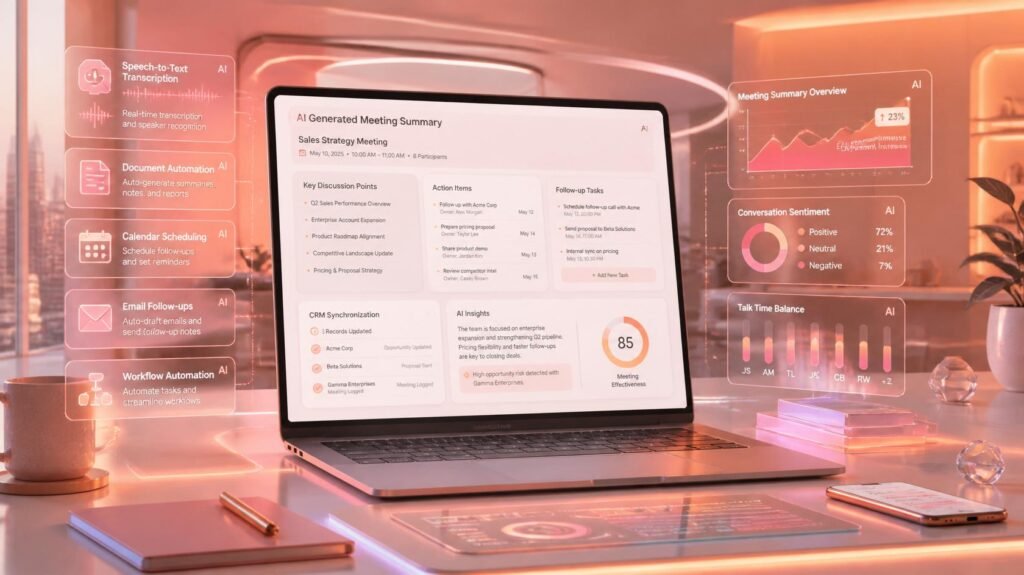
Trend #3: Automated Meeting Summaries
One of the most valuable applications of AI Meeting Intelligence is the ability to generate accurate meeting summaries automatically. Sales professionals often spend a significant portion of their day documenting customer conversations, writing follow-up emails, updating CRM records, and creating action plans. These repetitive administrative tasks reduce the amount of time available for selling.
Modern AI meeting intelligence platforms eliminate much of this manual work by listening to conversations, identifying important discussion points, and creating structured summaries within minutes after a meeting ends.
Instead of reviewing an hour-long recording, sales representatives receive a concise overview that includes customer questions, product interests, objections, next steps, and agreed deadlines.
This improves productivity while ensuring important details are not forgotten.
Automated summaries also create consistency across the organization. Every meeting follows a similar reporting format, making it easier for managers, customer success teams, and executives to understand the current status of each opportunity.
Another major advantage is improved collaboration.
Sales, marketing, customer support, and implementation teams often need access to customer conversations. AI-generated summaries allow different departments to quickly understand customer needs without listening to lengthy recordings.
| Automated AI Feature | Business Benefit |
|---|---|
| Meeting summaries | Saves administrative time |
| Action item extraction | Improves accountability |
| CRM updates | Reduces manual work |
| Follow-up recommendations | Faster customer responses |
| Conversation highlights | Easier collaboration |
Many AI platforms can also draft personalized follow-up emails based on the discussion, helping sales representatives respond more quickly while maintaining a professional customer experience.
As organizations continue to increase the number of virtual meetings, automated documentation is becoming an essential productivity tool rather than simply a convenience.
Trend #4: Buyer Sentiment Analysis
Understanding what customers truly think during a meeting has always been one of the biggest challenges in B2B sales.
Buyers rarely express every concern directly. Their tone, language, hesitation, and level of engagement often reveal valuable information that traditional meeting notes fail to capture.
This is where AI Meeting Intelligence provides a significant advantage.
Using natural language processing and speech analysis, AI evaluates customer sentiment throughout the conversation.
Instead of simply recognizing spoken words, the system identifies emotional signals that may indicate:
- Strong buying interest
- Uncertainty
- Price concerns
- Product confusion
- Competitive comparisons
- Frustration
- Positive engagement
Sales representatives can use these insights to better understand customer priorities and adjust their communication strategies accordingly.
For example, if AI detects hesitation during pricing discussions, representatives can spend more time explaining business value instead of immediately moving to the next topic.
Similarly, if customers show strong interest when discussing specific features, future meetings can focus more heavily on those capabilities.
Buyer sentiment analysis also helps sales managers identify opportunities that require additional support.
Deals showing declining customer engagement can receive immediate attention before they become lost opportunities.
| Customer Signal | AI Insight |
|---|---|
| Positive language | Strong purchase intent |
| Long pauses | Possible uncertainty |
| Repeated questions | Need for clarification |
| Competitor mentions | Increased competitive pressure |
| High engagement | Greater buying interest |
Another advantage is improving customer experience.
Rather than following scripted sales conversations, representatives can adapt naturally based on customer reactions, resulting in more personalized discussions.
As AI models become increasingly sophisticated, buyer sentiment analysis is expected to become one of the most valuable capabilities within modern sales technology platforms.
Trend #5: Revenue Intelligence Integration
One of the fastest-growing trends in AI Meeting Intelligence is its integration with revenue intelligence platforms.
Traditionally, revenue forecasting depended primarily on CRM updates entered manually by sales representatives. Unfortunately, CRM information is often incomplete, outdated, or influenced by subjective opinions.
AI Meeting Intelligence introduces a more accurate approach.
Instead of relying only on CRM records, organizations combine customer conversation data with pipeline analytics to gain deeper visibility into deal health.
Every sales meeting becomes a valuable source of revenue intelligence.
AI can automatically detect signals such as:
- Buying intent
- Budget discussions
- Decision-maker involvement
- Procurement timelines
- Competitive threats
- Product interest
- Contract negotiations
These insights help businesses predict future revenue more accurately because forecasts are based on actual customer conversations rather than assumptions.
Revenue leaders also gain visibility into pipeline risks much earlier.
If multiple customer meetings repeatedly mention pricing concerns or delayed purchasing decisions, AI highlights these patterns before they affect quarterly revenue.
Another important advantage is identifying successful sales behaviors.
Organizations can compare conversations from closed-won opportunities against closed-lost deals to understand which communication techniques produce better results.
This allows companies to continuously improve their sales process using real customer data.
| Revenue Intelligence Capability | Business Value |
|---|---|
| Pipeline analysis | Better forecasting |
| Deal health monitoring | Early risk detection |
| Customer engagement tracking | Higher win rates |
| Buying signal identification | Improved opportunity management |
| Sales performance insights | Smarter coaching decisions |
As businesses increasingly adopt data-driven sales strategies, integrating AI Meeting Intelligence with revenue intelligence systems is becoming a competitive advantage.
Organizations can move beyond historical reporting and make faster, more informed decisions based on live customer interactions.
The combination of conversation intelligence, CRM data, and predictive analytics helps sales teams improve pipeline visibility, increase forecast accuracy, and drive more consistent revenue growth.
Trend #6: Predictive Deal Insights
One of the most exciting developments in AI Meeting Intelligence is the ability to predict the likelihood of a deal closing successfully. Traditional sales forecasting often relies on CRM updates, intuition, and historical performance. While these methods provide useful information, they may not accurately reflect the current state of customer engagement.
AI changes this process by analyzing conversations across the entire sales cycle and identifying patterns that indicate whether a deal is progressing positively or showing signs of risk.
Modern AI platforms evaluate hundreds of conversation signals, including:
- Decision-maker participation
- Frequency of customer meetings
- Buying intent
- Budget discussions
- Product interest
- Competitive mentions
- Follow-up responsiveness
- Objection trends
Instead of simply reporting what has already happened, AI predicts what is likely to happen next.
For example, if customer conversations consistently include implementation planning, pricing discussions, and executive participation, AI may classify the opportunity as having a high probability of closing.
Conversely, if meetings repeatedly focus on unresolved objections or lack executive involvement, the system can alert sales managers before the opportunity stalls.
This enables organizations to allocate resources more effectively and provide additional support where needed.
| Predictive AI Capability | Business Impact |
|---|---|
| Win probability scoring | Better forecasting |
| Deal risk identification | Earlier intervention |
| Buying signal detection | Higher conversion rates |
| Opportunity prioritization | Improved sales productivity |
| Forecast confidence | More accurate revenue planning |
Predictive deal insights help sales teams move from reactive decision-making to proactive pipeline management. Instead of waiting until opportunities are lost, organizations can take action while there is still time to influence the outcome.
Trend #7: AI Compliance Monitoring
As businesses operate across different industries and regions, regulatory compliance has become increasingly important. Financial services, healthcare, legal firms, and many enterprise organizations must ensure that customer conversations comply with internal policies and external regulations.
AI Meeting Intelligence is making compliance monitoring more efficient by automatically reviewing conversations for potential risks.
Instead of manually auditing a small sample of recorded meetings, AI can analyze every conversation across the organization.
The technology identifies compliance-related issues such as:
- Missing legal disclosures
- Unauthorized promises
- Sensitive customer information
- Regulatory violations
- Required policy statements
- Risky sales language
This approach helps organizations maintain consistent communication standards while reducing compliance risks.
For sales managers, AI-generated compliance reports make it easier to identify training needs and improve conversation quality across the team.
Compliance monitoring also protects businesses during audits by creating searchable records of customer interactions and documenting required disclosures.
| Compliance Feature | Business Benefit |
|---|---|
| Automatic policy checks | Reduced compliance risk |
| Conversation monitoring | Consistent communication |
| Risk detection | Faster issue resolution |
| Audit-ready documentation | Simplified regulatory reporting |
| Compliance alerts | Better governance |
As regulations continue to evolve, AI-powered compliance monitoring is becoming an essential component of enterprise sales technology.
Trend #8: Multi-Channel Meeting Intelligence
Customer conversations no longer happen only through video meetings. Modern buyers communicate using emails, phone calls, chat platforms, messaging applications, webinars, and virtual events.
One of the latest AI Meeting Intelligence trends is combining insights from multiple communication channels into a single, unified view of the customer journey.
Rather than analyzing each interaction separately, AI connects conversations across different platforms to provide a complete picture of customer engagement.
This enables sales teams to understand:
- How buyer interest changes over time
- Which communication channels generate the best engagement
- Frequently discussed customer concerns
- Preferred communication styles
- Overall relationship health
For example, a customer may show high enthusiasm during a video meeting but later express concerns through email. By combining information from both channels, AI provides a more accurate assessment of deal health.
Organizations also gain a unified timeline of customer interactions, making collaboration between sales, customer success, and support teams much easier.
| Communication Channel | AI Insight |
|---|---|
| Video meetings | Conversation analysis |
| Phone calls | Voice intelligence |
| Emails | Intent and sentiment tracking |
| Chat platforms | Engagement analysis |
| CRM activities | Complete customer history |
Multi-channel intelligence allows businesses to create more personalized customer experiences because every interaction contributes to a broader understanding of customer needs.
As enterprises adopt omnichannel communication strategies, this capability will become increasingly valuable for maintaining consistent customer relationships.

Best Practices for Implementing AI Meeting Intelligence
Adopting AI Meeting Intelligence successfully requires more than installing new software. Organizations need a clear strategy that aligns technology with business goals and ensures employees understand how to use AI effectively.
The following best practices can help businesses maximize the value of their investment.
Define Clear Business Objectives
Before selecting an AI meeting intelligence platform, organizations should identify what they want to achieve.
Common objectives include:
- Improving sales coaching
- Increasing CRM accuracy
- Reducing administrative work
- Enhancing customer engagement
- Improving revenue forecasting
- Strengthening compliance
Clear goals make it easier to measure the return on investment and prioritize implementation efforts.
Integrate AI With Existing Sales Tools
AI Meeting Intelligence delivers the greatest value when connected with existing business systems.
Organizations should integrate AI with:
- Customer Relationship Management (CRM) platforms
- Revenue intelligence tools
- Sales engagement software
- Marketing automation platforms
- Collaboration tools
Integration eliminates duplicate work and creates a centralized source of customer information.
Protect Customer Privacy
Since meeting intelligence platforms process sensitive conversations, organizations must establish strong privacy and security practices.
Key considerations include:
- Inform participants when meetings are recorded
- Encrypt meeting data
- Limit access based on user roles
- Comply with data protection regulations
- Regularly review security policies
Responsible AI usage builds trust while reducing compliance risks.
Train Sales Teams
Employees should understand how AI supports their work rather than replacing it.
Training should cover:
- Interpreting AI-generated insights
- Using conversation analytics
- Reviewing meeting summaries
- Improving customer interactions
- Protecting sensitive information
Organizations that combine AI technology with continuous learning achieve stronger adoption and better business outcomes.
Continuously Measure Performance
AI implementation should be monitored using measurable business metrics.
| Performance Metric | Why It Matters |
|---|---|
| Meeting preparation time | Measures productivity improvements |
| CRM update accuracy | Tracks data quality |
| Sales cycle length | Evaluates efficiency |
| Win rate | Measures business impact |
| Customer engagement | Indicates conversation quality |
Regular analysis helps organizations refine AI usage and identify new opportunities for improvement.
Future of AI Meeting Intelligence
The future of AI Meeting Intelligence extends far beyond recording and transcribing sales conversations. As artificial intelligence becomes more advanced, meeting intelligence platforms will evolve into strategic assistants that help sales teams make better decisions before, during, and after every customer interaction.
One of the biggest developments will be agentic AI, where intelligent AI agents can perform tasks with minimal human intervention. Instead of simply analyzing conversations, these agents will prepare meeting agendas, research customer accounts, recommend personalized talking points, generate proposals, schedule follow-up meetings, and automate post-meeting workflows.
Predictive analytics will also become more accurate. By combining conversation intelligence with CRM data, buyer intent signals, website activity, and historical sales performance, AI will identify opportunities that are most likely to close and recommend the best next actions.
Another emerging trend is multilingual meeting intelligence. Global organizations conduct sales meetings across different regions and languages. Future AI systems will provide accurate real-time translation, sentiment analysis, and conversation summaries while preserving business context.
Generative AI will continue improving customer communication by creating personalized follow-up emails, executive summaries, proposal drafts, and sales presentations based on meeting discussions.
Security and compliance capabilities will also become more sophisticated. AI will automatically detect sensitive information, monitor regulatory compliance, and alert organizations to potential risks before they become serious issues.
As businesses continue investing in digital selling, AI Meeting Intelligence will become a core component of modern SalesTech platforms, enabling sales teams to work smarter, improve customer experiences, and accelerate revenue growth.
| Future Trend | Business Impact |
|---|---|
| Agentic AI assistants | Autonomous meeting preparation and follow-up |
| Predictive analytics | More accurate sales forecasting |
| Multilingual AI | Better global collaboration |
| Generative AI | Faster content creation and customer communication |
| Advanced compliance monitoring | Reduced regulatory risks |
| Unified customer intelligence | Better decision-making across teams |
Organizations that adopt these innovations early will be better positioned to build efficient sales processes, strengthen customer relationships, and remain competitive in an increasingly data-driven marketplace.
Conclusion
Customer conversations contain some of the most valuable information in the entire sales process. Every meeting provides insights into buyer needs, purchasing timelines, objections, competitive challenges, and future opportunities. Yet many organizations still rely on manual note-taking and fragmented CRM updates that capture only a small portion of this information.
AI Meeting Intelligence is transforming how businesses manage customer interactions by automatically analyzing conversations, generating summaries, identifying buyer sentiment, improving sales coaching, supporting compliance, and delivering predictive deal insights.
The eight trends discussed in this guide demonstrate that meeting intelligence is no longer just a productivity tool. It has become a strategic asset that helps organizations make faster decisions, improve forecasting accuracy, strengthen customer engagement, and increase sales performance.
Businesses that integrate AI Meeting Intelligence with their CRM, revenue intelligence, and sales enablement platforms can reduce administrative work while giving sales teams more time to focus on meaningful customer conversations.
As artificial intelligence continues to evolve, meeting intelligence platforms will become even more intelligent, offering autonomous workflows, deeper analytics, and personalized recommendations that support every stage of the customer journey.
For organizations looking to improve sales efficiency and build a scalable revenue engine, investing in AI Meeting Intelligence is becoming a business necessity rather than a competitive advantage.
Frequently Asked Questions (FAQs)
1. What is AI Meeting Intelligence?
AI Meeting Intelligence uses artificial intelligence, natural language processing, and machine learning to analyze business meetings, generate transcripts, summarize conversations, identify action items, and provide insights that improve sales performance and decision-making.
2. How does AI Meeting Intelligence help sales teams?
It automates meeting documentation, tracks customer sentiment, identifies buying signals, improves sales coaching, updates CRM records, and provides predictive insights that help sales teams close deals more effectively.
3. What are the benefits of AI Meeting Intelligence?
Some of the biggest benefits include:
- Reduced administrative workload
- Better sales coaching
- Improved forecast accuracy
- Faster CRM updates
- Enhanced customer engagement
- Stronger collaboration across teams
- More informed business decisions
4. Can AI Meeting Intelligence improve revenue forecasting?
Yes. By analyzing real customer conversations alongside CRM and pipeline data, AI can identify buying intent, deal risks, and customer engagement levels, helping organizations create more accurate revenue forecasts.
5. Is AI Meeting Intelligence secure?
Most enterprise AI meeting intelligence platforms include encryption, role-based access controls, compliance monitoring, and security features designed to protect sensitive business conversations. Organizations should also follow data privacy regulations and internal governance policies.