

The traditional sales funnel has been one of the most widely used models in sales and marketing for decades. Businesses typically attracted a large audience at the top of the funnel, nurtured prospects through the middle, and converted a smaller number into customers at the bottom. The process appeared relatively straightforward.
Awareness came first. Interest followed. Then came consideration, decision, and purchase. However, the modern B2B buying process no longer follows such a predictable path. Today’s buyers research independently, compare multiple solutions, read reviews, visit websites, consume content, speak with peers, interact with AI tools, and often engage with sales representatives much later in their buying journey.
They may move forward, pause, compare alternatives, return to earlier research, or involve new stakeholders at any stage. Artificial intelligence is accelerating this transformation. Instead of managing prospects through a fixed sales funnel, businesses are increasingly using AI to understand buyer behavior and create more personalized, adaptive, and connected experiences.
This shift is leading to the rise of AI-powered buying journeys. An AI-powered buying journey uses data, automation, predictive insights, generative AI, and intelligent systems to respond to each buyer based on their behavior, interests, needs, and position in the decision-making process.
The result is a more dynamic approach to revenue generation. Rather than asking, “How do we move every prospect through the same funnel?”, businesses are increasingly asking, “What does this specific buyer need to move forward?” That difference is changing the future of B2B sales.
What Is a Traditional Sales Funnel?
A traditional sales funnel represents the journey a potential customer takes from discovering a brand to making a purchase.
The funnel is usually divided into several stages:
- Awareness
- Interest
- Consideration
- Intent
- Decision
- Purchase
The concept is simple.
A large number of people enter the funnel at the top. As they move through different stages, some lose interest while others become qualified prospects and eventually become customers.
A basic sales funnel may look like this:
Awareness → Interest → Consideration → Decision → Purchase
This model has helped businesses organize sales and marketing activities for many years. Marketing teams focus on attracting potential buyers. Sales teams identify qualified leads. Nurturing activities encourage prospects to move closer to a purchase decision. The problem is that modern buyers rarely move through this journey in a straight line.
Why the Traditional Sales Funnel Is Losing Relevance
The traditional funnel assumes that buyers move through a predictable sequence. Modern buying behavior is much more complex. A buyer might discover a solution through LinkedIn, read a blog article, compare competitors, watch a product demonstration, leave the buying process, return several weeks later, search for customer reviews, ask an AI assistant for recommendations, download a resource, and eventually speak with a sales representative. This is not a straight line. It is a connected network of interactions.
Modern Buyers Control More of the Journey
Buyers now have access to more information than ever before.
Before contacting a sales representative, they can research:
- Product features
- Pricing
- Competitors
- Customer reviews
- Industry reports
- Case studies
- Use cases
- Implementation requirements
- Technical documentation
This means the traditional model of pushing information through the funnel is becoming less effective. Buyers often decide when and how they want to engage. The role of sales and marketing is therefore changing from controlling the buyer journey to supporting and improving it.
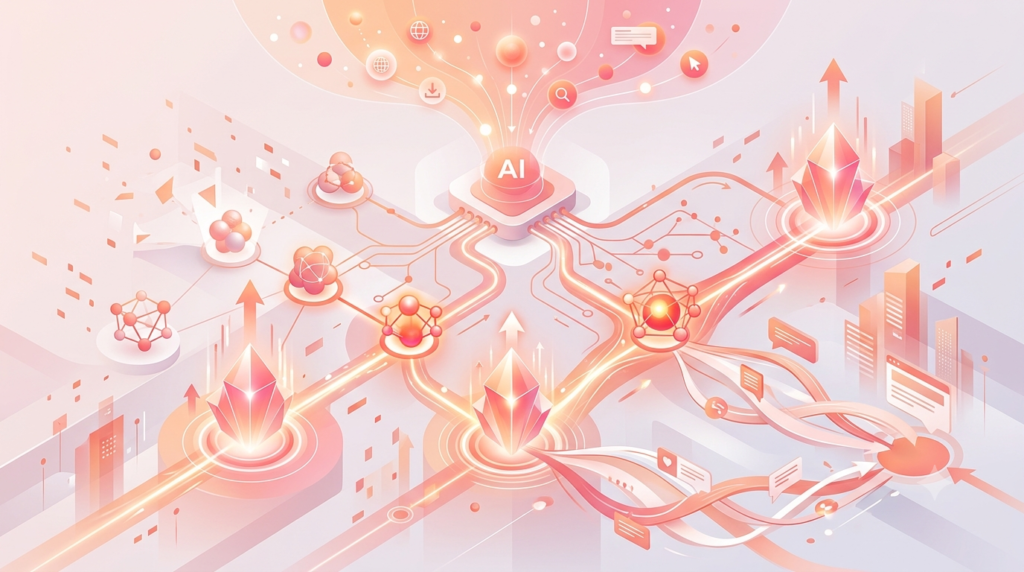
What Are AI-Powered Buying Journeys?
An AI-powered buying journey is a personalized and dynamic customer experience shaped by artificial intelligence.
Instead of assigning every prospect to the same sequence, AI analyzes data and identifies the most relevant action for an individual buyer.
The system may consider:
- Website activity
- Content engagement
- Email interactions
- CRM data
- Purchase history
- Account information
- Intent signals
- Conversation data
- Product usage
- Previous sales interactions
AI can then help businesses determine what should happen next.
For one prospect, the best action may be a personalized email.
For another, it may be a relevant case study.
For another, it may be immediate outreach from a sales representative.
The journey changes based on the buyer.
This makes AI-powered buying journeys more adaptive than traditional sales funnels.
The Core Difference
Traditional sales funnels are generally designed around stages.
AI-powered buying journeys are designed around behavior, context, and intent.
The focus shifts from simply moving a prospect to the next stage to understanding what information or interaction could help that buyer make a decision.
Traditional Sales Funnels vs AI-Powered Buying Journeys
| Traditional Sales Funnel | AI-Powered Buying Journey |
|---|---|
| Linear process | Dynamic and adaptive |
| Broad audience segments | Individual-level personalization |
| Manual analysis | AI-driven insights |
| Fixed campaigns | Real-time adjustments |
| Stage-based approach | Behavior-based approach |
| Reactive engagement | Predictive engagement |
| Limited personalization | Scalable personalization |
| Sales-led progression | Buyer-led experience |
| Historical reporting | Continuous intelligence |
| Standard communication | Context-based engagement |
The biggest difference is flexibility.
A traditional funnel often asks buyers to follow the company’s process.
An AI-powered buying journey adapts the experience around the buyer.
How AI Changes Buyer Journey Management
AI gives revenue teams the ability to process large amounts of customer and prospect data.
A sales representative cannot realistically analyze thousands of interactions manually.
AI can identify patterns across large datasets and turn those patterns into useful insights.
For example, an AI system may detect that prospects who visit a specific product page, download a case study, and return to the website within a few days are more likely to become qualified opportunities.
The business can then prioritize similar prospects.
AI can also recommend the next best action.
This might include:
- Sending a personalized email
- Sharing a relevant resource
- Assigning a sales representative
- Scheduling a product demonstration
- Launching a retargeting campaign
- Providing a personalized product recommendation
The goal is to make buyer engagement more relevant.
From Manual Decisions to Intelligent Recommendations
Sales teams have traditionally depended heavily on manual decisions.
Representatives decide which lead to contact, when to follow up, and what message to send.
AI can support these decisions by providing context.
Instead of replacing sales professionals, AI can help them make faster and more informed decisions.
This is particularly valuable when sales teams manage hundreds or thousands of potential buyers.
The Role of AI in Modern B2B Buying
B2B buying often involves multiple stakeholders.
A purchasing decision may include:
- Business leaders
- Sales leaders
- IT teams
- Finance teams
- Procurement teams
- End users
- Security teams
Each stakeholder may have different concerns.
A chief financial officer may focus on return on investment.
A technology leader may focus on integration.
A security team may focus on risk and compliance.
An end user may focus on usability and productivity.
AI can help businesses understand these different requirements and provide more relevant information.
Instead of sending the same message to every contact, organizations can personalize communication based on role, behavior, interests, and stage of evaluation.
This is particularly important in complex enterprise sales.
AI Helps Connect Buying Committee Signals
One person may download a technical guide.
Another stakeholder from the same company may visit a pricing page.
A third may attend a webinar.
When these activities are analyzed separately, the business may miss the bigger opportunity.
AI can help connect these signals and provide a more complete account-level view.
This allows sales and marketing teams to understand whether buying activity is increasing across an organization.
Key Technologies Behind AI-Powered Buying Journeys
AI-powered buying journeys depend on several connected technologies.
Customer Data Platforms
Customer data platforms help unify information from multiple sources.
This can include:
- Website activity
- CRM records
- Email engagement
- Advertising platforms
- Customer interactions
- Product usage data
A unified data foundation makes AI insights more useful.
Predictive Analytics
Predictive analytics uses historical and current data to identify patterns.
Sales teams can use predictive insights to estimate:
- Purchase likelihood
- Lead quality
- Deal risk
- Customer churn
- Potential revenue
- Pipeline movement
Generative AI
Generative AI can help create personalized content at scale.
This may include:
- Sales emails
- Follow-up messages
- Account research
- Meeting summaries
- Product recommendations
- Sales content
Conversational AI
Conversational AI helps organizations engage buyers through:
- Chatbots
- AI assistants
- Automated conversations
- Intelligent website experiences
AI Sales Agents
AI sales agents can perform more advanced tasks.
They may:
- Research accounts
- Analyze prospect data
- Draft personalized outreach
- Update CRM records
- Recommend next actions
- Support follow-up workflows
These technologies are increasingly working together to create more intelligent buyer experiences.
How AI Improves Buyer Personalization
Personalization is one of the biggest advantages of AI-powered buying journeys.
Traditional personalization often depends on simple information such as:
- First name
- Job title
- Company name
- Industry
AI can analyze much more information.
It can identify:
- Topics a prospect has researched
- Content they have engaged with
- Products they have viewed
- Similar accounts
- Recent intent signals
- Previous interactions
- Stage of evaluation
This allows businesses to create more relevant experiences.
From Segmentation to Individual Experiences
Traditional marketing often uses audience segments.
For example:
Send this campaign to all technology companies with more than 500 employees.
AI-powered systems can move toward a more individual approach.
The system may identify that two buyers work in similar companies but have completely different interests.
One may be researching cybersecurity.
Another may be focused on reducing operational costs.
AI can help tailor the buyer journey accordingly.
AI and B2B Sales Prospecting
Sales prospecting has traditionally been highly manual.
Sales representatives often spend significant time researching companies, identifying potential contacts, reviewing information, and preparing outreach.
AI can automate parts of this process.
An AI-powered prospecting system can help:
- Analyze target accounts
- Identify buying signals
- Research company information
- Prioritize prospects
- Recommend messaging
- Summarize account activity
This allows sales teams to spend more time on meaningful conversations.
However, automation should not eliminate the human element.
The strongest approach combines AI efficiency with human judgment.
Better Account Research
AI can quickly collect and organize information from available business data sources.
Sales representatives can then use that information to prepare for conversations.
Instead of spending hours researching every account, teams can focus more on understanding the most important opportunities.
This can improve sales productivity while reducing repetitive administrative work.
Predictive Analytics and Buyer Intent
Buyer intent is becoming increasingly important in modern sales.
Intent signals can indicate that a prospect may be researching a solution.
Examples may include:
- Visiting relevant pages
- Downloading industry content
- Searching for specific topics
- Comparing products
- Returning repeatedly to a website
- Engaging with product content
AI can analyze these signals alongside other information.
This helps sales teams identify which accounts may deserve immediate attention.
Predictive Engagement
Traditional sales teams often react after a prospect submits a form.
AI can help organizations become more proactive.
For example, the system may identify increased activity from a target account and recommend relevant engagement.
This creates an opportunity for sales teams to engage when interest is growing.
Timing can make a significant difference in B2B sales.
AI can help revenue teams identify when a buyer may be ready for additional engagement.
AI Sales Agents and the Buying Journey
AI sales agents are changing how revenue teams manage buyer interactions.
Unlike traditional automation, AI agents can analyze context and complete multiple tasks.
For example, an AI sales agent could:
- Research a target company.
- Review recent account activity.
- Identify relevant stakeholders.
- Summarize account information.
- Draft personalized outreach.
- Recommend the next best action.
- Update the CRM.
This can significantly reduce manual work.
AI sales agents can also support continuous buyer engagement.
However, organizations need clear controls.
AI-generated communication should remain accurate, relevant, and aligned with the company’s brand and sales strategy.
AI Agents and Revenue Teams
The most valuable use of AI agents is not simply sending more messages.
It is helping sales teams make better decisions.
An effective AI sales agent should understand context and support meaningful workflows.
The objective should be improved sales efficiency rather than uncontrolled automation.
How AI Improves Lead Qualification
Not every lead deserves the same level of attention.
One of the biggest challenges for sales teams is identifying which prospects are most likely to become customers.
AI can improve qualification by analyzing multiple signals.
These may include:
- Company size
- Industry
- Engagement
- Website behavior
- Previous interactions
- Buying intent
- Account fit
- Technology requirements
AI can then help prioritize leads.
This does not mean AI should make every decision automatically.
Instead, it can provide sales teams with better information.
Better Prioritization
A sales representative with 200 leads cannot treat every lead equally.
AI can help identify:
- High-priority opportunities
- Accounts showing strong intent
- Leads requiring additional nurturing
- Low-value prospects
- Accounts that are becoming inactive
This improves sales productivity and helps teams focus their time more effectively.
AI-Powered Content and Buyer Engagement
Content remains an important part of the buying journey.
Buyers need different information at different stages.
Early-stage buyers may need educational content.
Later-stage buyers may need:
- Case studies
- Product comparisons
- ROI information
- Technical documentation
- Implementation guides
- Customer success stories
AI can help match content with buyer needs.
For example, an AI system may detect that a buyer is repeatedly exploring implementation information.
Instead of continuing to send introductory content, the system can recommend technical resources.
This creates a more relevant experience.
Content Recommendations at Scale
AI can analyze buyer behavior and identify which content may be useful next.
This can help businesses create a connected content experience.
Instead of treating every blog post, email, webinar, or case study as a separate activity, AI can help connect them into a broader journey.
The Importance of Omnichannel Buyer Experiences
Modern buyers use multiple channels.
They may interact with a business through:
- Websites
- Webinars
- Search engines
- AI assistants
- Sales representatives
- Digital advertising
The challenge is maintaining continuity.
A buyer should not feel like they are starting from the beginning every time they change channels.
AI can help connect these interactions.
For example, if a prospect attends a webinar and later visits a product page, AI can combine those signals.
The sales team receives a more complete view of the buyer journey.
Creating Connected Experiences
A disconnected customer experience can create friction.
A prospect may already understand the basics of a product but continue receiving introductory emails.
AI can reduce this problem by analyzing previous interactions.
This helps organizations deliver more relevant communication.
Why the Buying Journey Is Replacing the Funnel
The sales funnel is still useful as a measurement framework.
Businesses can continue tracking:
- Leads
- Opportunities
- Conversions
- Pipeline
- Revenue
However, the funnel is no longer sufficient for understanding the complete buyer experience.
The buying journey provides a broader perspective.
It recognizes that buyers may:
- Enter at different stages
- Move backward
- Pause their research
- Compare alternatives
- Involve new stakeholders
- Change priorities
AI makes it possible to manage this complexity more effectively.
The buyer journey is therefore becoming a more useful operational framework for modern revenue teams.
Challenges of AI-Powered Buying Journeys
AI-powered buying journeys also introduce challenges.
Data Quality
AI systems depend on data.
Poor-quality or incomplete data can lead to inaccurate recommendations.
Organizations need strong data management practices.
Privacy and Compliance
Businesses must manage customer and prospect data responsibly.
AI personalization should respect privacy regulations and organizational policies.
Over-Automation
Too much automation can create poor experiences.
Buyers do not want to receive irrelevant or obviously automated messages.
Human oversight remains important.
Technology Integration
AI tools must connect with existing systems.
This may include:
- CRM platforms
- Marketing automation platforms
- Customer data platforms
- Analytics tools
- Sales engagement platforms
Disconnected systems reduce the value of AI.
Trust and Transparency
Organizations also need to understand how AI-generated recommendations are being used.
Sales teams should be able to review important AI insights rather than blindly following automated suggestions.
Trust will be an important factor in successful AI adoption.
How to Build an AI-Powered Buying Journey
Businesses do not need to replace their entire sales process immediately.
A step-by-step approach is often more effective.
Step 1: Map the Current Buyer Journey
Understand how buyers currently interact with the business.
Identify:
- Key channels
- Important touchpoints
- Common challenges
- Conversion barriers
- Content gaps
Step 2: Unify Customer Data
AI works best with connected data.
Bring together relevant information from:
- CRM systems
- Marketing platforms
- Website analytics
- Customer interactions
- Sales activity
Step 3: Identify High-Value AI Use Cases
Start with practical use cases.
For example:
- Lead scoring
- Account prioritization
- Personalized outreach
- Content recommendations
- Sales forecasting
Step 4: Introduce AI Gradually
Avoid trying to automate everything immediately.
Test AI workflows and measure results.
This helps organizations understand which applications create real value.
Step 5: Keep Humans in the Process
Sales professionals should remain involved in important decisions and customer interactions.
AI should enhance human capabilities rather than remove strategic human judgment.
Step 6: Continuously Optimize
Buyer behavior changes.
AI models, data, and workflows should be reviewed regularly.
Continuous optimization is essential.
A Practical Framework for AI-Powered Buying Journeys
Organizations can build their strategy around five stages.
| Stage | AI Opportunity |
|---|---|
| Discover | Identify target accounts and intent |
| Understand | Analyze buyer behavior and needs |
| Engage | Deliver personalized experiences |
| Guide | Recommend the next best action |
| Optimize | Learn from outcomes and improve |
This approach focuses less on pushing buyers through fixed stages.
Instead, it focuses on supporting buyers throughout their decision-making process.
How Sales and Marketing Teams Will Change
AI-powered buying journeys require stronger alignment between sales and marketing.
Both teams need access to shared information.
Marketing can use AI to understand engagement and deliver relevant content.
Sales can use AI to prioritize accounts and prepare for conversations.
The result is a more connected revenue process.
Sales Teams Will Become More Strategic
AI can automate repetitive tasks such as:
- Research
- Data entry
- Basic follow-ups
- Meeting summaries
- Account analysis
Sales representatives can spend more time on:
- Relationship building
- Complex problem-solving
- Strategic conversations
- Negotiation
- Customer needs
This is one of the most important opportunities created by AI.
Measuring the Success of AI-Powered Buying Journeys
Traditional funnel metrics remain useful.
However, businesses should also measure the quality and effectiveness of the buyer experience.
Important metrics may include:
- Engagement rate
- Sales cycle length
- Conversion rate
- Pipeline velocity
- Lead-to-opportunity conversion
- Win rate
- Customer acquisition cost
- Customer satisfaction
- Revenue growth
AI can also help identify which interactions contribute most to successful outcomes.
This gives revenue teams better visibility into what is working.
The Future of Sales Funnels
The sales funnel is unlikely to disappear completely.
It will continue to be useful for reporting and high-level revenue analysis.
However, the operational approach is changing.
The future of sales will become more:
- Personalized
- Predictive
- Dynamic
- Intelligent
- Buyer-driven
Instead of one funnel for every prospect, businesses will increasingly manage thousands of individual buying journeys.
AI will make this possible at scale.
From Funnel Management to Journey Orchestration
The next stage of sales technology is likely to focus on journey orchestration.
AI systems can analyze signals across multiple channels and coordinate the next best action.
This could include automatically determining:
- Which content to recommend
- When to contact a prospect
- Which sales representative should engage
- What message is most relevant
- Which accounts require attention
The goal will not simply be more automation.
It will be more intelligent engagement.
Conclusion
The traditional sales funnel was built for a different era of buying. It assumed that customers moved through a predictable and linear path. Modern buyers do not behave that way. They research independently, move between channels, involve multiple stakeholders, compare solutions, and expect relevant experiences throughout the decision-making process.
This is why businesses are moving toward AI-powered buying journeys. AI helps organizations understand individual buyers, identify intent, personalize engagement, prioritize opportunities, and recommend the next best action.
The goal is not to completely eliminate the sales funnel. The goal is to move beyond a one-size-fits-all approach. The most successful revenue teams will increasingly focus on understanding each buyer and creating experiences that adapt to their needs.
As AI sales agents, predictive analytics, generative AI, and journey orchestration technologies continue to develop, sales processes will become more intelligent and responsive. The future of sales will not be about pushing every buyer through the same funnel. It will be about creating the right journey for every buyer.
Frequently Asked Questions
What is an AI-powered buying journey?
An AI-powered buying journey uses artificial intelligence to analyze buyer behavior, personalize interactions, predict needs, and recommend the next best action across the customer journey.
Are traditional sales funnels still relevant?
Yes. Sales funnels remain useful for measuring pipeline and conversions. However, they are less effective at representing the complex and non-linear way modern buyers research and make purchasing decisions.
How does AI improve B2B sales?
AI can improve sales by helping teams identify high-priority accounts, analyze buyer intent, personalize outreach, automate repetitive tasks, and recommend next best actions.
What role do AI sales agents play?
AI sales agents can support sales teams by researching accounts, analyzing information, drafting outreach, updating CRM systems, and helping manage workflows.
Can AI replace sales representatives?
AI is more likely to augment sales representatives than completely replace them. Human skills remain important for relationship building, negotiation, trust, and complex decision-making.
What is the biggest benefit of AI-powered buying journeys?
The biggest benefit is the ability to provide more relevant and personalized experiences at scale while helping sales and marketing teams make better decisions.