

In the current highly dynamic business environment, firms keep looking for innovative ways of selling products or services faster, reaching many consumers and earning money without having to incur too much cost. Among the most significant developments in the field of sales at the moment is the concept of smart sales automation.
Contrary to some perceptions out there, the development of smart sales automation technology is not simply another tech trend. On the contrary, it is revolutionizing the manner in which businesses generate leads, engage with clients, follow up and close deals. In fact, adoption of the technology by firms has been associated with unprecedented growth rates of up to 300 percent.
In this blog, we discuss smart sales automation technology, its significance and application.
Smart Sales Automation Definition
Smart sales automation is the process of automating sales processes through AI, software tools, and other innovations.
Simply put, it allows for delegating the most boring and time-consuming sales tasks to machines so that humans can concentrate on developing customer relations and sealing deals.
For instance, it allows for the automated email sending with the content adjusted according to the client’s behavior rather than a salesperson sending emails personally.
Moreover, a sales manager doesn’t have to update all contacts in an excel table – it is possible to integrate CRM software into the process.
The result of this innovation is an accelerated and smooth sales process.
Why Do Businesses Choose to Automate Sales?
Until recently, businesses relied heavily on manual management of their sales teams. The typical sales team had to:
- Call each lead manually
- Send follow-ups individually
- Manually record updates
- Maintain records via spreadsheets
Such methods may have been effective several years ago, but the modern market requires more advanced approaches.
Businesses choose automation due to four main factors:
- Speed matters more than ever
In today’s fast-moving market, leads expect instant responses. If a business delays even a little, the prospect often loses interest and moves to a competitor who responds faster. - Sales teams need to handle more leads
As businesses scale, the number of incoming leads increases rapidly. Managing them manually becomes inefficient, so automation helps prioritize and organize leads at scale. - Customers expect personalization
Modern buyers don’t respond well to generic messages. They expect tailored communication that matches their needs, behavior, and interests, making engagement more effective. - Businesses want to reduce costs
Hiring and maintaining large sales teams is expensive. Automation reduces repetitive manual work, allowing companies to handle more leads with fewer resources.
How Smart Sales Automation Works
Smart sales automation works using the synergy of several tools integrated into one system. How does it usually work? First of all, a prospective buyer demonstrates their interest in a particular product or service by filling in a form, clicking on an ad or engaging in social media interaction.
Then, the interested party’s contact data is automatically collected and added to a CRM system.
Based on preset rules or AI behavior, the following actions will take place:
- Lead qualification (hot/warm/cold)
- Automatic messaging
- Scheduling follow-up contacts
- Notification to sales team members (if necessary)
At each sales stage, the system continues to function independently. It results in no lead being ignored, no action forgotten about, and all opportunities tracked.
How Smart Sales Automation Is Supercharging Business Growth by 300%

Modern sales automation practices have begun transforming the manner in which organizations develop and compete in today’s fast-paced digital economy. Unlike before, companies no longer solely rely on conventional manual processes and approaches due to the fact that speed and efficiency determine which competitor captures an opportunity.
Faster response time brings more conversions
Slow response time is one of the main reasons why some sales opportunities are lost. Once a lead gets in touch, they need to get a prompt response. And smart automation allows sending automatic messages, and often instantly.
This fact alone leads to a significant increase in conversions since buyers’ expectations are immediately met.
Better lead management improves efficiency
Not every lead is equal. Some are ready to buy, while others are just exploring. Smart systems automatically analyze behavior and classify leads based on interest level. This helps sales teams focus only on high-quality leads instead of wasting time on unqualified ones.
Automated follow-ups prevent lost opportunities
In traditional sales, many deals are lost simply because the salesperson forgets to follow up or follows up too late. Automation ensures that follow-ups happen at the right time, every time. This increases the chances of closing deals without additional effort.
Personalized communication increases trust
Customers respond better when they feel understood. Smart automation tools can personalize messages based on customer data like:
- Name
- Location
- Interest
- Previous interactions
This makes communication feel more human even though it is automated.
Sales teams become more productive
Instead of spending hours on repetitive tasks, sales teams can focus on:
- Talking to serious buyers
- Closing deals
- Building relationships
- Strategy and planning
This improves overall productivity and performance.
Scaling becomes easier without extra hiring
One of the biggest advantages of automation is scalability. Businesses can handle hundreds or thousands of leads without increasing the size of their team. This is one of the main reasons companies report massive growth after adopting automation systems.
Key Features of Smart Sales Automation
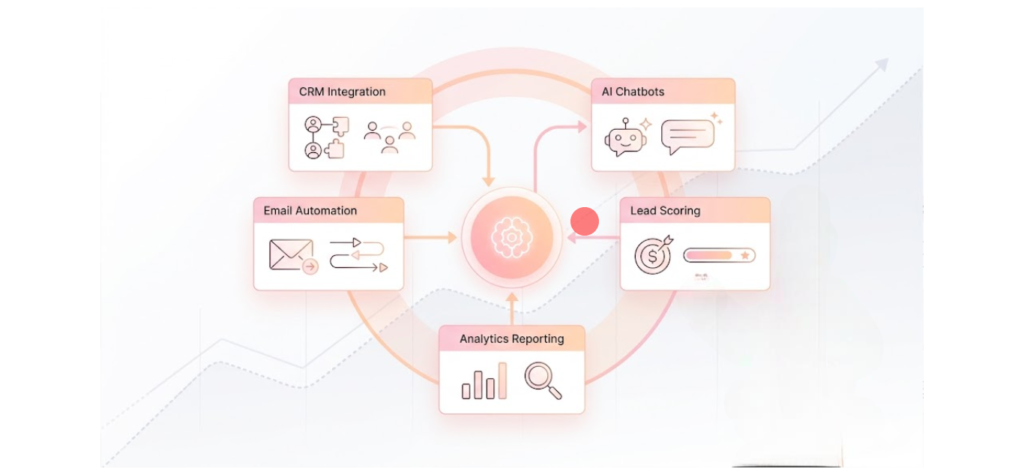
To truly understand the power of smart sales automation, we need to look at the core features that make it so effective in modern businesses. These features work together like a connected system, helping sales teams save time, reduce manual effort, and improve overall performance.
1. CRM Integration
The CRM integration ensures that all customers’ information is gathered in one place where it can be easily accessed by sales representatives. CRM eliminates scattered and outdated data kept in different emails and spreadsheets. The integration also ensures that data is always up-to-date in real time.
2. Email Automation
The email automation involves sending emails based on various actions taken by customers, such as signing up, downloading something, or being inactive. This technique ensures that businesses do not waste time communicating with leads manually and helps nurture them during the sales process.
3. AI Chatbots
AI chatbots are responsible for instantly replying to customers’ questions, giving them necessary information, and qualifying leads. These bots ensure that response time is shortened and customers are satisfied with prompt replies to their questions.
4. Lead Scoring Systems
The lead scoring system ranks customers based on their behavior, engagement, and interest. This helps salespeople concentrate on the most relevant clients who have a higher chance of converting.
5. Workflow Automation
The workflow automation deals with repetitive activities that need to be done to nurture leads further. Such tasks include assigning leads, following up with them, and ensuring that the lead moves through the entire sales pipeline
Benefits of Smart Sales Automation
| Benefit | Explanation (In Depth) |
|---|---|
| Higher conversion rates | Faster and consistent follow-ups ensure leads are engaged quickly, increasing the chances of turning prospects into paying customers. |
| Faster sales cycles | Automation removes delays in communication and approvals, helping deals move through the pipeline much more quickly. |
| Improved customer experience | Customers receive instant replies, personalized communication, and smooth interactions at every stage of the journey. |
| Increased sales team productivity | Sales teams spend less time on repetitive tasks and more time focusing on meaningful conversations and closing deals. |
| Reduced operational costs | Businesses can scale efficiently without hiring large teams, as automation handles many manual sales tasks. |
| Better lead quality | Smart systems filter and prioritize high-intent leads, allowing teams to focus only on the most valuable prospects. |
| Consistent follow-ups | Automated reminders and workflows ensure no lead is missed, forgotten, or left without proper engagement. |
| Revenue growth (2x–5x impact) | Many businesses see significant revenue growth after implementing smart sales automation effectively due to improved efficiency and conversions. |
Industry Sectors Applying Smart Sales Automation
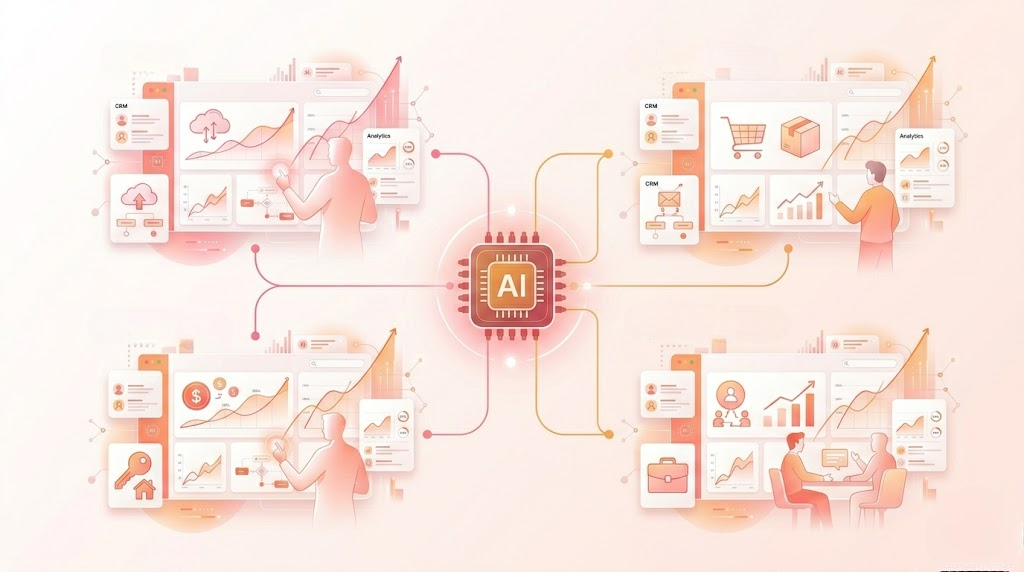
The application of smart sales automation is not confined to any particular industry sector. It is being applied in various industries due to its scalability and flexibility.
1. SaaS Companies
Companies working in the Software-as-a-Service industry focus heavily on subscription-based models. Automation helps them handle onboarding of users, send out updates, and manage renewals.
2. E-commerce Businesses
In e-commerce businesses, automation is used to follow up on orders, recover abandoned carts, offer personalized product recommendations, and run customer engagement campaigns.
3. Fintech Companies
Fintech companies deploy automation in managing leads, promoting their financial products, and offering personalized financial solutions to customers.
4. Real Estate
Companies working in the real estate sector use automation to manage inquiries related to property purchases, arrange site visits, and follow up on potential buyers.
5. B2B Services
Companies providing business-to-business services use automation to manage lengthy sales processes and nurture leads.
Challenges for Businesses in Sales Automation
Although sales automation is extremely effective, it poses certain difficulties when applied inappropriately.
For example, over-automation is a serious issue. In the case when companies overly depend on sales automation, the communication process may become too automated and therefore less friendly.
Poor configuration is one more issue. If the workflow, CRM solutions, and automation itself are poorly set up, it will not yield the desired outcomes.
Absence of human interaction can also be problematic. Despite being fully automated, the business should maintain personal interactions with customers.
Too many sales automation tools can be confusing. Businesses often face difficulties because they have several incompatible sales automation tools.
Thus, the perfect combination of sales automation and strategy is required.
Future of Smart Sales Automation
The future of sales automation is becoming smarter and more autonomous. In the future, business owners will use AI that controls the whole sales pipeline without any human interaction. It will be able to understand client behavior, make predictions on purchasing decisions, and act accordingly.
- Also, voice-activated sales AI assistants will become prevalent as people would be able to communicate with companies using natural speech.
- Predictive automation technologies will be more sophisticated, meaning that AI will be able to determine who among customers is most likely to buy without their prior indication.
- Lastly, hyper-personalization technology will become widespread, meaning that every client will receive a personalized experience. Sales will not become a hard, laborious activity but rather turn into an ecosystem working in the background.
Companies adopting this technology early will have a huge competitive advantage.
Conclusion
Not only is it becoming a necessity to be innovative in sales today, but smart sales automation has become crucial for growth in a highly competitive environment.
This enables companies to become more efficient, productive, and scalable while ensuring they do not increase their workload in any way. The most significant thing about sales automation is that sales personnel become able to concentrate on the things that matter most to success.
Smart sales automation can change the entire process of doing business and make sales a more efficient activity resulting in higher profits and better organization overall.
The trend that the sales industry is developing toward is becoming increasingly clear and evident. In order to succeed, a company needs to move forward with this trend.
Frequently Asked Questions (FAQs)
- Define smart sales automation in simple terms
Smart sales automation refers to the application of artificial intelligence solutions to complete repetitive tasks in sales including email campaigns, lead management, CRM updates, and customer follow-up procedures.
- In what way does smart sales automation help achieve business growth?
The benefits of using this solution are higher conversion rates that result from quicker response times, improved follow-ups, increased personalization and attention to the leads that are valuable. This increases revenue generation for businesses.
- Is smart sales automation beneficial only for big businesses?
This technology can be beneficial for companies of any size. However, small enterprises have even more benefits as it helps them to scale up without recruiting a team of salespeople.
- Will sales automation replace sales teams?
Sales automation does not replace teams but assists them in their work as it reduces repetitive tasks leaving sales teams more time to complete crucial tasks.
- List several major tools for smart sales automation
There are several major tools that can be applied including CRM, email automation services, AI chatbots, lead scoring, and workflow automation applications.