

AI technology is revolutionizing B2B sales, and SDRs are no exception. The companies that used to solely depend on human SDRs now consider AI-powered SDRs that can perform research, personalize communication, qualify leads, schedule appointments, and follow up with them 24/7.
As a result, there is an emerging problem for sales leaders today:
Should your company invest in AI SDRs, continue using human SDRs, or do both?
It’s not as easy to choose between AI and human SDRs as it may seem on the surface. On the one hand, AI SDRs are fast, automated, and excellent in performing repetitive tasks. But on the other hand, human SDRs are still unbeaten in building relationships, reading buying signals and having difficult conversations.
The point here is not in substituting people by AI. It’s about improving the sales process and letting revenue teams work with high-potential deals.
In this ultimate guide, we’ll provide a comparative analysis of AI SDR vs Human SDR based on several key aspects: productivity, personalization, pipeline creation, conversion rate, cost, scalability, buyer experience, and more. We’ll discuss when to use AI and human SDRs and explain why many companies decide to use both together.

What Is an AI SDR?
An AI Sales Development Representative (AI SDR) is software powered by artificial intelligence that automates many of the repetitive tasks traditionally handled by sales development teams.
Modern AI SDR platforms use technologies such as large language models, machine learning, CRM integrations, intent data, and workflow automation to identify prospects, research companies, personalize outreach, qualify leads, and book meetings.
Unlike basic automation tools that simply send scheduled emails, AI SDRs continuously analyze prospect behavior and adapt outreach based on engagement signals.
Typical Responsibilities of an AI SDR
An AI SDR can perform tasks such as:
- Identifying ideal customer profiles (ICPs)
- Researching companies and prospects
- Finding verified business contacts
- Writing personalized outbound emails
- Sending multichannel outreach campaigns
- Following up automatically
- Scoring leads based on engagement
- Booking meetings
- Updating CRM records
- Providing sales analytics
These capabilities allow sales teams to increase outreach without proportionally increasing headcount.
Benefits of AI SDRs
Organizations adopting AI SDRs often experience:
- Faster prospecting
- Consistent follow-up sequences
- Reduced manual work
- Improved response times
- Higher operational efficiency
- Better CRM hygiene
- Increased sales productivity
- Scalable outbound campaigns
However, AI still has limitations, especially when conversations require empathy, negotiation, or strategic thinking.
What Is a Human SDR?
A Human Sales Development Representative (SDR) is a sales professional responsible for generating qualified opportunities for Account Executives by engaging with potential buyers.
Human SDRs combine research, communication skills, business knowledge, and emotional intelligence to build trust with prospects throughout the early stages of the buying journey.
Unlike AI systems, human SDRs can adapt to unexpected questions, understand emotional cues, and navigate complex decision-making processes.
Core Responsibilities of a Human SDR
Typical daily responsibilities include:
- Prospect research
- Cold calling
- Personalized email outreach
- LinkedIn networking
- Qualifying inbound leads
- Discovery conversations
- Objection handling
- Meeting scheduling
- CRM management
- Collaboration with marketing and account executives
Human SDRs often become the first personal interaction between a prospect and your company, making their role essential in high-value B2B sales.
AI SDR vs Human SDR: Understanding the Core Difference
Although both AI SDRs and Human SDRs aim to generate qualified pipeline, their strengths are fundamentally different.
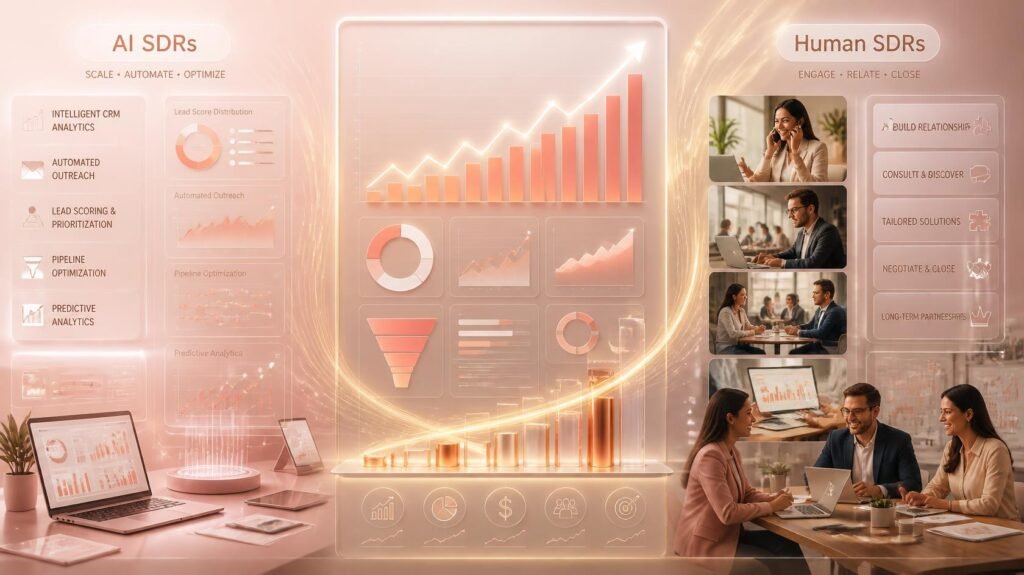
AI excels at speed, automation, consistency, and data processing. Human SDRs excel at communication, empathy, strategic thinking, and relationship building.
The most successful organizations understand that these capabilities complement rather than replace one another.
AI SDR vs Human SDR Comparison
| Criteria | AI SDR | Human SDR |
|---|---|---|
| Prospect Research | Automated | Manual |
| Outreach Speed | Extremely Fast | Moderate |
| Email Personalization | AI-generated | Human-crafted |
| Cold Calling | Limited | Excellent |
| Emotional Intelligence | Very Low | High |
| Objection Handling | Basic | Advanced |
| Relationship Building | Limited | Excellent |
| CRM Updates | Automatic | Manual |
| Learning Ability | Data-driven | Experience-driven |
| Scalability | Excellent | Hiring dependent |

Why AI SDRs Are Growing So Quickly
The quick development of AI-powered SDR tools is caused by growing demands on sales departments to produce more pipeline without additional costs.
Companies are required to communicate with a larger number of potential clients, answer faster, personalize communication, and provide regular follow-ups without hiring too many sales specialists.
These challenges can be solved with the help of automation provided by AI which makes people involved in sales to concentrate on more creative aspects of their work.
Here are some of the most important drivers of AI SDR tools usage:
- Increasing costs of outbound sales
- Growth of prospect database size
- Growing need to provide faster responses
- Advancements in generative AI
- Improved CRM/sales tools integration
- More competitive B2B environment
Instead of eliminating sales positions, AI becomes a productivity booster for salespeople.
AI SDR vs Human SDR: Performance Comparison
Choosing between an AI SDR and a Human SDR isn’t about identifying a winner—it’s about understanding where each performs best. Every B2B sales organization has different goals, sales cycles, and customer expectations. Some prioritize high-volume outbound prospecting, while others focus on building long-term relationships with enterprise buyers.
To make the right decision, evaluate both approaches across the factors that have the greatest impact on pipeline generation and revenue.
AI SDR vs Human SDR at a Glance
| Category | AI SDR | Human SDR |
|---|---|---|
| Outreach Volume | Excellent | Moderate |
| Personalization | Very Good | Excellent |
| Cold Calling | Limited | Excellent |
| Follow-up Consistency | Excellent | Moderate |
| Relationship Building | Limited | Excellent |
| Cost Efficiency | Excellent | Moderate |
| Scalability | Excellent | Limited |
| Adaptability | Moderate | Excellent |
| Data Processing | Excellent | Moderate |
| Complex Sales | Moderate | Excellent |
Productivity Comparison
One of the key factors that makes businesses choose AI SDRs is efficiency. Human SDRs have limited hours to work in and can deal with a limited number of leads during one day. On the other hand, an AI SDR can handle thousands of leads simultaneously without getting tired.
In just minutes, an AI SDR can gather information about a company, find out who the decision-makers are, communicate with them, schedule meetings, and update the CRM database.
It is impossible for human SDRs to compete with AI when it comes to operational speed.
Productivity Comparison Table
| Task | AI SDR | Human SDR |
|---|---|---|
| Prospect Research | Seconds | 10–20 minutes |
| Email Generation | Instant | 10–15 minutes |
| CRM Updates | Automatic | Manual |
| Follow-ups | Fully Automated | Manual |
| Lead Scoring | Real-Time | Manual |
| Appointment Scheduling | Automatic | Manual |
Winner
For repetitive and high-volume tasks, AI SDRs provide significantly higher productivity.
Personalization: Can AI Match Human Conversations?
Personalization is essential in modern B2B sales. Buyers expect outreach that reflects their industry, company challenges, and business goals.
AI has made remarkable progress by using CRM data, website activity, LinkedIn profiles, and intent signals to create personalized messages at scale.
However, human SDRs remain superior when conversations require emotional intelligence, active listening, negotiation, or adapting to unexpected responses.
AI Personalization vs Human Personalization
| Feature | AI SDR | Human SDR |
|---|---|---|
| Company Research | Excellent | Excellent |
| Industry Context | Excellent | Excellent |
| Emotional Intelligence | Low | Excellent |
| Storytelling | Moderate | Excellent |
| Handling Objections | Limited | Excellent |
| Building Trust | Moderate | Excellent |
Example
Suppose a prospect replies:
“We’re already evaluating another vendor, but budget approval is delayed.”
An AI SDR might send a predefined nurturing response.
A Human SDR can ask follow-up questions, understand the buying committee, identify concerns, and position the solution more strategically.
This flexibility often determines whether an opportunity progresses.
Cost Comparison
Hiring and training SDRs is expensive. Organizations must account for salaries, incentives, onboarding, software licenses, management, and ongoing coaching.
AI SDR platforms require software subscriptions but can handle significantly larger workloads.
Estimated Annual Cost
| Expense | AI SDR | Human SDR |
|---|---|---|
| Annual Cost | Lower | Higher |
| Training | Minimal | Continuous |
| Benefits | None | Required |
| Recruitment | None | Required |
| Scalability Cost | Low | High |
For startups and fast-growing businesses, AI SDRs often provide a more cost-effective method of expanding outbound activities.
However, enterprise organizations typically benefit from combining AI with experienced sales professionals.
Outreach Speed
Speed matters because prospects are more likely to respond when engagement happens quickly.
AI SDRs can respond almost immediately after a lead downloads a resource, visits a pricing page, or submits a contact form.
Human SDRs usually require additional time to review the lead and prepare outreach.
Outreach Comparison
| Activity | AI SDR | Human SDR |
|---|---|---|
| First Email | Seconds | Hours |
| Follow-up | Automated | Manual |
| Lead Qualification | Instant | Moderate |
| CRM Update | Automatic | Manual |
| Meeting Scheduling | Instant | Manual |
Why Speed Matters
Research consistently shows that faster response times increase the likelihood of connecting with qualified prospects.
AI ensures that no lead waits for an initial response, even outside business hours.
Lead Qualification
Lead qualification determines whether prospects match your Ideal Customer Profile (ICP) and are ready to move forward.
AI SDRs evaluate behavioral data, firmographics, website activity, email engagement, and CRM information to prioritize leads.
Human SDRs add another layer by asking discovery questions, identifying business challenges, and assessing buying intent during conversations.
Qualification Comparison
| Qualification Area | AI SDR | Human SDR |
|---|---|---|
| Firmographic Analysis | Excellent | Excellent |
| Behavioral Analysis | Excellent | Moderate |
| Discovery Calls | Limited | Excellent |
| Budget Qualification | Moderate | Excellent |
| Decision Maker Identification | Excellent | Excellent |
| Buying Intent Analysis | Very Good | Excellent |
The strongest qualification process combines AI insights with human conversations.
Relationship Building
Relationships remain one of the most valuable assets in B2B sales.
Enterprise buyers often spend weeks or months evaluating vendors before making purchasing decisions.
During this period, trust becomes more important than automation.
Human SDRs naturally build rapport through:
- Active listening
- Personalized conversations
- Empathy
- Industry knowledge
- Follow-up discussions
- Problem-solving
AI can support these interactions but cannot fully replace authentic human relationships.
Relationship Comparison
| Capability | AI SDR | Human SDR |
|---|---|---|
| Rapport Building | Moderate | Excellent |
| Trust Development | Moderate | Excellent |
| Negotiation Support | Limited | Excellent |
| Active Listening | Limited | Excellent |
| Strategic Conversations | Moderate | Excellent |
Scalability
One of AI’s greatest strengths is scalability.
When a company wants to expand into new regions or target thousands of additional prospects, AI SDRs can increase outreach almost instantly.
Expanding a human SDR team requires:
- Recruitment
- Interviews
- Hiring
- Training
- Onboarding
- Management
This process may take several months.
Scalability Comparison
| Factor | AI SDR | Human SDR |
|---|---|---|
| Expansion Speed | Excellent | Slow |
| Hiring Required | No | Yes |
| Training Time | Minimal | High |
| Capacity Growth | Instant | Gradual |
| Cost of Scaling | Lower | Higher |
For organizations prioritizing rapid outbound growth, AI SDRs provide a significant operational advantage.
Pipeline Generation
Pipeline quality is ultimately more important than outreach volume.
Thousands of emails have little value if they don’t generate qualified meetings.
AI SDRs excel at filling the top of the sales funnel through:
- Continuous prospecting
- Automated nurturing
- Lead prioritization
- Personalized campaigns
Human SDRs strengthen the middle of the funnel by converting interested prospects into meaningful sales conversations.
Pipeline Comparison
| Stage | AI SDR | Human SDR |
|---|---|---|
| Prospect Discovery | Excellent | Very Good |
| Outreach | Excellent | Good |
| Lead Qualification | Very Good | Excellent |
| Meeting Booking | Excellent | Excellent |
| Opportunity Creation | Good | Excellent |
| Relationship Expansion | Moderate | Excellent |
Real-World Use Cases
Best Use Cases for AI SDRs
- Large outbound campaigns
- High-volume prospecting
- CRM data enrichment
- Automated follow-ups
- Lead scoring
- Appointment scheduling
- Email personalization at scale
- Global outreach across time zones
Best Use Cases for Human SDRs
- Enterprise sales
- Complex B2B negotiations
- Discovery calls
- Objection handling
- Strategic account management
- Relationship-based selling
- Executive conversations
- Multi-stakeholder deals
Key Takeaways
AI SDRs significantly outperform human SDRs in speed, automation, scalability, and cost efficiency, making them ideal for high-volume prospecting and repetitive sales activities. Human SDRs, however, remain indispensable for building trust, navigating complex buying journeys, handling objections, and creating meaningful business relationships.
The most successful sales organizations don’t choose one over the other—they combine AI-driven efficiency with human expertise to create a balanced, high-performing sales development strategy.
ROI Comparison: AI SDR vs Human SDR
Every sales leader eventually asks the same question:
Which option delivers a better return on investment?
The answer depends on your sales model, deal size, target audience, and growth objectives.
AI SDRs typically produce a higher ROI for repetitive outbound activities because they automate research, outreach, follow-ups, and lead qualification with minimal incremental cost. Human SDRs generate stronger ROI when selling high-value products that require relationship building and multiple stakeholder interactions.
Rather than measuring only cost, businesses should evaluate pipeline quality, conversion rates, sales cycle length, and revenue generated.
ROI Comparison
| Metric | AI SDR | Human SDR |
|---|---|---|
| Initial Investment | Low to Moderate | High |
| Operating Cost | Low | High |
| Pipeline Volume | Excellent | Good |
| Lead Quality | Very Good | Excellent |
| Enterprise Deal Success | Moderate | Excellent |
| Long-Term ROI | Excellent | Excellent |
When AI Delivers Better ROI
AI SDRs generally provide better returns when your organization needs to:
- Generate thousands of outbound leads
- Automate repetitive prospecting
- Scale quickly without expanding headcount
- Improve follow-up consistency
- Reduce manual CRM work
- Increase productivity across sales teams
When Human SDRs Deliver Better ROI
Human SDRs create greater value when selling:
- Enterprise software
- High-ticket B2B solutions
- Complex SaaS platforms
- Consulting services
- Financial products
- Multi-year contracts
In these situations, trust and strategic conversations often influence buying decisions more than automation.
Common Mistakes When Implementing AI SDRs
Many companies invest in AI sales tools expecting instant results. Unfortunately, poor implementation often leads to disappointing outcomes.
Technology alone cannot solve sales challenges. AI performs best when supported by a clear sales process, accurate customer data, and human oversight.
Mistakes to Avoid
| Mistake | Business Impact | Solution |
|---|---|---|
| Sending generic AI emails | Low response rates | Train AI using ICP data and personalization |
| Poor CRM data quality | Inaccurate outreach | Maintain clean customer records |
| No human review | Messaging errors | Review high-value communications |
| Over-automation | Reduced trust | Combine automation with human interaction |
| Ignoring analytics | Missed optimization opportunities | Monitor campaign performance regularly |
| Replacing every SDR | Lower relationship quality | Build a hybrid sales team |
How to Build a Hybrid SDR Team
The future of sales isn’t AI versus humans it’s AI working alongside humans.
Leading B2B organizations are adopting hybrid sales models where AI manages repetitive tasks while SDRs focus on conversations that require expertise and relationship building.
Recommended Workflow
| Stage | AI Responsibility | Human Responsibility |
|---|---|---|
| Prospect Discovery | Find target accounts | Review strategic opportunities |
| Contact Research | Collect contact information | Validate key prospects |
| Email Personalization | Generate first drafts | Refine messaging for priority accounts |
| Outreach | Launch automated sequences | Handle manual outreach for key accounts |
| Lead Qualification | Score leads | Conduct discovery calls |
| Meeting Booking | Schedule meetings | Prepare prospects for sales conversations |
| CRM Updates | Automatic | Review and enrich important records |
This approach increases efficiency without sacrificing the human connection that drives complex B2B sales.
Best Practices for AI SDR Success
Organizations achieving the best results with AI SDRs follow consistent operational practices.
Recommended Best Practices
- Define a clear Ideal Customer Profile (ICP).
- Train AI using successful sales messaging.
- Personalize outreach beyond first-name tokens.
- Monitor campaign performance weekly.
- Continuously refine email sequences.
- Review AI-generated messages before large campaigns.
- Keep CRM data accurate.
- Align SDRs with marketing and RevOps teams.
- Measure pipeline quality instead of outreach volume.
- Let humans handle high-value conversations.
AI SDR Tools Worth Evaluating
The AI sales technology landscape is evolving rapidly, with new platforms offering advanced automation, personalization, and prospecting capabilities.
Popular AI SDR Platforms
| Platform Type | Primary Purpose |
|---|---|
| AI Prospecting Platforms | Identify and prioritize prospects |
| AI Email Assistants | Generate personalized outreach |
| Conversation Intelligence | Analyze sales calls |
| Revenue Intelligence Platforms | Forecast pipeline performance |
| Sales Engagement Platforms | Automate multichannel outreach |
| CRM AI Assistants | Improve customer data and workflows |
When evaluating tools, focus on:
- CRM integration
- Personalization capabilities
- Analytics and reporting
- Workflow automation
- Data security
- Scalability
- Ease of implementation
Future Trends in AI Sales Development
AI sales technology continues to evolve beyond basic email automation.
Over the next few years, AI SDRs are expected to become more proactive, predictive, and context-aware.
Some emerging trends include:
- Autonomous prospect research
- Predictive buying signal analysis
- Real-time conversation recommendations
- AI-generated sales playbooks
- Intent-based outreach automation
- Voice AI for inbound qualification
- Advanced revenue forecasting
- Deeper CRM intelligence
- Personalized multichannel engagement
- Agentic AI coordinating entire outbound workflows
Businesses that prepare for these changes today will be better positioned to scale efficiently as AI capabilities mature.
AI SDR Implementation Checklist
Before deploying AI SDRs across your organization, ensure the following foundations are in place.
| Checklist Item | Status |
|---|---|
| Ideal Customer Profile defined | ✔ |
| CRM data cleaned | ✔ |
| Email templates optimized | ✔ |
| Lead scoring configured | ✔ |
| Human approval process established | ✔ |
| Analytics dashboard implemented | ✔ |
| Compliance requirements reviewed | ✔ |
| Team training completed | ✔ |
| Success metrics defined | ✔ |
| Continuous optimization plan created | ✔ |
Expert Insight
The most successful sales organizations are not replacing SDRs with AI—they are redefining the SDR role.
Instead of spending hours researching prospects or updating CRM records, human SDRs can dedicate more time to building relationships, understanding customer challenges, and creating qualified opportunities.
AI becomes a productivity partner rather than a replacement.
Which Should You Choose: AI SDR, Human SDR, or Both?
The decision isn’t about replacing people with technology. It’s about selecting the right combination of automation and human expertise based on your sales process, customer expectations, and business objectives.
If your primary challenge is generating a larger volume of qualified leads, AI SDRs can significantly improve efficiency by automating repetitive tasks. However, if your organization focuses on enterprise sales, strategic accounts, or complex buying journeys, experienced human SDRs remain indispensable.
For most modern B2B organizations, a hybrid model delivers the best results.
Decision Framework
| Business Requirement | Best Choice |
|---|---|
| High-volume outbound prospecting | AI SDR |
| Startup with limited sales budget | AI SDR |
| Enterprise SaaS sales | Human SDR |
| Complex B2B negotiations | Human SDR |
| Global prospecting across multiple time zones | AI SDR |
| Strategic account-based selling | Human SDR |
| Scaling outbound operations rapidly | AI SDR |
| Improving relationship quality | Human SDR |
| Increasing productivity without hiring | AI SDR |
| Long-term revenue growth | Hybrid AI + Human SDR |
When AI SDRs Are the Better Choice
AI SDRs are ideal when your business needs to increase outreach while keeping operational costs under control.
They work particularly well for:
- SaaS companies generating large outbound campaigns
- Startups with lean sales teams
- Businesses expanding into new markets
- Companies managing thousands of prospects
- Organizations that need consistent follow-ups
- Teams looking to improve sales productivity
When Human SDRs Are the Better Choice
Human SDRs remain the preferred choice when sales require trust, consultation, and strategic communication.
They are best suited for:
- Enterprise software sales
- Account-Based Marketing (ABM)
- High-value B2B contracts
- Government and public sector sales
- Financial and healthcare industries
- Multi-stakeholder buying committees
- Long sales cycles
- Strategic partnerships
The Future of Sales Development
The future of sales is not AI replacing humans—it is AI enhancing human capabilities.
As Agentic AI and intelligent automation continue to evolve, SDRs will spend less time on repetitive administrative work and more time on high-value activities such as:
- Building executive relationships
- Conducting discovery meetings
- Solving customer challenges
- Creating tailored sales strategies
- Collaborating with Account Executives
- Expanding strategic accounts
Organizations that embrace this transformation will be better positioned to improve productivity, shorten sales cycles, and generate sustainable pipeline growth.
Internal Linking Opportunities
| Anchor Text | Related Blog Topic |
|---|---|
| AI Sales Agents | What Are AI Sales Agents and How Do They Work? |
| Sales Automation | Sales Automation Best Practices for B2B Teams |
| Revenue Intelligence | Revenue Intelligence Platforms: Complete Buyer’s Guide |
| Lead Qualification | AI-Powered Lead Qualification Strategies |
| Sales Prospecting | Modern B2B Sales Prospecting Guide |
| Account-Based Marketing | Sales-Led ABM Strategy Guide |
| Revenue Operations | RevOps Explained for Growing Businesses |
| CRM Automation | CRM Automation Best Practices |
| Intent Data | Intent Data vs Buyer Signals |
| Sales Engagement | Top Sales Engagement Platforms Compared |
Authoritative External Resources
The following trusted resources can strengthen your article by providing readers with additional insights:
- Salesforce Resource Center
- HubSpot Sales Blog
- Microsoft Sales Documentation
- Gartner Research
- McKinsey Insights
- Harvard Business Review
- IBM Think
- LinkedIn Sales Solutions
- OpenAI Documentation
- Google AI Resources
Frequently Asked Questions
What is an AI SDR?
An AI SDR is an artificial intelligence-powered sales development solution that automates prospect research, outreach, lead qualification, follow-ups, and meeting scheduling to improve sales efficiency.
Can AI completely replace human SDRs?
No. AI excels at repetitive and data-driven tasks, but human SDRs remain essential for relationship building, negotiation, discovery calls, and complex B2B sales conversations.
Which is more cost-effective: AI SDR or Human SDR?
For high-volume outbound prospecting, AI SDRs are generally more cost-effective. For enterprise sales with high-value deals, experienced human SDRs often deliver stronger long-term ROI.
Are AI SDRs suitable for small businesses?
Yes. Small businesses can use AI SDRs to automate outreach, reduce manual work, and scale sales activities without significantly increasing headcount.
Do AI SDRs integrate with CRM platforms?
Most modern AI SDR solutions integrate with popular CRM platforms, enabling automated data synchronization, lead tracking, and workflow management.
How do AI SDRs personalize outreach?
AI SDRs analyze CRM data, company information, buyer intent signals, and previous interactions to generate personalized messages tailored to individual prospects.
What industries benefit most from AI SDRs?
Technology, SaaS, cybersecurity, fintech, professional services, manufacturing, and B2B consulting are among the industries that benefit significantly from AI-powered sales development.
What are the limitations of AI SDRs?
AI SDRs may struggle with emotional intelligence, complex negotiations, strategic decision-making, and nuanced conversations that require human judgment.
Should startups invest in AI SDRs?
Startups looking to scale outbound sales efficiently often benefit from AI SDRs, especially when resources are limited and rapid growth is a priority.
What is the future of AI in sales development?
The future lies in hybrid sales teams where AI handles repetitive operational tasks while human SDRs focus on relationship building, consultative selling, and strategic customer engagement.