
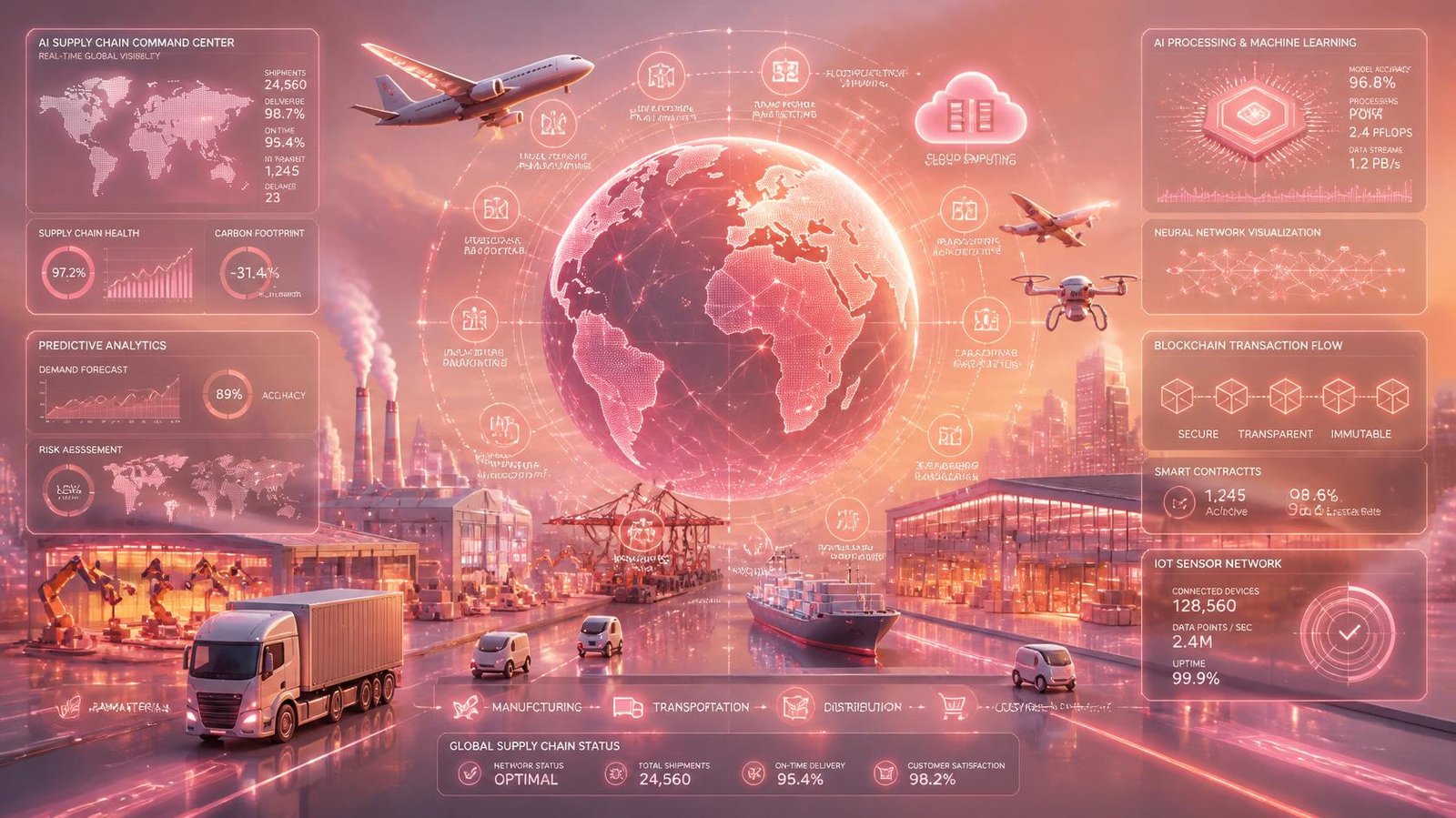
It has become extremely challenging for modern supply chains to cope with the growing complexity of their operations. Global markets, changing demands from customers, shortages of supplies, shipping problems, and the rising expectations of customers make traditional methods of supply chain management inefficient.
Artificial intelligence (AI) helps firms overcome all these challenges and brings intelligence and automation into the supply chain management at any stage of operations. By means of AI analysis of large quantities of real-time information and the creation of predictions, companies can optimize their inventory and logistics.
Many organizations, including manufacturing firms, retailers, hospitals, e-commerce enterprises, etc., use artificial intelligence in their supply chains to minimize expenses and maximize efficiency and customer satisfaction.
In this guide, you will find out how AI revolutionizes the process of supply chain management, what applications it includes, what its advantages are, and why it has become one of the crucial technologies that influence supply chains nowadays.
What Is AI in Supply Chain Management?
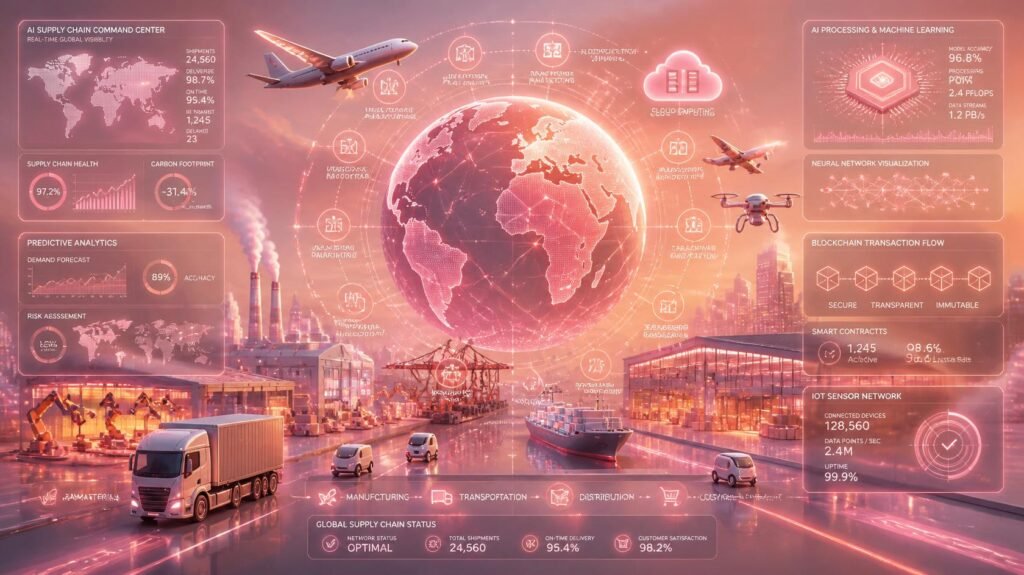
AI in supply chain management is the application of intelligent algorithms, machine learning, predictive analytics, computer vision, and automation tools to enhance supply chain management practices.
In contrast to conventional supply chains that require extensive human intervention and depend heavily on past performance data, AI constantly analyzes data from various sources and gives recommendations based on its findings.
AI helps organizations make smarter decisions by:
- Forecasting customer demand
- Optimizing inventory levels
- Improving warehouse operations
- Planning efficient transportation routes
- Predicting equipment failures
- Detecting supply chain risks
- Automating repetitive tasks
- Enhancing supplier management
As supply chains become increasingly digital, AI is becoming the foundation of intelligent supply chain management.
Why AI Is Transforming Supply Chain Management
Supply chains today produce vast quantities of data each day. This data is generated by suppliers, manufacturers, warehouses, logistics, online purchases, customer behavior, weather updates, and market trends.
The manual processing of such data without AI would prove to be very challenging and cumbersome for any company.
AI revolutionizes the supply chain processes as it allows companies to:
- Make quick decisions
- Cut down on costs
- Improve forecast accuracy
- Become more efficient
- Increase visibility within the supply chain
- Save on waste and inventories
- Enhance customer experience
Rather than responding to issues that have occurred, companies would be able to prevent them beforehand.
Key Applications of AI in Supply Chain Management
1. Intelligent Demand Forecasting
The demand forecasting application is among the most useful uses of AI in supply chain management. Traditional forecasting techniques depend only on past sales records for their estimates. Customer behavior keeps changing depending on seasons, promotions, economics, weather, and other market occurrences.
Some of the data that AI uses in forecasting include:
- Sales history
- Purchasing behavior of the customer
- Market demands
- Trends in social media
- Economics
- Weather predictions
- Promotions
This helps organizations develop an excellent demand forecast to prevent either shortage or excess of inventory.
Advantages
- Increased accuracy of forecasts
- Prevention of shortages
- Reduction in inventory cost
- Effective production planning
- Customer satisfaction
2. Inventory Optimization
Maintaining the right inventory levels is one of the biggest challenges in supply chain management. Too much inventory increases storage costs. Too little inventory results in lost sales. AI continuously monitors inventory levels and predicts future demand, helping businesses maintain optimal stock levels.
AI systems can automatically recommend:
- When to reorder products
- How much inventory to purchase
- Which products require safety stock
- Inventory allocation across warehouses
This reduces unnecessary inventory while ensuring products remain available when customers need them.
3. Predictive Maintenance
Manufacturing equipment and warehouse machinery are critical components of modern supply chains. Unexpected equipment failures can delay production, increase repair costs, and disrupt deliveries. AI-powered predictive maintenance uses sensor data from machines to detect signs of wear before equipment fails. Instead of waiting for a breakdown, businesses receive early warnings and can schedule maintenance at the right time.
Benefits include:
- Reduced downtime
- Lower maintenance costs
- Increased equipment lifespan
- Improved operational efficiency
- Better production planning
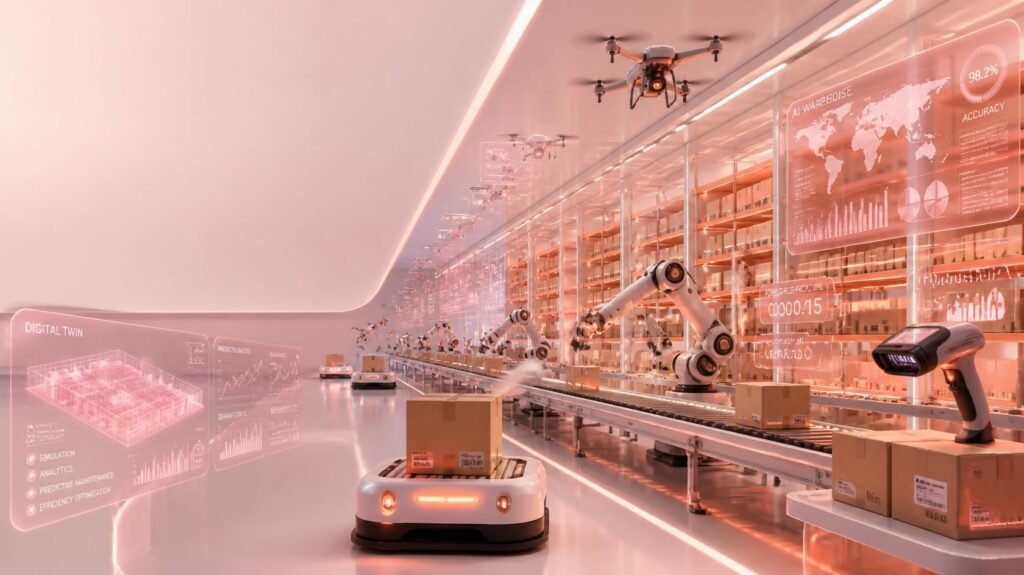
4. Warehouse Automation
Warehouses have become increasingly intelligent with AI-powered automation.
AI improves warehouse operations by optimizing:
- Product storage
- Picking routes
- Packing processes
- Inventory tracking
- Labor allocation
Many warehouses now use AI-driven robots that automatically move products, scan inventory, and prepare shipments. Computer vision systems can also identify damaged goods, monitor inventory accuracy, and improve quality control. The result is faster order processing with fewer human errors.
5. Route Optimization and Logistics
Transportation is one of the most expensive components of any supply chain.
AI helps logistics companies determine the fastest and most efficient delivery routes by analyzing:
- Traffic conditions
- Weather
- Fuel costs
- Delivery schedules
- Driver availability
- Road closures
Instead of following fixed delivery routes, AI dynamically adjusts routes in real time to minimize delays.
Advantages include:
- Faster deliveries
- Reduced fuel consumption
- Lower transportation costs
- Improved on-time delivery rates
- Better customer experience
6. Supplier Risk Management
A supply chain is only as strong as its suppliers. Supplier disruptions caused by financial instability, natural disasters, political events, or production issues can significantly impact business operations.
AI continuously monitors supplier performance using data such as:
- Delivery history
- Product quality
- Financial health
- Market news
- Global events
- Production capacity
When AI detects potential risks, businesses can identify alternative suppliers before disruptions occur. This improves supply chain resilience and reduces operational risk.
7. Real-Time Supply Chain Visibility
One of the biggest challenges organizations face is the lack of visibility across their supply chain. AI integrates data from multiple systems into a centralized dashboard, allowing businesses to monitor operations in real time.
Companies can track:
- Inventory levels
- Shipment status
- Warehouse performance
- Supplier activity
- Transportation progress
- Customer orders
Real-time visibility enables faster decision-making and improves overall supply chain performance.
Table: Traditional vs AI-Powered Supply Chain Management
| Feature | Traditional Supply Chain | AI-Powered Supply Chain |
|---|---|---|
| Demand Forecasting | Historical estimates | Predictive analytics with real-time data |
| Inventory Management | Manual monitoring | Automated optimization |
| Warehouse Operations | Labor-intensive | AI-assisted automation |
| Logistics Planning | Fixed routes | Dynamic route optimization |
| Decision-Making | Reactive | Predictive and proactive |
| Risk Management | Limited visibility | Continuous risk monitoring |
| Customer Service | Slower issue resolution | Faster, data-driven responses |
How AI Improves Decision-Making
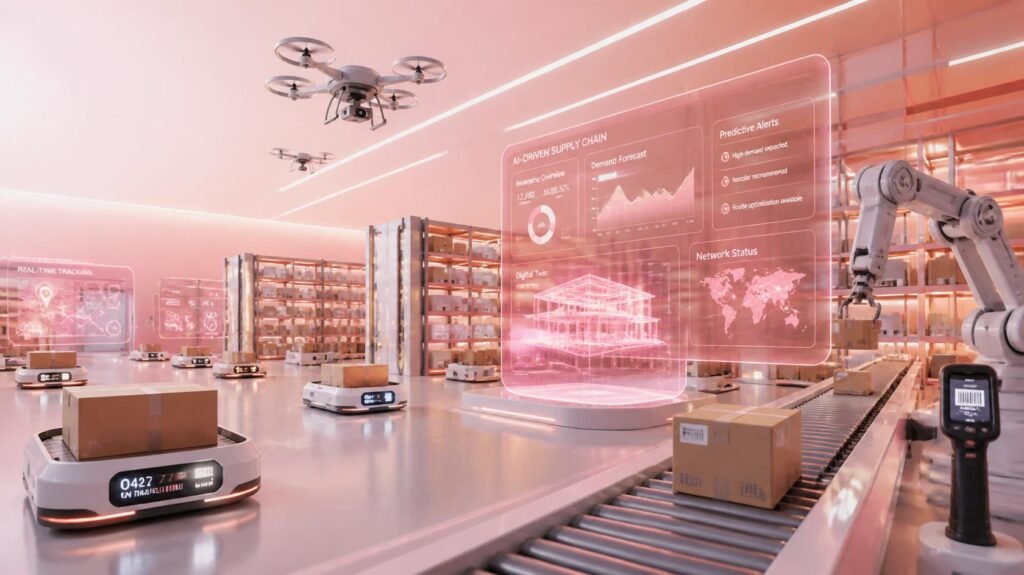
AI helps supply chain management professionals to overcome the need for gut feelings and base their decisions on data. Thanks to its ability to process massive amounts of data within seconds, AI helps discover trends and even predict any possible disruptions and what would be the most efficient course of action in that situation.
For instance, in case of an increase in demand for a product, AI will recommend making necessary changes to production plans, reorganizing warehouse inventory and delivery plans in order to react to the change without interrupting other operations.
Moreover, AI-based dashboards allow decision-makers to see real-time information about inventory level, performance of suppliers, transportation, and demand from customers.
Benefits of AI in Supply Chain Management
Artificial Intelligence provides tangible gains at all stages of the supply chain process through automation of tedious tasks, analysis of big data, and provision of real-time information. This helps businesses work efficiently and improve customers’ satisfaction.
Below are some of the main gains that organizations enjoy due to implementation of Artificial Intelligence into their supply chain management process.
1. Enhanced Demand Forecast
Demand forecast is necessary for correct inventory control and satisfaction of the customer needs. Artificial Intelligence performs an analysis of historical data, seasonality, customers’ behavior, market situation, and other factors to predict the demand accurately.
Enhanced forecasting allows businesses to keep the required levels of inventory without either surplus or shortages of goods.
2. Enhanced Inventory Control
The use of Artificial Intelligence in monitoring inventory levels helps to order products at the required time. Organizations can keep the optimal level of inventory.
This leads to:
- Lower inventory holding costs
- Reduced waste
- Improved warehouse efficiency
- Better product availability
3. Faster Decision-Making
In traditional supply chain management decision-making, there is usually the need for manual assessment of various reports and spreadsheets. However, artificial intelligence can process millions of data points in seconds and generate actionable insights.
Decision-makers get alerts in time regarding customer needs and preferences, supplier performance, and transportation disruptions.
4. Lower Costs
The use of AI technology means that organizations can automate repetitive tasks such as inventory management, order processing, route planning, and warehousing. As a result, businesses can save on labor costs, reduce errors, and enhance operational efficiency.
Moreover, companies can cut costs by making effective forecasts about the demand, transportation, and maintenance operations.
5. Improved Customer Experience
Customers nowadays want quick delivery and order processing together with timely shipments. The use of artificial intelligence in business helps to satisfy these expectations of clients by improving inventory availability and optimizing delivery routes.
Improved customer experience results in better relations with customers and increased customer loyalty.
6. Higher Supply Chain Visibility
The technology gathers information from suppliers, transportation, warehouses, and inventory databases.
Real-time visibility means continuous monitoring of business operations, and identification of any possible bottleneck.
Key Applications of AI in Supply Chain Management
Several advanced technologies work together to create intelligent supply chains.
| Technology | Primary Function |
|---|---|
| Machine Learning | Learns from historical data to improve predictions |
| Predictive Analytics | Forecasts demand and identifies potential risks |
| Natural Language Processing (NLP) | Processes supplier communications and customer feedback |
| Computer Vision | Detects damaged products and monitors warehouse inventory |
| Robotics | Automates picking, packing, and warehouse operations |
| Internet of Things (IoT) | Collects real-time data from sensors and connected devices |
| Digital Twins | Creates virtual models to simulate supply chain scenarios |
| Robotic Process Automation (RPA) | Automates repetitive administrative tasks |
These technologies enable organizations to build more agile, data-driven, and efficient supply chain operations.
Real-World Applications of AI in Supply Chain Management
AI is transforming supply chains across multiple industries by addressing unique operational challenges.
Retail
Retailers use AI to forecast customer demand, optimize inventory, personalize promotions, and reduce stock shortages during peak shopping seasons.
Manufacturing
Manufacturers rely on AI for predictive maintenance, production planning, quality control, and supplier risk analysis. These capabilities help minimize downtime and improve production efficiency.
E-Commerce
E-commerce companies use AI to recommend products, automate warehouse operations, optimize delivery routes, and improve order fulfillment speed.
Healthcare
Hospitals and pharmaceutical companies apply AI to manage medical inventory, forecast demand for critical supplies, and ensure timely delivery of essential products.
Food and Beverage
AI helps food manufacturers monitor inventory, reduce waste, predict demand, and maintain product quality throughout the supply chain.
Challenges of Implementing AI in Supply Chain Management
Although AI offers significant advantages, successful implementation requires careful planning and investment.
High Initial Investment
AI software, cloud infrastructure, sensors, and employee training require substantial upfront costs. Small and medium-sized businesses may face budget constraints during implementation.
Data Quality Issues
AI depends on accurate, complete, and consistent data. Poor-quality or outdated information can reduce forecasting accuracy and lead to incorrect business decisions.
Organizations should establish strong data governance practices before adopting AI solutions.
Integration with Legacy Systems
Many businesses still operate older supply chain systems that may not easily integrate with modern AI platforms.
Successful implementation often requires system upgrades, API integrations, or cloud migration.
Skills Gap
AI technologies require skilled professionals who understand data analytics, machine learning, and digital transformation.
Organizations must invest in employee training or hire experienced specialists to maximize the value of AI solutions.
Cybersecurity Risks
As supply chains become more connected through AI and IoT devices, cybersecurity becomes increasingly important.
Businesses should implement strong security measures, including encryption, access controls, and continuous monitoring, to protect sensitive operational data.
Future Trends of AI in Supply Chain Management
AI continues to evolve rapidly, and several emerging trends are expected to shape the future of supply chain management.
Autonomous Supply Chains
Future AI systems will automate many operational decisions with minimal human intervention, enabling faster responses to changing market conditions.
Hyper-Personalized Demand Forecasting
AI will analyze customer preferences, regional buying patterns, and external factors to generate highly personalized demand forecasts.
AI-Powered Sustainability
Organizations will use AI to reduce carbon emissions, optimize transportation routes, minimize waste, and improve energy efficiency across supply chain operations.
Advanced Digital Twins
Digital twin technology will become more sophisticated, allowing businesses to simulate supply chain scenarios before making operational decisions.
Human-AI Collaboration
Rather than replacing supply chain professionals, AI will support them by providing insights and recommendations while humans focus on strategic planning and relationship management.
Conclusion
Artificial Intelligence is fundamentally transforming supply chain management by enabling organizations to become more efficient, agile, and data-driven. From intelligent demand forecasting and inventory optimization to predictive maintenance, warehouse automation, and real-time logistics management, AI helps businesses make faster decisions while reducing costs and improving customer satisfaction.
As global supply chains continue to grow in complexity, organizations that embrace AI will be better equipped to manage disruptions, respond to market changes, and deliver superior customer experiences. While challenges such as implementation costs, data quality, and cybersecurity remain, the long-term benefits of AI far outweigh these obstacles.
Businesses that invest in AI today are laying the foundation for smarter, more resilient, and future-ready supply chains.
Frequently Asked Questions (FAQs)
1. What is AI in supply chain management?
AI in supply chain management refers to the use of artificial intelligence technologies to automate processes, improve forecasting, optimize inventory, enhance logistics, and support data-driven decision-making.
2. How does AI improve demand forecasting?
AI analyzes historical sales, market trends, customer behavior, weather patterns, and external factors to generate more accurate demand forecasts than traditional forecasting methods.
3. What are the biggest benefits of AI in supply chain management?
Key benefits include improved forecasting, inventory optimization, reduced operational costs, better decision-making, enhanced customer satisfaction, and increased supply chain visibility.
4. Which industries use AI in supply chain management?
Industries such as retail, manufacturing, healthcare, logistics, food and beverage, automotive, and e-commerce widely use AI to improve supply chain performance.
5. Can AI reduce supply chain costs?
Yes. AI helps reduce costs by automating routine tasks, optimizing transportation routes, minimizing inventory waste, improving maintenance planning, and increasing operational efficiency.
6. What technologies support AI-powered supply chains?
Machine learning, predictive analytics, computer vision, natural language processing (NLP), robotics, IoT, digital twins, and robotic process automation (RPA) are commonly used technologies.
7. What challenges do businesses face when adopting AI?
Common challenges include high implementation costs, poor data quality, integration with legacy systems, cybersecurity risks, and the need for skilled professionals.
8. What is the future of AI in supply chain management?
Future developments include autonomous supply chains, AI-driven sustainability initiatives, advanced digital twins, hyper-personalized forecasting, and stronger collaboration between humans and AI systems.