

Artificial intelligence has rapidly moved beyond assisting sales professionals with isolated tasks. Today, businesses are entering a new era where intelligent software can actively participate in revenue generation instead of simply supporting it. These advanced systems, known as AI Revenue Agents, are changing how organizations discover prospects, qualify leads, engage customers, manage pipelines, and forecast revenue.
For years, sales automation focused on eliminating repetitive activities such as sending emails, updating CRM records, scheduling meetings, or creating reports. While these improvements increased efficiency, they still depended heavily on human intervention for decision-making. AI Revenue Agents represent a much larger shift. They combine artificial intelligence, automation, machine learning, natural language processing, predictive analytics, and reasoning capabilities to make informed decisions and execute entire sales workflows with minimal human involvement.
Businesses operating in competitive B2B markets face increasing pressure to respond faster to buyers, personalize every interaction, shorten sales cycles, and improve forecasting accuracy. Buyers also expect immediate responses regardless of time zones or business hours. Meeting these expectations manually becomes difficult as companies scale.
This growing complexity has created an environment where autonomous AI systems are becoming essential rather than optional. Instead of acting like simple chatbots or rule-based automation tools, AI Revenue Agents continuously analyze customer behavior, evaluate sales opportunities, recommend next actions, communicate with prospects, and learn from every interaction.
The emergence of generative AI, large language models, enterprise knowledge graphs, and autonomous AI frameworks has accelerated this transformation. Organizations are beginning to build digital sales teams where human representatives collaborate with AI agents that handle research, qualification, follow-ups, proposal preparation, CRM management, forecasting, and pipeline optimization simultaneously.
As organizations pursue greater operational efficiency and sustainable revenue growth, AI Revenue Agents are becoming one of the most significant innovations in modern SalesTech.

Understanding AI Revenue Agents
An AI Revenue Agent is an intelligent software system designed to perform revenue-generating activities across the sales lifecycle with minimal supervision. Unlike traditional automation software that follows predefined workflows, AI Revenue Agents analyze situations, make context-aware decisions, adapt to changing customer behavior, and continuously improve through data-driven learning.
Instead of waiting for a salesperson to initiate every action, these agents proactively identify opportunities and execute tasks that contribute directly to business growth.
An AI Revenue Agent can:
- Discover potential customers
- Research companies automatically
- Analyze buying intent
- Prioritize qualified leads
- Personalize outreach
- Respond to customer inquiries
- Schedule meetings
- Update CRM systems
- Recommend pricing strategies
- Predict deal outcomes
- Monitor pipeline health
- Generate reports
- Suggest next-best actions
This level of autonomy allows sales professionals to spend more time building relationships and closing strategic opportunities instead of performing repetitive administrative work.
Traditional sales software often requires users to manually configure workflows, create rules, and trigger automations. AI Revenue Agents operate differently because they continuously evaluate incoming information before determining the most appropriate action.
Rather than replacing sales teams, these systems function as intelligent digital teammates capable of handling thousands of parallel activities without fatigue.
Why Businesses Are Adopting AI Revenue Agents
Sales organizations generate enormous amounts of information every day. Customer conversations, CRM updates, website visits, product demonstrations, emails, proposals, support interactions, marketing campaigns, pricing discussions, and purchasing signals all contribute valuable insights.
Unfortunately, most organizations struggle to convert this growing volume of information into timely decisions.
Sales representatives often spend significant portions of their workday performing non-selling activities. Administrative updates, manual prospect research, CRM maintenance, meeting scheduling, proposal generation, and follow-up emails consume valuable hours that could otherwise be invested in customer engagement.
AI Revenue Agents solve this challenge by continuously monitoring every available data source and executing routine revenue tasks automatically.
Several business factors have accelerated adoption:
| Business Challenge | Traditional Approach | AI Revenue Agent Solution |
|---|---|---|
| Manual prospect research | Hours of research | Automated company analysis |
| Delayed lead response | Human availability | Instant engagement |
| CRM data quality | Manual updates | Automatic synchronization |
| Sales forecasting | Historical estimates | Predictive AI forecasting |
| Lead prioritization | Basic scoring | Dynamic AI qualification |
| Follow-up consistency | Human reminders | Continuous autonomous engagement |
Beyond operational efficiency, businesses recognize another major advantage. AI Revenue Agents create consistency across the sales organization.
Human performance naturally varies due to workload, experience, and availability. AI systems execute standardized processes continuously, reducing variability while improving customer experience.
How AI Revenue Agents Differ from Traditional Sales Automation
Although both technologies improve efficiency, they operate in fundamentally different ways.
Traditional sales automation focuses on executing predefined instructions.
Examples include:
- Send an email after form submission.
- Assign a lead based on territory.
- Create a CRM task after a meeting.
- Notify a manager when a deal exceeds a certain value.
These workflows require humans to define every condition before automation occurs.
AI Revenue Agents behave differently because they analyze context before deciding what action should be taken.
Instead of following static rules, they answer questions such as:
- Which prospect is most likely to convert today?
- Which customer requires immediate attention?
- What messaging should be personalized?
- Which deal presents the highest risk?
- What pricing strategy maximizes closing probability?
- Which account should receive executive involvement?
This reasoning capability enables much more sophisticated automation.
Table: Traditional Automation vs AI Revenue Agents
| Feature | Traditional Sales Automation | AI Revenue Agents |
|---|---|---|
| Decision Making | Rule-based | Context-aware AI |
| Learning Ability | None | Continuous learning |
| Personalization | Limited | Highly personalized |
| CRM Updates | Manual workflows | Automatic |
| Lead Qualification | Static scoring | Dynamic evaluation |
| Forecasting | Historical analysis | Predictive intelligence |
| Customer Communication | Templates | AI-generated conversations |
| Pipeline Management | Manual reviews | Continuous optimization |
As AI models improve, this gap continues to widen.
Modern AI Revenue Agents increasingly perform tasks previously considered exclusive to experienced sales professionals.
Core Technologies Behind AI Revenue Agents
AI Revenue Agents are not powered by a single technology. Instead, they combine several advanced artificial intelligence capabilities that work together to understand customers, analyze data, make decisions, and execute actions.
Understanding these technologies helps explain why AI Revenue Agents are becoming significantly more capable than earlier automation tools.
Machine Learning
Machine learning enables AI Revenue Agents to recognize patterns from historical sales data.
Rather than relying solely on predefined rules, machine learning identifies relationships between customer behavior and successful outcomes.
For example, the system may discover that companies with specific employee counts, industries, funding stages, website activity, and buying signals convert at significantly higher rates.
These insights continuously improve lead prioritization.
Natural Language Processing
Sales communication revolves around language.
Emails, proposals, customer meetings, CRM notes, chat conversations, contracts, and support tickets all contain valuable information.
Natural Language Processing (NLP) allows AI Revenue Agents to understand these conversations.
Instead of simply identifying keywords, NLP extracts customer intent, sentiment, urgency, objections, competitive mentions, purchasing timelines, and decision-maker roles.
This deeper understanding allows AI agents to personalize future interactions.
Generative AI
Generative AI enables AI Revenue Agents to create high-quality content in real time.
Rather than selecting predefined templates, these systems can generate:
- Personalized emails
- Follow-up sequences
- Meeting summaries
- Sales proposals
- Product recommendations
- Customer responses
- Opportunity summaries
Every communication becomes context-aware instead of generic.
Predictive Analytics
Sales leaders depend heavily on forecasting.
Predictive analytics allows AI Revenue Agents to estimate future outcomes based on historical performance combined with current customer behavior.
Instead of relying solely on sales representative opinions, AI evaluates hundreds of variables simultaneously.
These forecasts become increasingly accurate as additional sales data becomes available.
Knowledge Graphs
Enterprise organizations store information across numerous systems.
Knowledge graphs connect these separate data sources into a unified understanding of customers.
AI Revenue Agents can therefore recognize relationships between contacts, departments, opportunities, previous purchases, support interactions, contracts, marketing campaigns, and buying committees.
This comprehensive perspective significantly improves decision-making.
The Evolution of Revenue Generation
Revenue generation has changed dramatically over the past three decades.
Initially, sales organizations relied almost entirely on manual outreach, spreadsheets, physical meetings, and phone calls. CRM platforms later introduced centralized customer management, followed by marketing automation, sales engagement platforms, predictive analytics, and conversational intelligence.
Today, businesses are entering the next stage of this evolution.
Instead of using software merely to assist human representatives, organizations are deploying autonomous AI systems capable of independently performing many revenue-generating activities.
| Sales Era | Primary Technology | Characteristics |
|---|---|---|
| Traditional Sales | Phone, Email, Spreadsheets | Entirely manual processes |
| CRM Era | Customer Relationship Management | Centralized customer data |
| Automation Era | Workflow Automation | Rule-based task execution |
| Intelligence Era | Predictive Analytics | Data-driven recommendations |
| Autonomous Revenue Era | AI Revenue Agents | Intelligent decision-making, continuous optimization, autonomous execution |
This progression illustrates why AI Revenue Agents are viewed as the next major milestone in SalesTech rather than simply another automation tool.

How AI Revenue Agents Transform Every Stage of the Sales Funnel
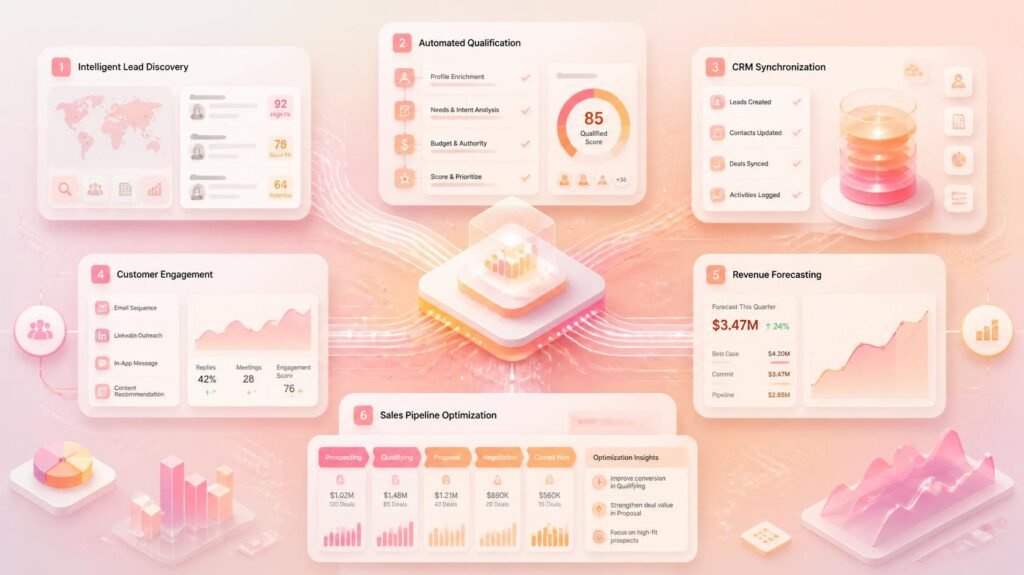
One of the biggest advantages of AI Revenue Agents is that they are not limited to a single phase of the customer journey. Traditional sales tools often specialize in one function—such as email automation, lead management, or forecasting. AI Revenue Agents, however, operate across the entire revenue lifecycle, ensuring that every stage of the funnel benefits from intelligent decision-making.
This end-to-end approach helps organizations eliminate gaps between marketing, sales development, account executives, customer success, and revenue operations. Instead of working in isolated systems, AI Revenue Agents create a connected workflow where data, insights, and actions flow continuously.
The journey begins long before a prospect fills out a form or schedules a meeting. AI agents monitor market signals, identify companies showing purchase intent, and build prospect lists based on predefined ideal customer profiles. They gather information from websites, business databases, social platforms, hiring trends, funding announcements, and other public sources to determine whether an organization is likely to become a customer.
Major Benefits of AI Revenue Agents
Organizations adopting AI Revenue Agents often experience improvements across multiple business functions rather than a single department. While revenue growth remains the primary objective, companies also report gains in productivity, customer experience, forecasting accuracy, operational efficiency, and employee satisfaction.
One of the most immediate benefits is the reduction of repetitive work.
Sales professionals frequently spend large portions of their day updating CRM records, scheduling meetings, writing follow-up emails, researching prospects, preparing reports, and organizing customer information. These tasks are necessary but do not directly generate revenue.
AI Revenue Agents automate much of this work, allowing sales teams to dedicate more time to relationship building and strategic selling.
Another significant advantage is speed.
Modern buyers expect responses within minutes rather than hours. Delayed communication often results in lost opportunities, especially in competitive industries where multiple vendors compete for the same customer.
AI Revenue Agents operate around the clock, engaging prospects instantly regardless of business hours or geographic location.
Consistency is another critical benefit.
Human performance naturally varies depending on workload, experience, and external factors. AI systems execute defined processes consistently, ensuring that every prospect receives timely follow-ups, personalized communication, and accurate information.
Organizations also benefit from improved forecasting.
Traditional forecasting relies heavily on sales representatives’ opinions and historical averages. AI Revenue Agents analyze real-time pipeline activity, engagement signals, market conditions, and historical trends to generate more reliable revenue predictions.
Perhaps the greatest long-term advantage is continuous learning.
Every customer interaction becomes training data that helps improve future recommendations, outreach strategies, and decision-making. Over time, AI Revenue Agents become increasingly accurate as they process larger volumes of business information.
Business Benefits of AI Revenue Agents
| Business Objective | Traditional Sales Process | AI Revenue Agent Impact |
|---|---|---|
| Lead Response Time | Several hours | Immediate engagement |
| Prospect Research | Manual investigation | Automated intelligence gathering |
| CRM Management | Manual data entry | Continuous automatic updates |
| Email Personalization | Basic templates | Dynamic AI-generated messaging |
| Sales Forecasting | Historical estimates | Predictive AI models |
| Opportunity Management | Periodic reviews | Continuous monitoring |
| Pipeline Visibility | Limited | Real-time insights |
| Sales Productivity | Administrative workload | More customer-facing time |

Essential Features of AI Revenue Agents
Although different vendors offer different capabilities, the most effective AI Revenue Agents share several core features that enable autonomous revenue generation.
Intelligent Lead Discovery
Instead of relying solely on inbound leads, AI Revenue Agents continuously search for businesses that match an organization’s ideal customer profile.
They evaluate factors such as:
- Industry
- Company size
- Revenue
- Hiring activity
- Technology stack
- Funding history
- Geographic location
- Buying signals
- Online engagement
This proactive approach allows sales teams to identify opportunities before competitors.
Dynamic Lead Qualification
Traditional lead scoring systems often become outdated because they depend on predefined rules.
AI Revenue Agents continuously reassess each prospect based on new information.
If a company’s engagement suddenly increases, the lead score automatically improves.
If activity declines, priorities shift accordingly.
This ensures that sales representatives always receive the most relevant opportunities.
Personalized Outreach
Generic email campaigns are becoming increasingly ineffective.
AI Revenue Agents generate personalized communications tailored to each prospect.
Instead of inserting only a company name into a template, AI considers:
- Industry challenges
- Recent company news
- Previous interactions
- Product interests
- Customer pain points
- Buying stage
- Decision-maker role
The result is communication that feels significantly more relevant.
Automated CRM Management
CRM quality remains one of the biggest challenges facing sales organizations.
Incomplete records reduce forecasting accuracy and create operational inefficiencies.
AI Revenue Agents automatically update customer records after meetings, emails, calls, and website interactions.
Sales professionals no longer need to spend valuable time entering information manually.
Pipeline Optimization
Rather than waiting for weekly pipeline reviews, AI Revenue Agents continuously evaluate opportunity health.
Potential risks are identified early.
Examples include:
- Reduced customer engagement
- Delayed decision timelines
- Missing stakeholders
- Competitive threats
- Pricing concerns
- Communication gaps
Managers receive recommendations before opportunities are lost.
Revenue Forecasting
AI Revenue Agents combine historical sales performance with current pipeline behavior to estimate future revenue.
Unlike spreadsheet forecasting, AI evaluates hundreds of variables simultaneously.
This improves planning across finance, operations, inventory management, and executive leadership.
Core Capabilities of AI Revenue Agents
| Capability | Business Value |
|---|---|
| Lead Discovery | Expands qualified pipeline |
| Lead Qualification | Prioritizes high-conversion opportunities |
| Personalized Outreach | Increases engagement rates |
| CRM Automation | Improves data accuracy |
| Meeting Scheduling | Accelerates customer interactions |
| Proposal Generation | Reduces administrative work |
| Pipeline Monitoring | Identifies deal risks early |
| Revenue Forecasting | Improves strategic planning |
Real-World Applications Across Industries
Although AI Revenue Agents are frequently associated with software companies, their applications extend across nearly every industry.
SaaS Companies
Software businesses often manage thousands of leads each month.
AI Revenue Agents automatically identify product-qualified leads, recommend upselling opportunities, personalize onboarding communications, and predict customer expansion potential.
This helps SaaS companies improve both acquisition and retention.
Manufacturing
Manufacturers frequently operate with long sales cycles involving multiple stakeholders.
AI Revenue Agents monitor buying committees, schedule follow-ups, analyze procurement timelines, and ensure that every participant receives relevant information throughout the purchasing journey.
Financial Services
Banks, insurance providers, and financial institutions handle complex customer relationships.
AI Revenue Agents assist advisors by identifying cross-selling opportunities, monitoring customer behavior, scheduling consultations, and recommending financial products based on individual needs.
Healthcare Technology
Healthcare organizations often require extensive product demonstrations, compliance documentation, and long purchasing processes.
AI Revenue Agents coordinate stakeholder communication, track regulatory milestones, and maintain consistent engagement throughout lengthy sales cycles.
Professional Services
Consulting firms, legal practices, accounting companies, and marketing agencies benefit from AI Revenue Agents by automating proposal generation, managing client communications, and identifying expansion opportunities among existing customers.
E-commerce B2B
Wholesale distributors use AI Revenue Agents to recommend products, monitor purchasing frequency, identify inventory trends, and re-engage inactive buyers before competitors do.
| Industry | Primary AI Revenue Agent Use Case |
|---|---|
| SaaS | Lead qualification and customer expansion |
| Manufacturing | Complex opportunity management |
| Healthcare | Multi-stakeholder sales coordination |
| Financial Services | Cross-selling and relationship management |
| Consulting | Proposal automation and client engagement |
| Telecommunications | Enterprise account management |
| Logistics | Contract renewal optimization |
| Wholesale Distribution | Purchase prediction and reorder automation |
AI Revenue Agents and Revenue Operations (RevOps)
Revenue Operations has emerged as one of the fastest-growing disciplines in modern business.
Rather than allowing marketing, sales, customer success, and finance to operate independently, RevOps aligns every revenue-generating function under shared goals, unified data, and standardized processes.
AI Revenue Agents strengthen this alignment by acting as intelligent connectors between departments.
For example, when marketing generates a highly engaged lead, the AI Revenue Agent immediately shares relevant information with the sales team. As the opportunity progresses, finance gains visibility into projected revenue, while customer success prepares onboarding resources even before the deal closes.
This continuous flow of information reduces operational friction and improves collaboration.
Revenue leaders also benefit from unified reporting.
Instead of compiling data from multiple platforms, AI Revenue Agents generate comprehensive dashboards that provide real-time visibility into pipeline health, conversion rates, customer engagement, forecast accuracy, and revenue trends.
As organizations continue investing in RevOps strategies, AI Revenue Agents are becoming central to maintaining alignment between teams while accelerating business growth.
Implementing AI Revenue Agents: A Step-by-Step Guide
Introducing AI Revenue Agents into a sales organization is not simply a technology upgrade. It is a transformation in how revenue teams operate, collaborate, and make decisions. Organizations that achieve the best results treat implementation as a strategic initiative involving sales leadership, marketing, revenue operations, customer success, IT, and data teams.
Most successful implementations follow these stages:
- Define clear revenue goals and KPIs.
- Audit CRM and customer data quality.
- Identify repetitive sales workflows suitable for automation.
- Integrate the AI Revenue Agent with existing sales tools.
- Launch a pilot program with a small team.
- Measure results and optimize continuously.
Many companies assume that deploying an AI Revenue Agent means replacing their existing CRM or sales software. In reality, most AI Revenue Agents integrate with current business systems, enriching existing workflows rather than disrupting them.
Common Challenges When Adopting AI Revenue Agents
Although AI Revenue Agents offer significant advantages, implementation is not without challenges. Understanding these obstacles allows organizations to prepare effectively and reduce implementation risks.
The most common implementation challenges include:
- Poor CRM data quality.
- Resistance from sales teams.
- Integration with legacy software.
- Privacy and compliance concerns.
- Unrealistic expectations about AI capabilities.
- Limited AI knowledge within the organization.
Sales leaders that address these issues early generally experience faster adoption and better ROI.
Best Practices for Maximizing ROI
Organizations that achieve the highest return on investment rarely depend on AI alone. Instead, they combine intelligent automation with experienced sales professionals, structured processes, and high-quality customer data.
To maximize ROI, organizations should:
- Keep humans involved in strategic sales decisions.
- Monitor AI performance regularly.
- Train employees to interpret AI recommendations.
- Personalize outreach instead of relying on generic templates.
- Align marketing, sales, and customer success around shared revenue goals.
- Continuously refine AI models using new customer data.
AI Revenue Agents and the Modern Sales Team
Contrary to common misconceptions, AI Revenue Agents are not replacing sales professionals. Instead, they are changing the nature of sales work.
Sales professionals can now spend more time on activities that directly influence revenue, such as:
- Building relationships with decision-makers.
- Conducting product demonstrations.
- Negotiating enterprise contracts.
- Creating account growth strategies.
- Expanding existing customer relationships.
Meanwhile, AI handles administrative work like CRM updates, lead research, scheduling, forecasting, and routine follow-ups.
Measuring Success After Deployment
Once AI Revenue Agents are deployed, organizations should monitor performance continuously rather than relying only on revenue growth.
Important KPIs include:
- Lead response time.
- Lead qualification accuracy.
- Pipeline velocity.
- Forecast accuracy.
- CRM data completeness.
- Customer engagement rate.
- Sales cycle length.
- Revenue growth.
These metrics provide a comprehensive view of how AI contributes to operational efficiency and business performance.
The Future of AI Revenue Agents
The next generation of AI Revenue Agents will move beyond task automation to become collaborative digital teammates capable of handling increasingly complex revenue processes.
Future innovations are expected to include:
- Multi-agent AI systems working together.
- Voice-enabled revenue assistants.
- Real-time buying intent analysis.
- Autonomous proposal and contract generation.
- AI-driven pricing optimization.
- Predictive customer expansion recommendations.
- Explainable AI for greater transparency.
- Stronger privacy and governance capabilities.
These advancements will enable businesses to create highly efficient, data-driven sales organizations while maintaining the human relationships that remain essential in B2B selling.
Conclusion
Artificial intelligence has already transformed the way businesses approach customer engagement, marketing automation, and data analysis. AI Revenue Agents represent the next stage of that evolution by moving beyond simple automation and becoming active participants in the revenue generation process. Instead of only supporting sales teams, these intelligent systems help identify opportunities, engage prospects, optimize pipelines, improve forecasting, and recommend actions that directly contribute to business growth.
For modern B2B organizations, speed, personalization, and data-driven decision-making are no longer competitive advantages they are business requirements. Buyers expect immediate responses, tailored communication, and seamless experiences throughout the purchasing journey. AI Revenue Agents make it possible to meet these expectations at scale while reducing the administrative burden on sales professionals.
However, successful implementation requires more than deploying new technology. Organizations must invest in high-quality data, establish clear governance policies, train employees, and continuously monitor performance. Businesses that combine AI capabilities with the expertise of experienced sales professionals will be better positioned to build stronger customer relationships and achieve sustainable revenue growth.
Frequently Asked Questions
1. What are AI Revenue Agents?
AI Revenue Agents are intelligent software systems that automate and optimize revenue-generating activities across the sales lifecycle. They can identify prospects, qualify leads, personalize outreach, update CRM records, forecast revenue, and recommend next-best actions with minimal human intervention.
2. How are AI Revenue Agents different from traditional sales automation?
Traditional sales automation follows predefined rules, such as sending emails or assigning leads based on fixed conditions. AI Revenue Agents use machine learning, predictive analytics, and generative AI to analyze context, make decisions, and continuously improve their performance.
3. Can AI Revenue Agents replace human sales representatives?
No. AI Revenue Agents are designed to support sales teams rather than replace them. They automate repetitive tasks and provide intelligent recommendations, allowing sales professionals to focus on relationship building, negotiations, and strategic selling.
4. Do AI Revenue Agents integrate with existing CRM platforms?
Yes. Most modern AI Revenue Agents integrate with popular CRM platforms, marketing automation software, communication tools, and customer support systems, enabling organizations to enhance existing workflows without replacing their current technology stack.
5. How do AI Revenue Agents improve revenue forecasting?
AI Revenue Agents analyze historical sales data, customer behavior, engagement signals, pipeline activity, and market trends to generate more accurate forecasts than traditional spreadsheet-based methods.