
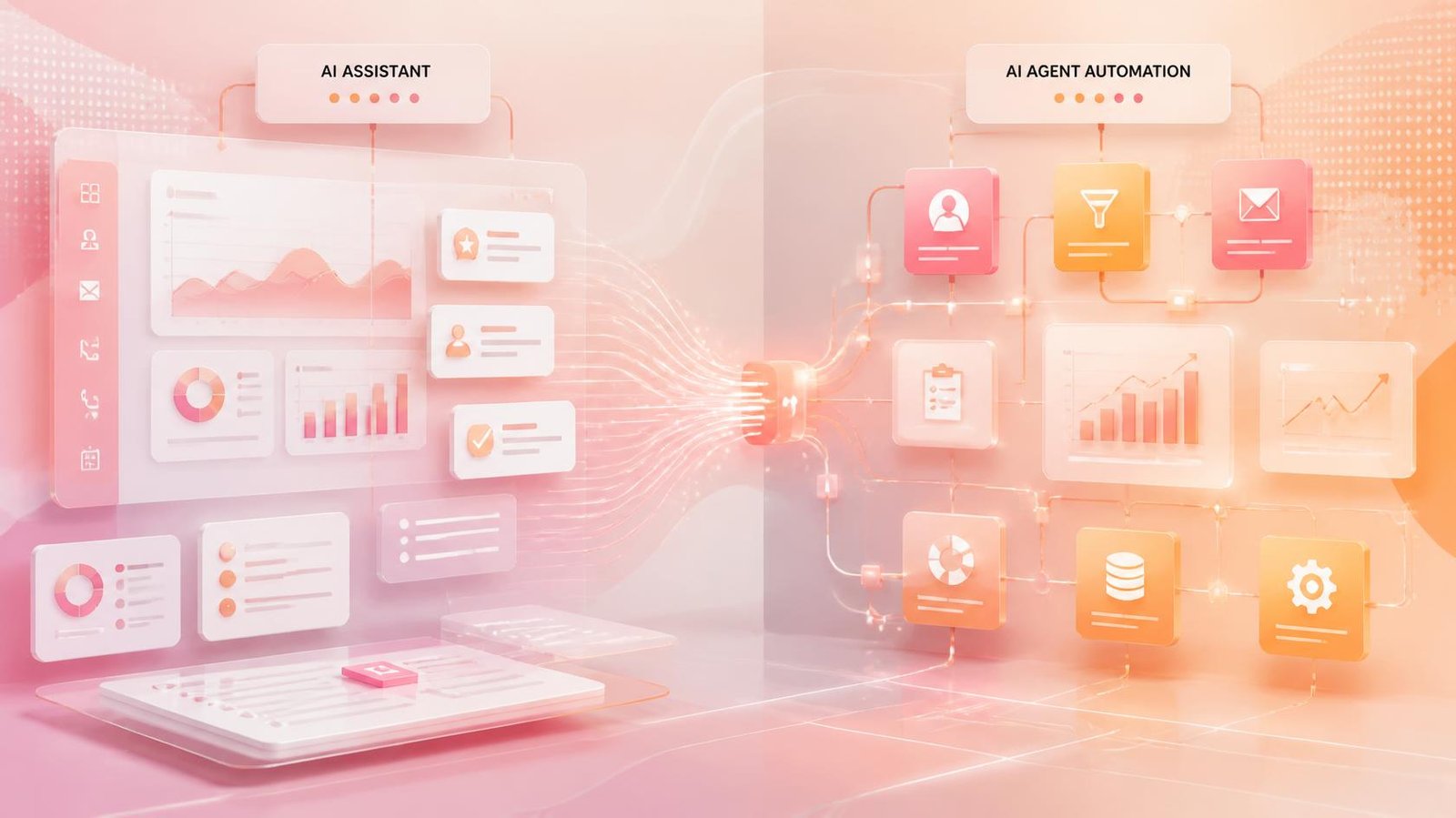
Artificial intelligence is changing how modern sales teams manage prospects, customer interactions, workflows, and revenue operations. Two technologies receiving significant attention are AI Agent Automation and AI assistants. Although they are often used interchangeably, they serve very different purposes in a sales environment.
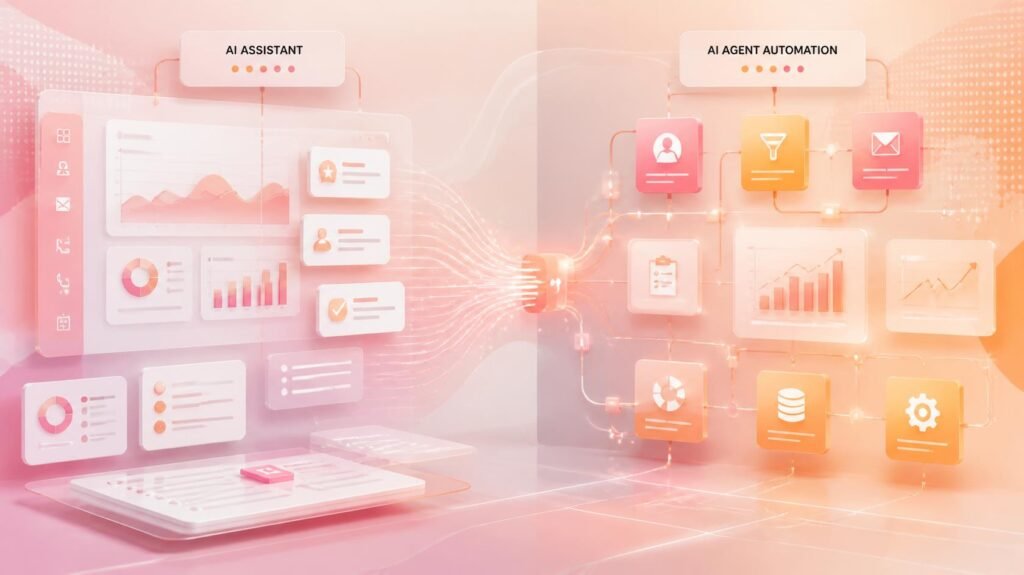
AI assistants are primarily designed to support people by providing information, generating content, answering questions, and helping with individual tasks. AI agents, on the other hand, can take a more autonomous approach by planning actions, interacting with business systems, executing workflows, and adapting to changing conditions.
Understanding the difference between AI Agent Automation vs AI Assistants is important for sales leaders deciding where AI should fit into their technology stack. The right approach can reduce repetitive work, improve sales productivity, accelerate response times, and create more scalable revenue operations.
What Is AI Agent Automation?
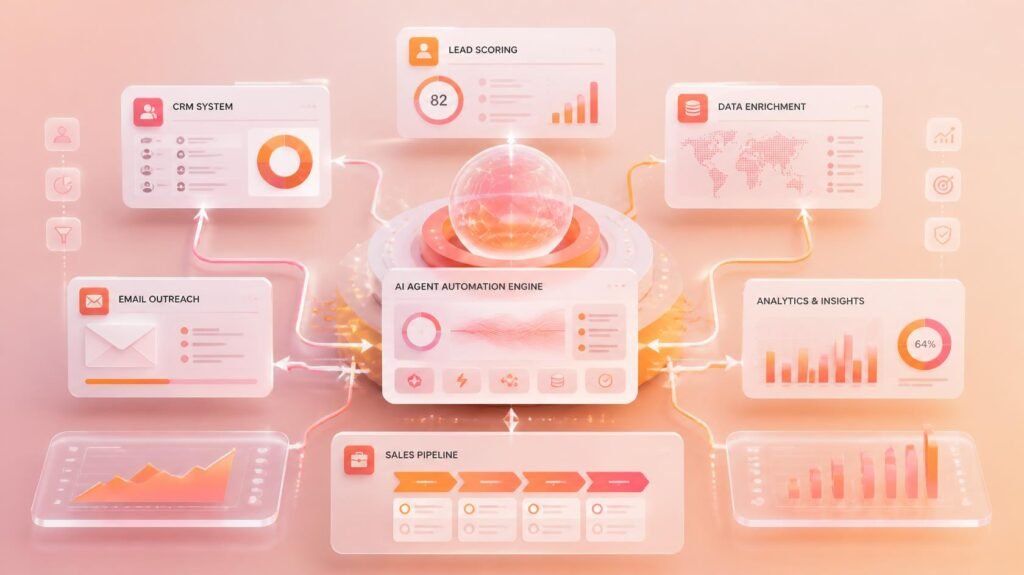
AI Agent Automation combines artificial intelligence with automated workflows to enable AI agents to perform tasks with limited human intervention. Instead of simply responding to a prompt, an AI agent can understand an objective, determine the steps required, use connected tools, execute actions, and evaluate the results.
For example, a sales AI agent could receive a new inbound lead, analyze the lead’s information, research the company, determine whether the prospect matches the ideal customer profile, update the CRM, personalize an outreach message, and route the lead to the appropriate salesperson.
The key difference is action and autonomy. AI Agent Automation is designed to move work forward rather than simply provide suggestions.
Key Characteristics of AI Agent Automation
- Executes multi-step workflows
- Connects with CRM and sales platforms
- Makes decisions based on predefined rules and context
- Performs repetitive tasks automatically
- Can interact with multiple business applications
- Handles workflow exceptions within defined boundaries
- Works toward a specific business objective
- Can operate continuously without requiring a prompt for every action
What Are AI Assistants?
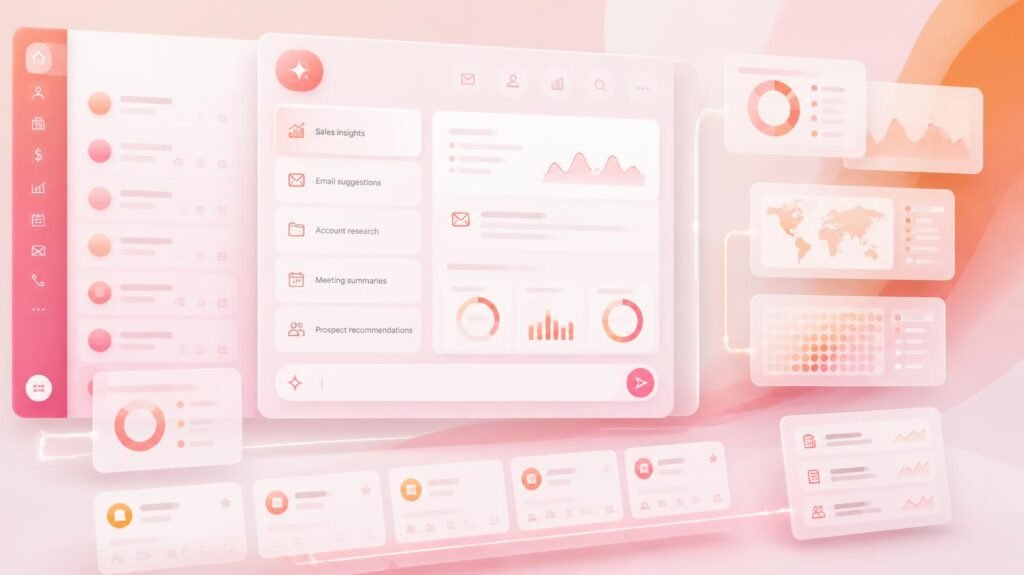
AI assistants are software tools designed to help people complete tasks more efficiently. They can answer questions, summarize information, create content, analyze data, draft emails, generate sales scripts, and provide recommendations.
For sales professionals, an AI assistant might help write a personalized follow-up email after a sales meeting. It could also summarize a customer conversation or suggest questions for an upcoming discovery call.
However, the salesperson generally remains responsible for reviewing the output and deciding what happens next.
Common AI Assistant Capabilities
- Writing and editing emails
- Summarizing meetings
- Answering sales questions
- Generating content
- Creating sales scripts
- Providing recommendations
- Analyzing information
- Preparing reports
- Supporting research
- Helping sales representatives make decisions
AI Agent Automation vs AI Assistants: The Core Difference
The simplest way to understand the distinction is this:
AI assistants help people perform tasks, while AI agents can perform tasks and coordinate workflows toward a goal.
An assistant may tell a salesperson which leads require attention. An AI agent can potentially identify those leads, prioritize them, update the CRM, trigger outreach, and notify the salesperson.
| Feature | AI Assistants | AI Agent Automation |
|---|---|---|
| Primary purpose | Assist users | Execute workflows |
| Human involvement | Usually high | Lower for routine workflows |
| Task execution | Limited | Extensive |
| Autonomy | Low to moderate | Moderate to high |
| CRM actions | Often user initiated | Can be automated |
| Multi-step workflows | Limited | Strong capability |
| Decision-making | Recommendations | Context-based actions |
| Tool integration | Moderate | Extensive |
| Continuous operation | Usually limited | Can operate continuously |
| Best use | Individual productivity | End-to-end process automation |
How AI Assistants Work in Sales
AI assistants typically operate as a human-in-the-loop technology. A salesperson provides an instruction, question, or piece of information, and the assistant generates an output.
For example, a salesperson might ask an AI assistant to create a follow-up email for a prospect who attended a product demonstration. The assistant analyzes the available context and generates an email that the salesperson can review and send.
This approach is valuable because it keeps the salesperson in control while reducing the time required for content creation and research.
Example Sales Assistant Workflow
Salesperson → AI Assistant → Recommendation/Content → Human Review → Action
This workflow is especially useful when the activity requires creativity, judgment, or relationship management.
How AI Agent Automation Works in Sales
AI Agent Automation takes the workflow further by allowing an AI agent to execute multiple actions.
Consider a new lead entering a company’s CRM. Instead of simply notifying a salesperson, an AI agent could perform several steps automatically.
Example
New Lead → Data Enrichment → ICP Analysis → Lead Scoring → CRM Update → Personalized Outreach → Sales Rep Notification
The agent can use information from different systems and execute predefined actions based on the results.
This can significantly reduce the number of manual steps sales representatives need to perform.
AI Agent Automation in Lead Management
Lead management is one of the strongest use cases for AI Agent Automation.
Traditional lead management often requires sales teams to manually review lead information, research companies, assign scores, update CRM records, and determine follow-up actions.
An AI agent can automate many of these repetitive activities.
For example, an agent can:
- Identify newly created leads
- Enrich company information
- Analyze job titles and industries
- Compare prospects against ICP criteria
- Assign lead scores
- Categorize prospects
- Update CRM fields
- Trigger appropriate workflows
- Alert sales representatives
- Initiate approved follow-up sequences
This allows sales representatives to spend more time on conversations instead of administrative work.
AI Assistants in Lead Management
AI assistants can also improve lead management, but their role is usually more supportive.
A salesperson could ask an AI assistant:
“Which of my leads should I prioritize today?”
The assistant can analyze available information and recommend prospects based on factors such as engagement, company size, industry, or previous interactions.
The salesperson then decides which lead to contact and what action to take.
This makes AI assistants particularly useful for decision support, while AI Agent Automation is better suited to workflow execution.
AI Agent Automation for Sales Outreach
Sales outreach involves many repetitive tasks, including prospect research, email personalization, follow-ups, CRM updates, and engagement tracking.
AI Agent Automation can connect these activities into a coordinated workflow.
For example, an AI agent can identify prospects that meet specific criteria, research their businesses, generate personalized messaging, and place prospects into an approved outreach workflow.
The sales team can establish rules that determine when the AI can act automatically and when human approval is required.
This creates a balance between automation and human oversight.
AI Assistants for Sales Outreach
AI assistants are highly useful for helping salespeople create better outreach.
A salesperson can provide prospect information and ask the assistant to create:
- Cold emails
- Follow-up emails
- LinkedIn messages
- Call scripts
- Meeting agendas
- Proposal drafts
- Account research summaries
The salesperson reviews the content before sending it.
This approach can improve productivity without giving AI complete control over customer communication.
AI Agent Automation vs AI Assistants for CRM
CRM management is another important area where the two technologies differ.
AI assistants can help salespeople understand CRM data, summarize accounts, or identify missing information.
AI agents can potentially take direct action inside the CRM.
| CRM Activity | AI Assistant | AI Agent Automation |
|---|---|---|
| Summarize account | ✓ | ✓ |
| Suggest next action | ✓ | ✓ |
| Draft CRM notes | ✓ | ✓ |
| Update CRM fields | Sometimes | ✓ |
| Assign leads | Limited | ✓ |
| Trigger workflows | Limited | ✓ |
| Monitor CRM events | Limited | ✓ |
| Execute multi-step actions | Limited | ✓ |
Benefits of AI Agent Automation for Sales Teams
AI Agent Automation can deliver several operational benefits when implemented correctly.
1. Reduces Repetitive Work
Sales teams often spend significant time on administrative tasks. Automating these activities allows representatives to focus on selling, relationship building, and strategic account management.
2. Improves Response Speed
Automated workflows can respond to certain events immediately. Faster responses can help sales teams engage prospects while their interest is still high.
3. Supports Sales Scalability
As lead volume increases, manually managing every workflow becomes difficult. AI agents can help sales organizations handle larger workloads without increasing administrative effort at the same rate.
4. Improves Workflow Consistency
Automated processes can follow predefined rules consistently. This can reduce the variation that occurs when different sales representatives manage similar processes in different ways.
5. Connects Sales Tools
Modern sales teams use CRM systems, marketing automation platforms, data enrichment tools, communication platforms, analytics systems, and other applications.
AI Agent Automation can help coordinate activities across these systems.
Benefits of AI Assistants for Sales Teams
AI assistants also provide significant value, particularly for individual productivity.
Faster Content Creation
Sales representatives can create emails, proposals, scripts, and summaries faster.
Better Research
AI assistants can summarize large amounts of information and help representatives prepare for customer conversations.
Improved Productivity
Instead of starting every task from scratch, salespeople can use AI to accelerate repetitive knowledge work.
Human Control
Sales representatives can review AI-generated outputs before making decisions or communicating with customers.
Better Sales Preparation
AI assistants can help prepare discovery questions, meeting summaries, account plans, and follow-up strategies.
When Should Sales Teams Use AI Assistants?
AI assistants are a strong choice when human judgment should remain central to the workflow.
They are particularly useful for:
- Content creation
- Sales research
- Meeting preparation
- Email drafting
- Account analysis
- Proposal creation
- Sales coaching
- Decision support
- Data summarization
If the goal is to help a salesperson work faster, an AI assistant may be the better starting point.
When Should Sales Teams Use AI Agent Automation?
AI Agent Automation becomes more valuable when the goal is to automate repeatable, multi-step processes.
It can be particularly useful for:
- Lead qualification
- Lead routing
- CRM management
- Data enrichment
- Sales follow-up workflows
- Account monitoring
- Pipeline administration
- Sales operations
- Customer onboarding
- Workflow coordination
If the goal is to automate a process rather than simply assist a person, AI Agent Automation is usually more appropriate.
AI Agent Automation and Human Oversight
Greater autonomy does not mean removing humans from sales operations.
Sales involves relationship building, negotiation, strategic decisions, pricing discussions, and sensitive customer interactions. These activities often require human judgment.
A practical model is to allow AI agents to handle routine activities while keeping humans responsible for high-impact decisions.
For example:
AI handles: lead enrichment, scoring, routing, scheduling, CRM updates, and routine follow-ups.
Humans handle: negotiations, strategic accounts, pricing exceptions, complex objections, and sensitive customer conversations.
This approach creates a more balanced sales automation strategy.
Challenges of AI Agent Automation
Despite its potential, AI Agent Automation also introduces challenges.
Data Quality
AI agents depend on reliable information. Poor CRM data can result in poor decisions and inaccurate actions.
Integration Complexity
Agents may need access to multiple business systems. Connecting these systems securely can require technical planning.
Governance
Organizations need clear rules around what agents can and cannot do.
Monitoring
Automated workflows should be monitored to identify unexpected behavior, errors, or unusual outcomes.
Human Escalation
Organizations should define when an AI agent must stop and transfer a task to a human.
Challenges of AI Assistants
AI assistants also have limitations.
They may generate inaccurate information, misunderstand context, or produce generic recommendations. Sales professionals therefore need to review important outputs.
Another limitation is that an assistant may not be able to execute the entire workflow. A salesperson may still need to copy information between systems or manually complete the next step.
This is where AI Agent Automation can provide a stronger operational advantage.
The Role of AI Agent Automation in Sales Technology
The sales technology landscape is moving toward more connected and intelligent workflows.
Instead of using separate tools for CRM management, lead research, outreach, analytics, and sales operations, organizations are increasingly looking for systems that can coordinate activities across the sales stack.
AI Agent Automation can become an orchestration layer that connects these systems.
For example:
CRM → AI Agent → Data Platform → Enrichment → Sales Automation → Analytics → CRM
The agent can coordinate the workflow while business rules determine the boundaries of its actions.
AI Assistants and AI Agents Can Work Together
The choice does not have to be AI Agent Automation vs AI Assistants.
Sales organizations can use both technologies together.
An AI assistant can support a salesperson directly, while AI agents automate the operational workflows surrounding that salesperson.
For example, an AI agent could identify and qualify a new opportunity. Once the opportunity reaches a certain stage, an AI assistant could help the salesperson prepare for the discovery call.
This creates a layered AI sales environment.
| Sales Function | Best Technology |
|---|---|
| Email drafting | AI Assistant |
| Meeting summaries | AI Assistant |
| Sales research | AI Assistant |
| Lead enrichment | AI Agent Automation |
| Lead routing | AI Agent Automation |
| CRM updates | AI Agent Automation |
| Complex negotiations | Human |
| Sales strategy | Human + AI Assistant |
| Multi-step workflow | AI Agent Automation |
AI Agent Automation vs AI Assistants: Which Is Better?
There is no universal winner.
The better technology depends on the business problem.
If a company wants to help employees work faster, AI assistants provide an effective solution. If the organization wants to automate repetitive processes across multiple systems, AI Agent Automation can provide greater value.
For many modern sales organizations, the strongest strategy is to combine both.
AI assistants can increase individual productivity, while AI agents can improve operational efficiency across the entire sales process.
How to Implement AI Agent Automation in Sales
Businesses should avoid automating every sales workflow immediately. A phased approach is usually more practical.
Step 1: Identify Repetitive Tasks
Start by identifying activities that are repetitive, rule-based, and time-consuming.
Step 2: Select High-Value Workflows
Prioritize workflows where automation can produce measurable business value.
Step 3: Define Agent Permissions
Determine which activities an AI agent can perform independently and which require human approval.
Step 4: Connect Business Systems
Integrate the CRM, sales engagement platform, data sources, communication tools, and other systems required by the workflow.
Step 5: Establish Monitoring
Track actions, errors, escalations, and business outcomes.
Step 6: Expand Gradually
Once an automated workflow performs reliably, expand AI Agent Automation to additional sales processes.
Measuring the Success of AI Agent Automation
Sales leaders should measure outcomes rather than simply counting AI interactions.
Important metrics include:
- Lead response time
- Sales productivity
- CRM data accuracy
- Lead qualification speed
- Sales cycle duration
- Administrative hours saved
- Follow-up completion rate
- Pipeline velocity
- Conversion rates
- Revenue influenced by automation
These metrics help organizations determine whether AI Agent Automation is actually improving sales performance.
The Future of AI Agent Automation and AI Assistants
The future of sales technology will likely involve greater collaboration between humans, AI assistants, and autonomous agents.
AI assistants will continue helping salespeople create, research, analyze, and communicate. AI agents will increasingly handle repetitive workflows and coordinate actions across business systems.
The result will not necessarily be a sales organization without humans. Instead, it will be a sales organization where humans focus on high-value activities while AI handles more of the operational workload.
This shift could make sales teams more productive, responsive, and scalable.
Conclusion
The difference between AI Agent Automation vs AI Assistants comes down largely to autonomy and execution.
AI assistants are designed to support people. They help sales professionals research accounts, create content, analyze information, and make better decisions.
AI Agent Automation goes further by enabling AI systems to execute multi-step workflows, interact with business applications, and complete routine tasks with less human intervention.
For SalesTech companies and revenue teams, the most effective strategy may be to use both. AI assistants can empower individual sales professionals, while AI agents can automate the processes surrounding them.
As sales technology continues evolving, organizations that combine human expertise with intelligent automation will be better positioned to improve productivity, reduce operational friction, and build scalable revenue operations.
Frequently Asked Questions
What is the difference between AI Agent Automation and AI assistants?
AI assistants primarily support users by providing information, recommendations, and generated content. AI Agent Automation enables AI agents to execute multi-step workflows and take actions across connected systems.
Are AI agents better than AI assistants for sales?
Not necessarily. AI assistants are better for individual productivity and decision support, while AI agents are better suited to repetitive, multi-step sales workflows.
Can AI agents update a CRM automatically?
Yes, when the AI agent has the required integrations and permissions. Organizations should establish appropriate controls and approval rules before allowing automated CRM actions.
Can AI assistants and AI agents work together?
Yes. AI assistants can support sales representatives directly while AI agents automate background workflows such as lead enrichment, routing, CRM updates, and follow-up processes.
Is AI Agent Automation replacing salespeople?
AI Agent Automation is primarily designed to automate repetitive operational work. Human salespeople remain important for relationship building, negotiation, strategic decisions, and complex customer interactions.
What is the biggest advantage of AI Agent Automation?
The biggest advantage is the ability to automate multi-step workflows rather than simply assist with individual tasks. This can reduce manual work and improve operational scalability.