

Today artificial intelligence affects all spheres of activity of modern companies, including sales. Manual and repetitive processes used in traditional sales, such as spreadsheets and manual follow-ups, become obsolete, as today’s buyers expect a quick response, personalized communication, and interaction through all touchpoints. Therefore, to satisfy customers’ needs and increase the effectiveness of sales process, companies invest in AI-based sales automation platforms that optimize workflows, enhance decision making, and help sales teams close more deals.
The process of purchasing in the B2B sphere becomes more complex each day and may include multiple contacts, such as visits to websites, downloading materials, interacting via email, attending webinars, comparing with competitors, etc. It is almost impossible to manage such a process manually, especially for growing companies. An AI sales automation platform solves the issue by automatically tracking the behavior of a buyer, scoring the lead, scheduling the follow-ups, generating personalized communication, and analyzing all the information obtained from real-time data.
AI does not replace sales representatives but helps to be more productive and devote more time to building relationships with clients and closing the deal rather than doing manual activities. Whether you run a startup, a mid-sized B2B company, or a global enterprise, implementing an AI sales automation platform can significantly improve lead conversion rates, shorten sales cycles, and increase overall sales efficiency.

What Is an AI Sales Automation Platform?
A sales automation system with artificial intelligence is a software system that uses a combination of sales automation and AI to perform repetitive tasks, analyze customer information, predict buyer behavior, and support sales teams in making informed decisions through the sales process.
As opposed to conventional systems where workflows are just executed as they are defined, AI-enabled systems continually learn from customer behavior and previous sales data and patterns.
Traditional Sales Automation vs AI Sales Automation
| Feature | Traditional Sales Automation | AI Sales Automation Platform |
|---|---|---|
| Workflow Automation | Rule-based | Intelligent and adaptive |
| Lead Scoring | Manual rules | AI-powered predictive scoring |
| Email Personalization | Limited | Dynamic personalization |
| Sales Forecasting | Historical reporting | Predictive analytics |
| Opportunity Detection | Manual | AI recommendations |
| Follow-up Scheduling | Predefined | Optimized using buyer behavior |
| Customer Insights | Basic CRM data | Deep behavioral analysis |
| Learning Capability | No | Continuously improves with data |
The major difference is intelligence. Traditional systems automate repetitive work, while AI platforms continuously improve sales performance by learning from every interaction.
AI sales automation platforms rely on fast data processing and intelligent caching to deliver recommendations in real time. Technologies that reduce latency and operational costs play a significant role in improving AI performance. If you’d like to understand one of these technologies, our guide on How It Reduces AI Costs and Improves LLM Performance provides a detailed overview.
Why Businesses Are Adopting AI Sales Automation Platforms
Sales teams face increasing pressure to generate more revenue while managing larger prospect databases and longer buying journeys. AI automation helps overcome these challenges.
Some of the biggest reasons organizations are investing in AI sales platforms include:
- Increasing sales productivity
- Reducing manual administrative tasks
- Faster lead qualification
- Better customer engagement
- Higher conversion rates
- Improved sales forecasting
- Personalized buyer experiences
- Better collaboration between sales and marketing
- Accurate pipeline management
- Scalable sales operations
Instead of spending hours updating CRM records or manually sending follow-up emails, sales representatives can focus on meaningful conversations with qualified prospects.
How AI Sales Automation Works
AI sales automation platforms integrate with your CRM, marketing automation tools, communication platforms, calendars, and customer databases.
The system continuously collects data from various sources, including:
- Website visits
- Email engagement
- CRM records
- Phone calls
- Video meetings
- Social media interactions
- Marketing campaigns
- Customer support tickets
- Purchase history
Machine learning algorithms analyze this information to identify buying signals, prioritize leads, recommend follow-up actions, and predict customer intent.
AI Sales Automation Workflow
| Stage | AI Function | Business Benefit |
|---|---|---|
| Lead Capture | Automatically collects leads | Faster response |
| Lead Qualification | Predictive lead scoring | Higher-quality opportunities |
| Prospect Research | Gathers customer insights | Better personalization |
| Outreach | AI-generated emails | Higher engagement |
| Follow-up | Smart reminders and automation | Improved response rates |
| Pipeline Analysis | Opportunity prediction | Better forecasting |
| Reporting | Automated dashboards | Faster decision-making |
Every stage becomes faster, smarter, and more accurate through artificial intelligence.

Key Features of an AI Sales Automation Platform
Choosing the right platform requires understanding the capabilities that directly impact sales performance.
1. AI Lead Scoring
Lead scoring is only one part of a successful sales strategy. To maximize conversions, businesses should also implement a structured lead qualification framework. Our article on Lead Scoring Best Practices for Modern Businesses explains how to identify high-value prospects and improve sales efficiency using data-driven techniques.
Common scoring factors include:
- Website activity
- Content downloads
- Email opens
- Company size
- Industry
- Job title
- Previous interactions
- Buying intent
- Engagement frequency
Instead of relying on assumptions, sales teams receive prioritized lead lists based on data-driven predictions.
2. Intelligent Email Personalization
Generic email campaigns rarely generate strong engagement.
AI platforms analyze customer interests and automatically create personalized outreach messages using:
- Previous conversations
- Industry information
- Product interests
- Pain points
- Company updates
- Buying stage
This increases email open rates, click-through rates, and reply rates.
3. Automated Follow-Ups
Many deals are lost simply because sales representatives forget to follow up at the right time.
AI automation ensures every lead receives timely communication by:
- Scheduling reminders
- Sending follow-up emails
- Triggering notifications
- Adjusting communication frequency
- Recommending the best time to contact prospects
Consistent follow-up significantly improves conversion rates.
4. Predictive Sales Forecasting
Sales forecasting has traditionally relied on historical performance and manual estimates.
AI platforms use:
- Historical sales trends
- Customer engagement
- Pipeline activity
- Market conditions
- Seasonal patterns
- Win-loss analysis
to generate more accurate revenue forecasts.
Benefits of AI Sales Automation Platforms
Organizations implementing AI-powered sales automation often experience improvements across multiple performance metrics.
| Benefit | Business Impact |
|---|---|
| Faster Lead Qualification | More qualified opportunities |
| Better Personalization | Higher engagement rates |
| Reduced Manual Tasks | Increased productivity |
| Improved Forecasting | Better revenue planning |
| Consistent Follow-Ups | Higher conversion rates |
| Better Pipeline Visibility | Improved decision-making |
| Faster Response Time | Better customer experience |
| Smarter Sales Insights | More informed strategies |
These benefits compound over time as the platform learns from additional customer interactions.
Signs Your Business Needs an AI Sales Automation Platform
Many organizations continue relying on outdated manual processes without realizing how much revenue they are losing.
You should consider implementing an AI sales automation platform if your business experiences any of the following:
- Sales representatives spend hours updating CRM records.
- Follow-up emails are inconsistent.
- Leads are not prioritized effectively.
- Conversion rates remain low despite high lead volume.
- Forecasting is frequently inaccurate.
- Sales cycles are becoming longer.
- Customer interactions lack personalization.
- Sales and marketing teams struggle to stay aligned.
- Important opportunities are overlooked.
- Manual reporting consumes significant time.
Addressing these challenges with AI-driven automation enables teams to focus on strategic selling rather than administrative work.
Core Components of an AI Sales Automation Platform
Understanding the core modules helps businesses evaluate platforms more effectively.
| Component | Purpose |
|---|---|
| CRM Integration | Centralizes customer information |
| AI Lead Scoring | Prioritizes high-value prospects |
| Email Automation | Sends personalized communications |
| Workflow Automation | Eliminates repetitive tasks |
| Sales Analytics | Measures performance metrics |
| Predictive Analytics | Forecasts future opportunities |
| Conversation Intelligence | Analyzes calls and meetings |
| Pipeline Management | Tracks deal progress |
| Reporting Dashboard | Visualizes KPIs |
| AI Recommendations | Suggests next best actions |
Together, these components create an intelligent sales ecosystem that supports every stage of the buyer journey.
How AI Improves Lead Conversion
Conversion of lead is not simply contacting the prospect in time – it is engaging with the right prospect with the right content in time. This is made possible with the use of AI, which combines behavioral and predictive analytics with automation.
For instance, when the prospect visits the pricing page of your website more than once, downloads a product comparison sheet, and views some follow-up emails, an AI sales automation software understands that all these actions are indicators of the buyer’s intent to purchase. Instead of waiting until the salesperson realizes it, it scores the lead as highly qualified and suggests making contact right away.
Moreover, the software can even write an email to the prospect, which will be personal to him or her.
Technologies That Power AI Sales Automation Platforms
Modern AI-driven sales automation solutions are dependent on the combination of several artificial intelligence technologies. Every technology has its own unique function within the process of automating activities for sales professionals.
Machine Learning (ML)
Through machine learning, the platform is able to learn from past sales data and keep on improving its recommendations.
For instance, if the system recognizes that there is a higher probability of leads in a certain industry converting into customers after downloading a price guide, it will automatically place a higher priority on such leads in the future.
Examples of machine learning include:
- Predictive lead scoring
- Opportunity detection
- Customer segmentation
- Sales forecasting
- Churn prediction
- Deal win probability
Natural Language Processing (NLP)
Naural Language Processing enables the AI system to understand and create human language.
This system enables the platform to:
- Analyze customer emails
- Summarize sales calls
- Create customized email drafts
- Identify the customer’s sentiments
- Suggest responses
- Identify key information from the conversation
Rather than reading every email individually, the sales person gets a summary and suggested next steps.
Predictive Analytics
PPredictive analytics analyzes past data together with real-time customer activity to predict future results.
A sales manager would be able to ask questions such as:
- Who are the leads that are most likely to become customers?
- Which deals are in danger?
- How much money is the company expecting to earn in this quarter?
- Which customers will upgrade their products?
- Which accounts should be attended to immediately?
Generative AI
Generative AI has become one of the most valuable additions to modern sales automation.
It can create:
- Personalized prospecting emails
- Follow-up messages
- Sales proposals
- Meeting summaries
- Product recommendations
- Call scripts
- Customer responses
Instead of starting from scratch, sales teams receive AI-generated content that they can quickly review and personalize.
Conversational Intelligence
CVoice call analysis, virtual meeting analysis, and chat analysis are all part of conversation intelligence.
The AI recognizes:
- Customer concerns
- Buying behavior
- Competitor references
- FAQs
- Product interest
- Sentiment shifts
- Sales rep performance
These can be used by managers to help improve sales techniques.
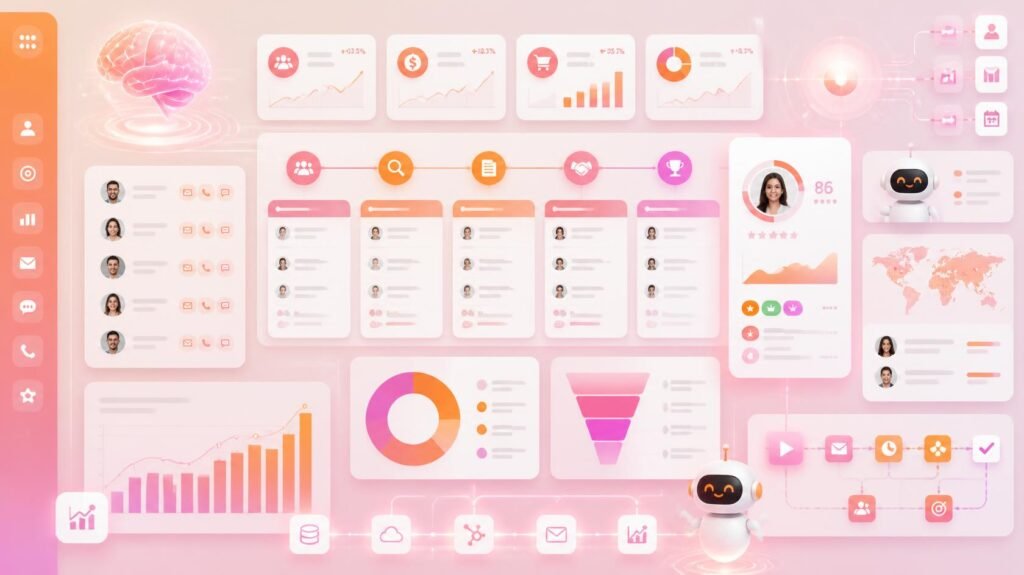
How an AI Sales Automation Platform Fits into the Sales Funnel
Rather than supporting only one stage of the sales process, AI automation adds value across the entire customer journey.
| Sales Funnel Stage | AI Capability | Business Benefit |
|---|---|---|
| Awareness | Lead capture | More prospects enter the pipeline |
| Interest | Behavioral tracking | Better understanding of buyer intent |
| Consideration | Personalized outreach | Higher engagement |
| Evaluation | AI recommendations | Faster decision-making |
| Purchase | Opportunity prioritization | Improved close rates |
| Retention | Customer insights | Stronger long-term relationships |
| Expansion | Upsell recommendations | Increased customer lifetime value |
Every interaction generates valuable data that helps improve future customer experiences.
Step-by-Step Implementation of an AI Sales Automation Platform
Implementing an AI sales automation platform requires more than purchasing software. Businesses must align people, processes, and technology to maximize value.
StEpisode 1: Defining Business Objectives
Begin with determining measurable objectives.
They could be:
- Growing the number of leads by 30%
- Cutting down the response time
- Increasing the conversion rate
- Reducing the sales cycle
- Boosting revenue per salesperson
- Improving customer retention
Having specific objectives will help you judge your success.
Step 2: Reviewing Your Current Sales Process
Before you automate anything, analyze your current processes.
The questions to ask are:
- What do salespeople do all the time?
- What tasks are repetitive?
- Where do we lose our leads?
- Which reports are done manually?
- Is the existing CRM working effectively?
Step 3: Clean Your CRM Data
Artificial intelligence depends on high-quality data.
Businesses should remove:
- Duplicate records
- Outdated contacts
- Incomplete profiles
- Incorrect company information
- Invalid email addresses
Clean data improves prediction accuracy and automation performance.
Step 4: Integrate Business Systems
Most AI sales automation platforms integrate with:
- CRM software
- Marketing automation platforms
- Email tools
- Calendar applications
- Customer support software
- Video conferencing platforms
- Analytics solutions
These integrations provide a complete view of every customer interaction.
Step 5: Train Sales Teams
Technology alone cannot improve sales performance.
Organizations should train representatives on:
- AI recommendations
- Lead prioritization
- Workflow automation
- CRM updates
- Reporting dashboards
- Customer insights
The goal is to help teams work alongside AI rather than rely on manual processes.
Step 6: Monitor Performance
After deployment, continuously measure:
- Lead conversion
- Pipeline growth
- Email engagement
- Sales productivity
- Revenue growth
- Customer satisfaction
Continuous optimization ensures long-term success.
Real-World Use Cases of AI Sales Automation Platforms
AI automation supports nearly every type of sales organization.
B2B SaaS Companies
Software companies often manage thousands of inbound leads each month.
AI platforms help them:
- Score trial users
- Identify product-qualified leads
- Trigger onboarding emails
- Recommend upsell opportunities
- Predict subscription renewals
This improves customer acquisition while reducing manual effort.
Manufacturing Businesses
Manufacturers typically have long sales cycles involving multiple decision-makers.
AI helps by:
- Tracking buyer engagement
- Managing distributor communications
- Forecasting demand
- Prioritizing enterprise accounts
- Scheduling follow-ups
Financial Services
Banks, insurance providers, and fintech companies use AI automation for:
- Customer qualification
- Loan application prioritization
- Cross-selling financial products
- Personalized financial recommendations
- Compliance-friendly communications
Healthcare Technology
Healthcare sales teams use AI to:
- Prioritize hospitals and clinics
- Schedule product demonstrations
- Track regulatory documents
- Monitor buying committees
- Improve account management
Industry Applications
Different industries use AI sales automation in different ways.
| Industry | Primary Use Case |
|---|---|
| SaaS | Lead qualification and onboarding |
| Manufacturing | Enterprise account management |
| Healthcare | Sales engagement and compliance |
| Financial Services | Customer qualification |
| Telecommunications | Upselling and renewals |
| Retail | Customer retention |
| Education Technology | Student enrollment automation |
| Logistics | Customer relationship management |
Although implementation varies, the objective remains the same: improve efficiency and increase revenue.
AI Sales Automation Workflow Example
The following example illustrates how a typical AI-powered workflow operates.
| Stage | Customer Action | AI Response |
|---|---|---|
| Website Visit | Visits pricing page | Records buying intent |
| Resource Download | Downloads whitepaper | Increases lead score |
| Email Engagement | Opens three emails | Recommends sales outreach |
| Demo Request | Books meeting | Assigns salesperson automatically |
| Sales Call | AI records conversation | Generates meeting summary |
| Proposal | Customer reviews proposal | AI recommends follow-up timing |
| Purchase | Deal closes | Starts customer onboarding workflow |
Without AI, these steps would require significant manual effort.
Measuring the Success of an AI Sales Automation Platform
Organizations should monitor key performance indicators (KPIs) to understand the platform’s impact.
Essential Sales KPIs
| KPI | Why It Matters |
|---|---|
| Lead Conversion Rate | Measures lead quality |
| Sales Cycle Length | Indicates process efficiency |
| Average Deal Size | Tracks revenue growth |
| Win Rate | Measures sales effectiveness |
| Customer Acquisition Cost | Evaluates profitability |
| Sales Productivity | Measures team efficiency |
| Pipeline Velocity | Tracks deal movement |
| Forecast Accuracy | Improves planning |
Tracking these metrics over time helps identify areas for further optimization.
Common Challenges During Implementation
Despite the obvious advantages that AI sales automation brings, there are certain difficulties that businesses may face while implementing it.
Inaccurate Data
Artificial Intelligence works properly only if the data is accurate and reliable. Errors in CRM can decrease the performance of lead scoring, forecasting and personalization.
Resistance to Change
Not all salespeople may be keen to embrace AI in their work routine. However, effective communication, training and demonstration of the time-saving feature can help.
Over-Automation
Fully automating all interactions with customers can make such communication seem cold. It is important to find the right balance between automation and human factor.
Data Integration
Integrating AI solutions with CRM, marketing and communication tools can be rather complex process that requires special approach.
Privacy and Compliance
It is necessary to make sure that all customer data is secured and complies with all required laws.
Best Practices for Successful AI Sales Automation
To make sure you get a good ROI on your investment, follow these best practices:
- Establish clear business objectives first.
- Have your CRM data be clean and accurate.
- Automate routine actions but make sure that customer conversations are personalized.
- Evaluate all the AI recommendations before taking action.
- Monitor KPIs and streamline your workflow processes.
- Regularly train your sales team on new AI features.
- Combine your sales and marketing data to get a single picture of your customer.
Adjust your automation rules based on customer behavior and your company’s goals.
Technologies That Power AI Sales Automation Platforms
An AI Sales Automation tool is based on the combination of several AI technologies. Every technology contributes to different tasks performed by the tool in order to assist sales teams with automation, understanding the intent of buyers, and engagement.
Machine Learning (ML)
Machine learning helps the system to learn from past data and enhance its recommendations.
In case the system recognizes that prospects from a certain industry, downloading a price guide, have higher chances to be converted into a customer, the system will always prefer those leads.
Machine learning is mostly applied to:
- Predictive lead scoring
- Opportunity identification
- Customer segmentation
- Revenue forecasting
- Churn prediction
- Deal win probability
Natural Language Processing (NLP)
Natural Language Processing helps AI understand and generate human language.
This technology allows platforms to:
- Analyze customer emails
- Summarize sales calls
- Generate personalized email drafts
- Detect customer sentiment
- Recommend responses
- Extract important information from conversations
Instead of reading every email manually, sales representatives receive concise summaries with recommended next actions.
Predictive Analytics
Predictive analytics examines historical data alongside real-time customer behavior to forecast future outcomes.
Sales managers can answer questions such as:
- Which leads are most likely to convert?
- Which deals are at risk?
- What revenue can be expected this quarter?
- Which customers are likely to upgrade?
- Which accounts require immediate attention?
Accurate forecasting enables better planning and resource allocation.
Generative AI
Generative AI has become one of the most valuable additions to modern sales automation.
It can create:
- Personalized prospecting emails
- Follow-up messages
- Sales proposals
- Meeting summaries
- Product recommendations
- Call scripts
- Customer responses
Instead of starting from scratch, sales teams receive AI-generated content that they can quickly review and personalize.
Conversational Intelligence
Conversation intelligence analyzes voice calls, virtual meetings, and chat interactions.
The AI identifies:
- Customer objections
- Buying signals
- Competitor mentions
- Frequently asked questions
- Product interests
- Sentiment changes
- Sales representative performance
Managers can use these insights for coaching and improving sales strategies.
How an AI Sales Automation Platform Fits into the Sales Funnel
Rather than supporting only one stage of the sales process, AI automation adds value across the entire customer journey.
| Sales Funnel Stage | AI Capability | Business Benefit |
|---|---|---|
| Awareness | Lead capture | More prospects enter the pipeline |
| Interest | Behavioral tracking | Better understanding of buyer intent |
| Consideration | Personalized outreach | Higher engagement |
| Evaluation | AI recommendations | Faster decision-making |
| Purchase | Opportunity prioritization | Improved close rates |
| Retention | Customer insights | Stronger long-term relationships |
| Expansion | Upsell recommendations | Increased customer lifetime value |
Every interaction generates valuable data that helps improve future customer experiences.
Step-by-Step Implementation of an AI Sales Automation Platform
Implementing an AI sales automation platform requires more than purchasing software. Businesses must align people, processes, and technology to maximize value.
Step 1: Define Business Objectives
Start by identifying measurable goals.
Examples include:
- Increase qualified leads by 30%
- Reduce response time
- Improve conversion rate
- Shorten sales cycle
- Increase revenue per sales representative
- Improve customer retention
Clear objectives make it easier to evaluate success.
Step 2: Audit Existing Sales Processes
Before introducing automation, evaluate current workflows.
Questions to ask include:
- Where do sales representatives spend most of their time?
- Which tasks are repetitive?
- Where are leads getting lost?
- Which reports require manual work?
- How effective is the current CRM?
Understanding these pain points helps determine which processes should be automated first.
Step 3: Clean Your CRM Data
Artificial intelligence depends on high-quality data.
Businesses should remove:
- Duplicate records
- Outdated contacts
- Incomplete profiles
- Incorrect company information
- Invalid email addresses
Clean data improves prediction accuracy and automation performance.
Step 4: Integrate Business Systems
Most AI sales automation platforms integrate with:
- CRM software
- Marketing automation platforms
- Email tools
- Calendar applications
- Customer support software
- Video conferencing platforms
- Analytics solutions
These integrations provide a complete view of every customer interaction.
Step 5: Train Sales Teams
Technology alone cannot improve sales performance.
Organizations should train representatives on:
- AI recommendations
- Lead prioritization
- Workflow automation
- CRM updates
- Reporting dashboards
- Customer insights
The goal is to help teams work alongside AI rather than rely on manual processes.
Step 6: Monitor Performance
After deployment, continuously measure:
- Lead conversion
- Pipeline growth
- Email engagement
- Sales productivity
- Revenue growth
- Customer satisfaction
Continuous optimization ensures long-term success.
Real-World Use Cases of AI Sales Automation Platforms
AI automation supports nearly every type of sales organization.
B2B SaaS Companies
Software companies often manage thousands of inbound leads each month.
AI platforms help them:
- Score trial users
- Identify product-qualified leads
- Trigger onboarding emails
- Recommend upsell opportunities
- Predict subscription renewals
This improves customer acquisition while reducing manual effort.
Manufacturing Businesses
Manufacturers typically have long sales cycles involving multiple decision-makers.
AI helps by:
- Tracking buyer engagement
- Managing distributor communications
- Forecasting demand
- Prioritizing enterprise accounts
- Scheduling follow-ups
Financial Services
Banks, insurance providers, and fintech companies use AI automation for:
- Customer qualification
- Loan application prioritization
- Cross-selling financial products
- Personalized financial recommendations
- Compliance-friendly communications
Healthcare Technology
Healthcare sales teams use AI to:
- Prioritize hospitals and clinics
- Schedule product demonstrations
- Track regulatory documents
- Monitor buying committees
- Improve account management
Industry Applications
Different industries use AI sales automation in different ways.
| Industry | Primary Use Case |
|---|---|
| SaaS | Lead qualification and onboarding |
| Manufacturing | Enterprise account management |
| Healthcare | Sales engagement and compliance |
| Financial Services | Customer qualification |
| Telecommunications | Upselling and renewals |
| Retail | Customer retention |
| Education Technology | Student enrollment automation |
| Logistics | Customer relationship management |
Although implementation varies, the objective remains the same: improve efficiency and increase revenue.
AI Sales Automation Workflow Example
The following example illustrates how a typical AI-powered workflow operates.
| Stage | Customer Action | AI Response |
|---|---|---|
| Website Visit | Visits pricing page | Records buying intent |
| Resource Download | Downloads whitepaper | Increases lead score |
| Email Engagement | Opens three emails | Recommends sales outreach |
| Demo Request | Books meeting | Assigns salesperson automatically |
| Sales Call | AI records conversation | Generates meeting summary |
| Proposal | Customer reviews proposal | AI recommends follow-up timing |
| Purchase | Deal closes | Starts customer onboarding workflow |
Without AI, these steps would require significant manual effort.
Measuring the Success of an AI Sales Automation Platform
Organizations should monitor key performance indicators (KPIs) to understand the platform’s impact.
Essential Sales KPIs
| KPI | Why It Matters |
|---|---|
| Lead Conversion Rate | Measures lead quality |
| Sales Cycle Length | Indicates process efficiency |
| Average Deal Size | Tracks revenue growth |
| Win Rate | Measures sales effectiveness |
| Customer Acquisition Cost | Evaluates profitability |
| Sales Productivity | Measures team efficiency |
| Pipeline Velocity | Tracks deal movement |
| Forecast Accuracy | Improves planning |
Tracking these metrics over time helps identify areas for further optimization.
Common Challenges During Implementation
While there are a number of benefits associated with AI sales automation, certain challenges may arise during implementation.
Data Quality Problems
AI requires quality data. Inaccuracies in the CRM system can limit the ability of lead scoring, forecasting, and personalization processes to operate effectively.
Change Resistance
Some sales people may be reluctant to accept new workflow procedures. Effective communication, proper training, and highlighting the benefits gained in terms of time can help to solve this problem.
Over-Automation
Over-automation of all customer interaction processes can make communication seem impersonal. Companies should find a compromise between the speed of processes and relationship building.
Technical Issues
The integration of AI software with existing CRM, marketing, and communication systems can be problematic and require thorough planning.
Privacy and Compliance
Companies have to comply with data privacy laws and protect customer data from misuse and loss.
Best Practices for Successful AI Sales Automation
To maximize return on investment, organizations should follow these best practices:
- Start with clear business objectives.
- Maintain clean and accurate CRM data.
- Automate repetitive tasks while keeping important customer conversations personal.
- Review AI-generated recommendations before acting on them.
- Continuously monitor KPIs and refine workflows.
- Train sales teams regularly on new AI capabilities.
- Integrate sales and marketing data for a unified customer view.
- Regularly update automation rules based on customer behavior and business goals.
These practices help businesses achieve sustainable improvements in productivity, lead conversion, and revenue growth.
Top AI Sales Automation Platforms in 2026
The market offers a wide range of AI-powered sales automation solutions, each designed for different business sizes and sales processes. While the best platform depends on your organization’s needs, comparing features can help narrow your options.
Comparison of Leading AI Sales Automation Platforms
| Platform | Best For | Key AI Features | CRM Integration | Ideal Business Size |
|---|---|---|---|---|
| HubSpot Sales Hub | Growing businesses | AI email assistant, predictive lead scoring, sales forecasting | Native | Small to Enterprise |
| Salesforce Sales Cloud | Large enterprises | Einstein AI, opportunity insights, forecasting | Native | Enterprise |
| Microsoft Dynamics 365 Sales | Microsoft ecosystem users | Copilot AI, predictive analytics, automated recommendations | Native | Mid-size to Enterprise |
| Zoho CRM | Budget-conscious businesses | Zia AI assistant, workflow automation, lead scoring | Native | Small to Mid-size |
| Pipedrive | Sales-focused teams | AI sales assistant, deal recommendations | Native | Small to Mid-size |
| Freshsales | Growing sales teams | Freddy AI, contact scoring, automated follow-ups | Native | Small to Mid-size |
Regardless of the platform you choose, success depends on implementation strategy, clean data, and user adoption rather than software alone.
AI Sales Automation vs Manual Sales Processes
Many organizations still rely on spreadsheets, manual reminders, and repetitive administrative work. Comparing these approaches highlights why AI automation has become essential.
| Category | Manual Sales Process | AI Sales Automation Platform |
|---|---|---|
| Lead Qualification | Manual review | Predictive AI scoring |
| Email Follow-ups | Manual scheduling | Automated workflows |
| Customer Insights | Limited | Real-time behavioral analysis |
| Reporting | Time-consuming | Automatic dashboards |
| Forecasting | Experience-based | Data-driven predictions |
| Pipeline Updates | Manual | Automatic synchronization |
| Meeting Summaries | Manual notes | AI-generated summaries |
| Productivity | Lower | Significantly higher |
Businesses adopting AI often experience faster decision-making and more consistent sales execution.
Return on Investment (ROI) of AI Sales Automation
One of the biggest reasons companies invest in AI sales automation is the measurable return on investment. By reducing manual work and improving lead conversion, organizations can increase revenue without proportionally increasing headcount.
Where ROI Comes From
- Reduced administrative workload
- Higher lead conversion rates
- Faster sales cycles
- Improved forecasting accuracy
- Better customer retention
- Increased average deal value
- More effective cross-selling and upselling
- Lower customer acquisition costs
Example ROI Scenario
Consider a B2B software company generating 2,000 leads each month.
| Metric | Before AI Automation | After AI Automation |
|---|---|---|
| Monthly Leads | 2,000 | 2,000 |
| Qualified Leads | 400 | 650 |
| Conversion Rate | 10% | 16% |
| New Customers | 40 | 104 |
| Average Deal Value | $8,000 | $8,000 |
| Monthly Revenue | $320,000 | $832,000 |
While actual results vary, this example illustrates how improvements in qualification and conversion can dramatically impact revenue.
How AI Improves Sales Productivity
The sales personnel do not dedicate more than fifty percent of their work time on selling activities. The other fifty percent of time is spent in performing administrative activities like entering information into CRM systems, reporting, planning meetings, and researching customers.
AI sales automation shifts this balance.
Time Savings by Activity
| Activity | Traditional Time | With AI Automation |
|---|---|---|
| CRM Updates | High | Minimal |
| Lead Research | High | Automated |
| Email Drafting | Moderate | AI-assisted |
| Meeting Notes | Manual | Automatic |
| Follow-up Scheduling | Manual | Automated |
| Pipeline Reporting | Hours | Real-time |
| Forecasting | Manual | Predictive |
By reducing administrative work, sales professionals can dedicate more time to building relationships, understanding customer challenges, and closing deals.
Common Mistakes Businesses Make
Even the most advanced platform cannot deliver results if implemented incorrectly. Understanding common mistakes helps organizations avoid unnecessary costs and maximize value.
1. Expecting AI to Replace Sales Teams
AI enhances decision-making and automates repetitive tasks, but it cannot replace the trust, negotiation, and relationship-building skills of experienced sales professionals.
2. Automating Every Customer Interaction
Customers appreciate efficiency, but they also expect genuine human engagement during important stages of the buying journey.
Businesses should automate:
- Lead routing
- Appointment scheduling
- Routine follow-ups
- CRM updates
- Reporting
Human representatives should continue handling:
- Discovery calls
- Product demonstrations
- Complex negotiations
- Strategic account management
- Customer success discussions
3. Ignoring Data Quality
Poor-quality CRM data leads to inaccurate lead scores, weak forecasts, and ineffective recommendations.
Regular data audits are essential.
4. Measuring Only Revenue
Revenue is important, but businesses should also monitor:
- Lead response time
- Pipeline velocity
- Win rate
- Customer lifetime value
- Sales cycle length
- Customer satisfaction
- Forecast accuracy
These metrics provide a more complete picture of AI performance.
5. Failing to Train Employees
Successful implementation requires ongoing training. Sales teams need to understand how AI generates recommendations and how to use those insights effectively.
Future Trends in AI Sales Automation
The next generation of sales automation platforms will go beyond simple workflow automation. Emerging technologies will make sales systems more proactive, predictive, and personalized.
Agentic AI
Instead of waiting for instructions, Agentic AI systems will independently perform complex tasks such as:
- Prioritizing accounts
- Scheduling meetings
- Drafting proposals
- Identifying upsell opportunities
- Recommending pricing strategies
These intelligent agents will act as virtual sales assistants.
Hyper-Personalization
Future platforms will analyze customer behavior in real time to create individualized experiences.
Examples include:
- Personalized product recommendations
- Dynamic pricing suggestions
- Customized email sequences
- Industry-specific messaging
- Tailored content recommendations
Voice AI
Voice assistants will help sales representatives by:
- Capturing meeting notes
- Updating CRM records
- Scheduling follow-ups
- Answering customer questions
- Retrieving account information
Predictive Revenue Intelligence
Rather than reporting what has happened, AI will increasingly predict:
- Which deals are likely to close
- Which customers may churn
- Which prospects require immediate attention
- Expected quarterly revenue
- Sales capacity requirements
These insights enable faster and more informed decision-making.
Unified Revenue Platforms
The boundaries between sales, marketing, and customer success platforms will continue to blur. AI will create a unified view of the customer journey, allowing every team to work from the same data and collaborate more effectively.
Conclusion
No longer a privilege of large companies, AI sales automation software has become an indispensable resource for any company that seeks competitiveness in an increasingly digitalized and data-driven market environment. Rising customer expectations and complicated sales cycles are only a few reasons why manual operations should be left behind.
With the help of AI-based automation technologies, it becomes possible to streamline routine operations, use predictive analytics for making decisions based on real-time data and obtain actionable insights. In the context of sales processes, AI helps salespeople concentrate on their core functions – developing relationships with customers, addressing their problems and making lucrative deals. Intelligent lead scoring, personalization of marketing messages, accurate forecasting and pipeline management are just several advantages of using AI sales automation tools.
It should be noted that technology is a crucial component, but it is not enough to make sales processes successful. Those companies that have found the most efficient way to use AI include the latter in combination with high-quality data, clear sales process and professional training for employees.
Frequently Asked Questions
What is an AI sales automation platform?
An AI sales automation platform is software that uses artificial intelligence to automate repetitive sales tasks, analyze customer behavior, prioritize leads, generate personalized communications, and provide predictive insights that help sales teams improve productivity and increase revenue.
Can small businesses benefit from AI sales automation?
Yes. Many modern platforms offer scalable pricing and features suitable for startups and small businesses. Even basic automation can reduce manual work, improve response times, and increase lead conversion.
Does AI replace sales representatives?
No. AI is designed to support sales professionals by automating routine activities and providing data-driven recommendations. Human skills such as relationship building, negotiation, and strategic thinking remain essential.
How long does implementation take?
Implementation timelines vary depending on business size, existing systems, and customization requirements. Small organizations may deploy a platform within a few weeks, while larger enterprises may require several months.
What should businesses look for in a platform?
Key capabilities include predictive lead scoring, workflow automation, CRM integration, AI-generated content, forecasting, reporting dashboards, conversation intelligence, and strong security features.
Is AI sales automation secure?
Most leading platforms include enterprise-grade security measures such as encryption, role-based access controls, audit logs, and compliance certifications. Businesses should still evaluate vendors carefully and ensure the platform meets their regulatory and security requirements.