
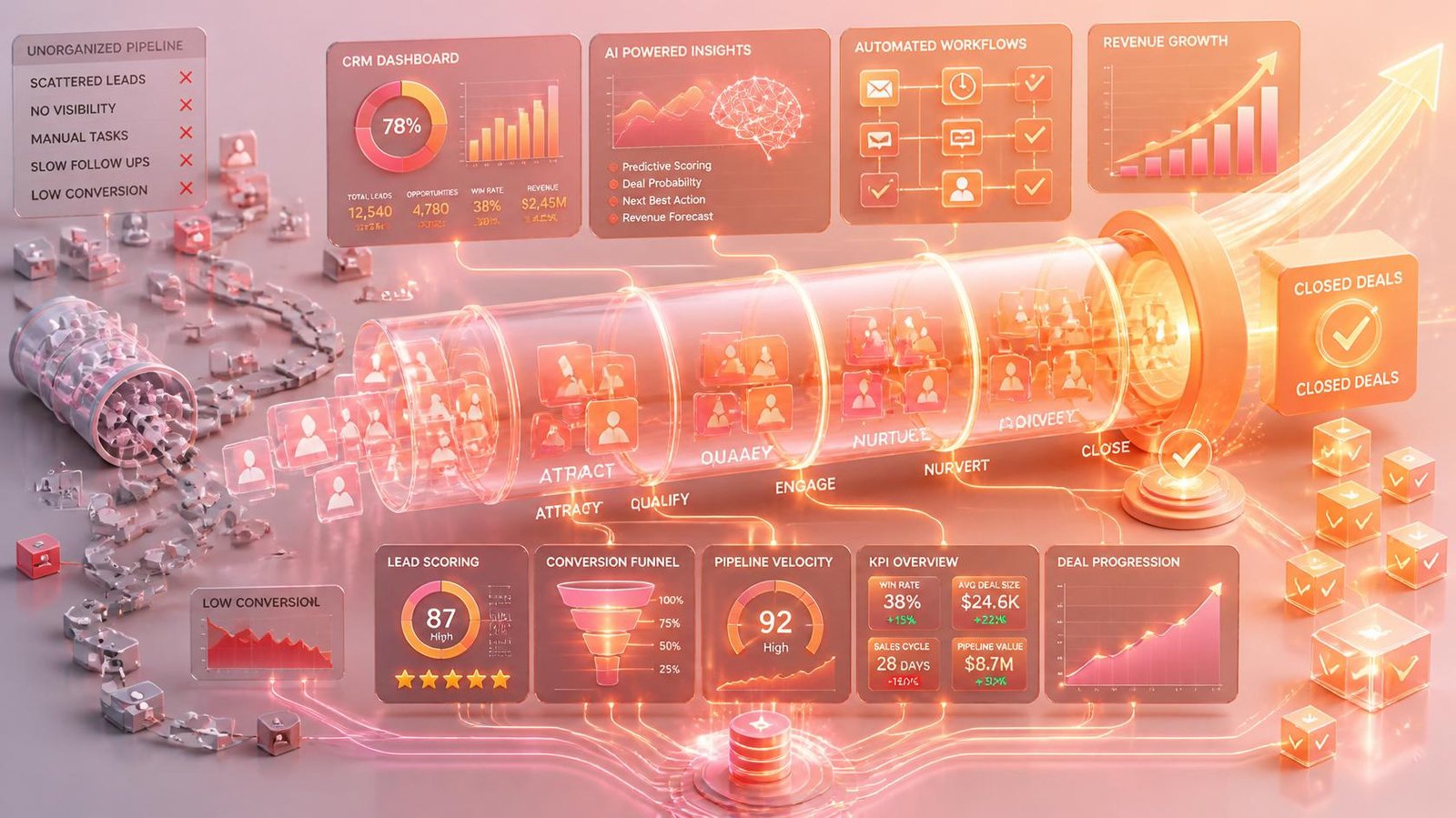
Every business wants a predictable flow of qualified leads that convert into paying customers. However, many sales teams struggle with slow-moving deals, inaccurate forecasting, poor lead qualification, and inconsistent follow-ups. These challenges often result in missed revenue opportunities and lower conversion rates. This is where Sales Pipeline Optimization becomes one of the most valuable strategies for modern businesses.
A well-optimized sales pipeline enables organizations to identify bottlenecks, prioritize high-value prospects, shorten sales cycles, and improve overall sales efficiency. Instead of relying on guesswork, sales teams can use data, automation, and customer insights to guide prospects through every stage of the buying journey.
As businesses continue to embrace digital transformation and AI-powered sales technologies, optimizing the sales pipeline is no longer optional. Companies that consistently monitor and refine their pipeline outperform competitors by closing deals faster, improving customer experiences, and generating sustainable revenue growth.
Whether you are a startup looking to build a scalable sales process or an established enterprise seeking better forecasting and higher conversion rates, this comprehensive guide will help you understand how Sales Pipeline Optimization can transform your sales performance.
In this article, you’ll learn the essential components of a high-performing sales pipeline, proven optimization strategies, key performance metrics, automation tools, common mistakes to avoid, and future trends shaping modern sales organizations.
What Is Sales Pipeline Optimization?
Sales Pipeline Optimization is the process of analyzing, improving, and managing every stage of the sales pipeline to increase efficiency, accelerate deal progression, and maximize revenue. It involves evaluating how leads move from initial contact to becoming loyal customers while eliminating obstacles that slow down the buying process.
An optimized pipeline ensures that sales representatives spend more time engaging with qualified prospects instead of chasing leads that are unlikely to convert. It also provides greater visibility into deal progress, enabling managers to forecast revenue more accurately and allocate resources effectively.
Rather than focusing solely on increasing the number of leads, pipeline optimization emphasizes improving lead quality, enhancing sales processes, and making informed decisions based on real-time data.
Key Objectives of Sales Pipeline Optimization
| Objective | Business Impact |
|---|---|
| Improve lead qualification | Higher conversion rates |
| Reduce sales cycle length | Faster revenue generation |
| Increase win rates | More closed deals |
| Improve forecasting accuracy | Better business planning |
| Identify pipeline bottlenecks | Faster decision-making |
| Enhance customer experience | Increased customer satisfaction |
| Improve team productivity | Better sales performance |
| Increase revenue predictability | Sustainable business growth |
Organizations that continuously optimize their pipeline create repeatable sales processes that support long-term scalability.
Why Sales Pipeline Optimization Matters
Many businesses invest heavily in lead generation but fail to convert enough opportunities because their sales pipeline is inefficient. A poorly managed pipeline creates confusion, delays, and inconsistent customer experiences.
Pipeline optimization helps businesses gain complete visibility into every opportunity while ensuring sales representatives focus on activities that generate the highest return.
Some of the biggest benefits include:
- Higher conversion rates
- Faster deal closures
- Better forecasting accuracy
- Increased sales productivity
- Improved collaboration between marketing and sales
- Stronger customer relationships
- Reduced customer acquisition costs
- More predictable revenue
According to industry research, companies with structured sales processes consistently achieve higher revenue growth than organizations with poorly defined pipelines.
Understanding the Sales Pipeline Stages
Every organization has its own sales process, but most pipelines follow a similar structure. Understanding each stage is the foundation of effective optimization.
| Pipeline Stage | Description | Primary Goal |
|---|---|---|
| Lead Generation | Collect potential customers through marketing campaigns, referrals, events, or outbound prospecting | Generate new opportunities |
| Lead Qualification | Determine whether a prospect matches the ideal customer profile | Focus on qualified buyers |
| Discovery | Understand customer pain points, challenges, and business goals | Build trust and gather information |
| Proposal | Present a tailored solution with pricing and value proposition | Demonstrate business value |
| Negotiation | Address concerns, pricing discussions, and contract terms | Reach mutual agreement |
| Closing | Finalize the purchase decision and complete contracts | Convert prospects into customers |
| Customer Onboarding | Ensure successful implementation and customer success | Improve retention and satisfaction |
Each stage should have clearly defined entry and exit criteria to prevent deals from becoming stagnant.
How an Optimized Sales Pipeline Works
A healthy sales pipeline is built on consistency, visibility, and continuous improvement. Every lead is evaluated based on predefined criteria, assigned appropriate follow-up actions, and tracked throughout the buying journey.
Instead of allowing opportunities to remain inactive for weeks, optimized pipelines use automated reminders, CRM workflows, lead scoring, and performance dashboards to keep deals progressing.
The process typically follows these steps:
| Step | Action |
|---|---|
| Lead enters CRM | Capture lead automatically |
| Qualification | Evaluate budget, authority, need, and timeline |
| Assign salesperson | Route lead based on expertise or territory |
| Schedule discovery | Understand customer requirements |
| Deliver proposal | Present customized solution |
| Automated follow-up | Maintain engagement |
| Close opportunity | Win or lose analysis |
| Customer success | Onboarding and relationship management |
This structured workflow improves accountability while reducing delays.
Signs Your Sales Pipeline Needs Optimization
Many businesses assume their pipeline is healthy simply because new leads continue to enter the system. However, the real issue often lies in how efficiently those leads progress through the sales journey.
Here are common warning signs that indicate optimization is needed.
| Warning Sign | Possible Cause |
|---|---|
| Deals remain open for months | Poor follow-up strategy |
| Low conversion rates | Weak lead qualification |
| Inaccurate revenue forecasts | Outdated CRM data |
| High customer acquisition costs | Inefficient sales process |
| Sales reps spend time on unqualified leads | Lack of lead scoring |
| Lost opportunities increase | Slow response times |
| Revenue fluctuates significantly | Inconsistent pipeline management |
| Limited visibility into deal status | Poor reporting systems |
Identifying these issues early enables organizations to make proactive improvements before revenue is affected.
Common Challenges That Affect Sales Pipeline Performance
Even experienced sales teams face challenges that reduce pipeline efficiency. Understanding these obstacles is the first step toward eliminating them.
Poor Lead Qualification
One of the most common problems is pursuing prospects that are unlikely to become customers. Without a structured qualification process, sales representatives waste valuable time on leads that do not have the budget, authority, or need to purchase.
Implementing qualification frameworks such as BANT (Budget, Authority, Need, Timeline) or MEDDICC helps prioritize high-potential opportunities.
Lack of Pipeline Visibility
Managers often struggle to understand where deals are getting stuck. Without real-time dashboards and accurate CRM updates, forecasting becomes unreliable and decision-making suffers.
A centralized CRM with automated reporting provides visibility into every stage of the pipeline.
Inconsistent Sales Processes
When every salesperson follows a different process, performance becomes difficult to measure. Standardized workflows ensure every opportunity receives consistent attention while making onboarding easier for new team members.
Slow Follow-Ups
Research consistently shows that responding to prospects quickly increases conversion rates. Delayed follow-ups allow competitors to engage buyers first.
Automated email sequences, reminders, and CRM notifications help maintain timely communication.
Poor Data Quality
Duplicate records, missing contact information, and outdated customer data reduce sales efficiency.
Regular CRM audits and automated data validation improve data accuracy.

Essential Components of a High-Performing Sales Pipeline
A successful pipeline depends on several interconnected components that work together to improve efficiency and increase conversions.
| Component | Purpose | Business Benefit |
|---|---|---|
| CRM Platform | Centralized customer management | Better visibility |
| Lead Scoring | Prioritize valuable prospects | Higher conversions |
| Sales Automation | Reduce manual work | Increased productivity |
| Analytics Dashboard | Monitor KPIs | Data-driven decisions |
| Email Automation | Consistent communication | Faster follow-ups |
| AI Insights | Predict buyer behavior | Better forecasting |
| Reporting | Measure sales performance | Continuous improvement |
| Customer Success Process | Improve retention | Long-term revenue |
Businesses that integrate these components into their sales strategy create a scalable pipeline capable of supporting long-term growth.
Why Sales Pipeline Optimization Is Becoming More Important
Modern buyers expect personalized experiences, faster responses, and seamless digital interactions throughout the purchasing journey. At the same time, businesses face increasing competition, longer buying cycles, and more stakeholders involved in purchasing decisions.
As a result, sales teams can no longer rely on spreadsheets, manual tracking, or intuition alone. Artificial intelligence, predictive analytics, CRM automation, and real-time reporting have become essential for maintaining a competitive edge.
Organizations that embrace Sales Pipeline Optimization are better positioned to identify high-intent buyers, reduce sales friction, improve forecasting accuracy, and create a more efficient sales process that supports sustainable revenue growth. In the next section, we’ll explore 10 proven Sales Pipeline Optimization strategies that help businesses close more deals faster, increase conversion rates, and build a predictable revenue engine.
10 Proven Sales Pipeline Optimization Strategies to Boost Revenue
Optimizing a sales pipeline is not about making one major change overnight. Instead, it requires continuous improvements across lead management, customer engagement, automation, analytics, and team collaboration. Businesses that consistently review and refine their sales processes are more likely to achieve predictable revenue growth and stronger customer relationships.
The following strategies can help organizations create a healthier pipeline that converts more opportunities into long-term customers.
1. Define Your Ideal Customer Profile (ICP)
Every successful sales pipeline begins with targeting the right audience. One of the biggest mistakes businesses make is trying to sell to everyone. When sales teams pursue unqualified prospects, they waste valuable time and resources while reducing overall conversion rates.
An Ideal Customer Profile (ICP) identifies the types of companies or customers that are most likely to benefit from your products or services. This profile should include industry, company size, annual revenue, business challenges, technology usage, location, and buying behavior.
For example, a B2B SaaS company selling CRM software may define its ideal customer as medium-sized businesses with 50–500 employees, a growing sales team, and an existing digital transformation strategy.
Benefits of an Ideal Customer Profile
| Benefit | Business Impact |
|---|---|
| Better lead targeting | Higher-quality prospects |
| Improved conversion rates | Increased revenue |
| Lower acquisition costs | Better ROI |
| Faster sales cycles | More efficient selling |
| Personalized messaging | Higher engagement |
Once the ICP is clearly defined, marketing and sales teams can align their efforts to attract prospects who are more likely to convert.
2. Improve Lead Qualification
Generating thousands of leads has little value if most of them are not ready to buy. Effective lead qualification helps sales representatives focus on opportunities with the highest potential.
Lead qualification involves evaluating whether a prospect has the budget, authority, business need, and timeline to make a purchasing decision.
Popular qualification frameworks include:
| Framework | Purpose |
|---|---|
| BANT | Budget, Authority, Need, Timeline |
| MEDDICC | Enterprise sales qualification |
| CHAMP | Challenges, Authority, Money, Prioritization |
| ANUM | Authority, Need, Urgency, Money |
| GPCT | Goals, Plans, Challenges, Timeline |
Rather than relying on assumptions, businesses should use CRM data, website behavior, content downloads, email engagement, and previous interactions to score leads automatically.
Example Lead Scoring Table
| Activity | Score |
|---|---|
| Website Visit | +5 |
| Download Whitepaper | +15 |
| Product Demo Request | +30 |
| Pricing Page Visit | +20 |
| Webinar Registration | +10 |
| Email Click | +5 |
| No Activity for 30 Days | -15 |
| Competitor Email Domain | -20 |
Lead scoring ensures sales teams prioritize prospects with genuine buying intent.
3. Standardize Your Sales Process
Many organizations struggle because every salesperson follows a different approach. While flexibility is important, inconsistent processes make forecasting difficult and create uneven customer experiences.
A standardized sales process establishes clear guidelines for every stage of the pipeline.
For example:
| Stage | Required Action |
|---|---|
| Lead Qualification | Complete qualification checklist |
| Discovery | Conduct needs analysis |
| Proposal | Send personalized proposal |
| Negotiation | Handle objections |
| Closing | Finalize contract |
| Onboarding | Introduce customer success team |
This consistency improves productivity while making it easier to train new sales representatives.
4. Shorten Your Sales Cycle
A lengthy sales cycle increases costs and reduces the number of opportunities a sales representative can manage.
Several factors contribute to delayed deals:
- Slow response times
- Multiple approval levels
- Poor follow-up
- Complicated proposals
- Manual processes
- Lack of urgency
Businesses can reduce sales cycle length by automating repetitive tasks and simplifying customer interactions.
Ways to Shorten the Sales Cycle
| Strategy | Result |
|---|---|
| Automate follow-ups | Faster responses |
| Offer online scheduling | Quicker meetings |
| Digital contracts | Faster approvals |
| Proposal templates | Reduced preparation time |
| CRM reminders | No missed follow-ups |
| AI recommendations | Better decision-making |
Shorter sales cycles enable businesses to close more deals with the same resources.
5. Use CRM Software Effectively
A Customer Relationship Management (CRM) platform serves as the foundation of modern Sales Pipeline Optimization.
Unfortunately, many companies only use a small percentage of their CRM capabilities.
A well-managed CRM allows businesses to:
- Track every customer interaction
- Store contact information
- Monitor deal stages
- Automate repetitive tasks
- Generate sales reports
- Forecast revenue
- Measure team performance
Key CRM Features
| Feature | Benefit |
|---|---|
| Contact Management | Organized customer data |
| Pipeline Tracking | Complete visibility |
| Workflow Automation | Reduced manual work |
| Lead Scoring | Better prioritization |
| Email Integration | Improved communication |
| Dashboard Reporting | Real-time insights |
| Mobile Access | Work from anywhere |
When CRM data is consistently updated, managers gain a clearer understanding of pipeline health and future revenue.
6. Automate Repetitive Sales Activities
Sales representatives should spend most of their time building relationships and closing deals—not completing repetitive administrative tasks.
Sales automation increases productivity while reducing human error.
Tasks suitable for automation include:
| Automated Task | Benefit |
|---|---|
| Welcome Emails | Immediate engagement |
| Meeting Scheduling | Time savings |
| Follow-up Reminders | Better consistency |
| Proposal Delivery | Faster communication |
| Lead Assignment | Balanced workloads |
| Data Entry | Improved accuracy |
| Pipeline Updates | Real-time visibility |
Automation also improves customer experience by ensuring prospects receive timely communication throughout the buying journey.
Comparing Manual vs Automated Sales Pipelines
| Factor | Manual Pipeline | Optimized Pipeline |
|---|---|---|
| Lead Assignment | Manual | Automatic |
| Follow-ups | Often delayed | Automated |
| Forecasting | Limited accuracy | Real-time |
| Reporting | Time-consuming | Instant dashboards |
| Customer Data | Scattered | Centralized CRM |
| Productivity | Lower | Higher |
| Sales Cycle | Longer | Shorter |
| Revenue Growth | Slower | More predictable |
The comparison clearly shows why businesses increasingly invest in automation technologies.
Sales Pipeline KPIs Every Business Should Track
Optimizing a pipeline requires continuous measurement. Without clear metrics, it becomes impossible to identify weaknesses or measure improvements.
The following KPIs provide valuable insights into sales performance.
| KPI | Why It Matters |
|---|---|
| Conversion Rate | Measures pipeline effectiveness |
| Win Rate | Indicates closing success |
| Average Deal Size | Evaluates revenue opportunities |
| Sales Cycle Length | Tracks efficiency |
| Pipeline Velocity | Measures deal movement |
| Customer Acquisition Cost | Determines profitability |
| Average Response Time | Impacts conversion rates |
| Forecast Accuracy | Supports planning |
| Opportunity-to-Close Ratio | Identifies pipeline quality |
| Customer Lifetime Value | Measures long-term growth |
Regularly reviewing these metrics enables sales leaders to identify trends and make informed decisions.
Building Better Collaboration Between Marketing and Sales
Sales Pipeline Optimization is not solely the responsibility of the sales department. Marketing plays a critical role in attracting qualified leads and nurturing them before they enter the pipeline.
Organizations with strong collaboration between marketing and sales experience:
- Higher lead quality
- Improved conversion rates
- Better customer experiences
- More accurate forecasting
- Increased revenue growth
Responsibilities of Each Team
| Marketing Team | Sales Team |
|---|---|
| Generate leads | Qualify opportunities |
| Create content | Conduct discovery calls |
| Run campaigns | Deliver proposals |
| Nurture prospects | Handle negotiations |
| Track engagement | Close deals |
| Measure campaign ROI | Build customer relationships |
Shared goals, regular meetings, and integrated CRM systems help both teams stay aligned throughout the customer journey.
The Role of Customer Experience in Pipeline Optimization
Today’s buyers expect more than competitive pricing. They want personalized communication, fast responses, and solutions tailored to their business challenges. Every interaction during the sales process shapes their perception of your company.
Improving customer experience within the pipeline can significantly increase conversion rates. Businesses should focus on understanding customer needs, responding quickly to inquiries, providing relevant content, and maintaining transparent communication at every stage. A positive buying experience builds trust and reduces the likelihood of prospects abandoning the sales process.
7. Use AI to Optimize Your Sales Pipeline
Artificial intelligence has transformed the way sales teams manage opportunities. Rather than manually reviewing hundreds of deals, AI analyzes customer behavior, communication history, buying intent, and historical sales data to recommend the next best actions.
For example, AI can identify which prospects are most likely to convert, predict when a customer may lose interest, recommend personalized follow-up emails, or alert sales representatives when a deal requires immediate attention.
How AI Improves Sales Pipeline Optimization
| AI Capability | Business Benefit |
|---|---|
| Predictive Lead Scoring | Prioritize high-intent buyers |
| Sales Forecasting | More accurate revenue predictions |
| Email Personalization | Better engagement |
| Conversation Intelligence | Improved customer interactions |
| Opportunity Scoring | Focus on valuable deals |
| Chatbots | Instant customer support |
| Automated Follow-ups | Higher response rates |
| Customer Behavior Analysis | Better decision-making |
AI helps sales professionals spend less time on administrative work and more time building meaningful customer relationships.
8. Monitor Pipeline Performance with Real-Time Analytics
An optimized sales pipeline requires continuous monitoring. Without accurate reporting, businesses cannot determine whether their optimization efforts are producing results.
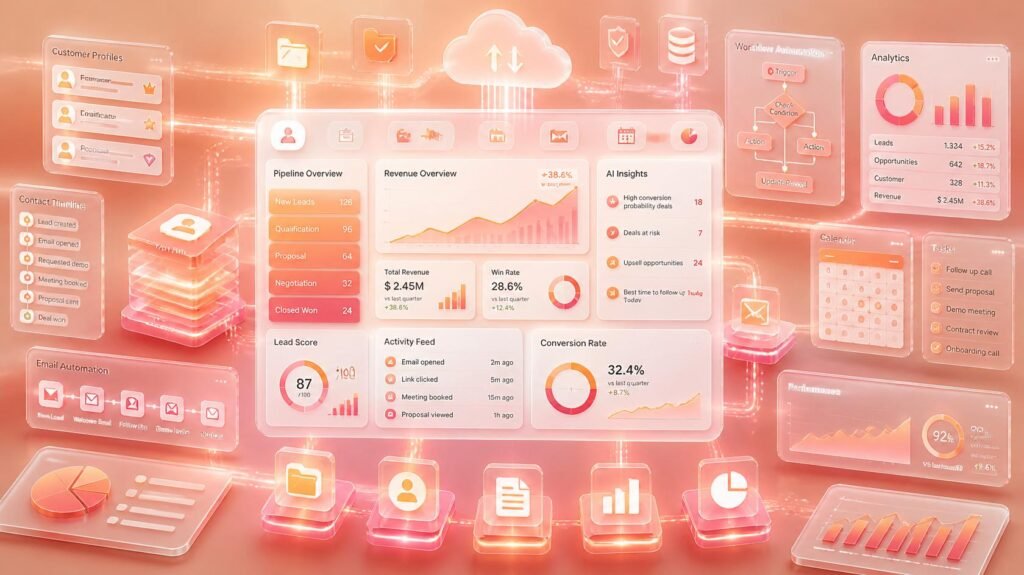
Modern CRM platforms provide dashboards that display real-time performance metrics, allowing managers to identify bottlenecks before they affect revenue.
Important questions analytics can answer include:
- Which pipeline stage loses the most opportunities?
- Which sales representative has the highest conversion rate?
- Which marketing campaigns generate the best leads?
- How long does it take to close an average deal?
- Which products generate the highest revenue?
Sales Dashboard Metrics
| Metric | Why It Matters |
|---|---|
| Total Pipeline Value | Measures revenue potential |
| Open Opportunities | Indicates future business |
| Closed-Won Deals | Tracks sales success |
| Closed-Lost Deals | Identifies improvement areas |
| Pipeline Velocity | Measures deal movement |
| Win Rate | Evaluates performance |
| Sales Cycle Length | Measures efficiency |
| Forecast Revenue | Supports planning |
Real-time reporting enables organizations to make informed decisions quickly rather than relying on outdated spreadsheets.
9. Optimize Follow-Up Strategies
Many deals are lost simply because businesses fail to follow up consistently. Prospects often require multiple interactions before making a purchasing decision.
An effective follow-up strategy combines personalization with automation. Instead of sending generic emails, sales teams should provide relevant information based on each prospect’s industry, pain points, and buying stage.
A structured follow-up process may include:
| Day | Activity |
|---|---|
| Day 1 | Thank-you email |
| Day 3 | Educational content |
| Day 7 | Product demonstration |
| Day 10 | Customer success story |
| Day 14 | Personalized follow-up |
| Day 21 | Final check-in |
Automated workflows ensure no opportunity is forgotten while maintaining consistent communication throughout the buying journey.
10. Continuously Review and Improve Your Pipeline
Sales Pipeline Optimization is an ongoing process rather than a one-time project. Customer expectations, market conditions, and buying behaviors continue to evolve, making regular pipeline reviews essential.
Successful organizations schedule monthly or quarterly pipeline audits to identify inefficiencies, remove inactive opportunities, update qualification criteria, and refine sales strategies.
Pipeline Review Checklist
| Review Area | Questions to Ask |
|---|---|
| Lead Quality | Are we attracting the right prospects? |
| Conversion Rates | Which stages need improvement? |
| Sales Cycle | Can deals move faster? |
| CRM Data | Is customer information accurate? |
| Forecasting | Are predictions reliable? |
| Sales Activities | Which actions generate results? |
| Customer Feedback | What can be improved? |
| Automation | Which tasks remain manual? |
Continuous improvement ensures the pipeline remains aligned with changing business objectives.
Common Sales Pipeline Optimization Mistakes
Even organizations with experienced sales teams make mistakes that reduce pipeline efficiency. Recognizing these issues helps businesses improve performance before revenue is affected.
Focusing on Quantity Instead of Quality
Many companies measure success by the number of leads entering the pipeline rather than the number of qualified opportunities. A smaller pipeline filled with high-quality prospects often produces better results than a large pipeline containing unqualified leads.
Ignoring CRM Updates
Outdated customer information leads to inaccurate forecasting and missed follow-up opportunities. Sales representatives should update CRM records immediately after every customer interaction.
Poor Lead Handoffs
Miscommunication between marketing and sales often causes qualified leads to lose interest before they receive timely follow-up.
Clearly defined lead handoff procedures improve customer experience and conversion rates.
Lack of Personalization
Today’s buyers expect personalized communication. Generic sales messages reduce engagement and lower response rates.
Businesses should customize emails, proposals, and presentations based on each prospect’s needs and challenges.
Failing to Measure KPIs
Without performance metrics, businesses cannot determine whether optimization efforts are successful.
Regular KPI reviews help identify trends and support continuous improvement.
Common Mistakes and Their Solutions
| Mistake | Solution |
|---|---|
| Poor lead qualification | Implement lead scoring |
| Slow response times | Automate follow-ups |
| Inconsistent processes | Standardize workflows |
| Outdated CRM data | Schedule regular audits |
| Weak forecasting | Use predictive analytics |
| Limited reporting | Create KPI dashboards |
| Generic messaging | Personalize communication |
| No pipeline reviews | Conduct monthly evaluations |
Best Sales Pipeline Optimization Tools
Technology plays a significant role in improving sales efficiency. Modern platforms integrate CRM, automation, analytics, AI, and communication into one centralized system.
The right tool depends on business size, budget, and sales complexity.
| Tool | Best For | Key Features |
|---|---|---|
| Salesforce Sales Cloud | Large Enterprises | AI forecasting, automation, reporting |
| HubSpot Sales Hub | SMBs and Growing Businesses | CRM, email tracking, automation |
| Microsoft Dynamics 365 Sales | Enterprise Organizations | AI insights, CRM integration |
| Pipedrive | Small Sales Teams | Visual pipeline management |
| Zoho CRM | Budget-Conscious Businesses | Automation, analytics, customization |
| Freshsales | Growing Companies | AI lead scoring, workflow automation |
| Monday CRM | Project-Based Sales Teams | Custom workflows and collaboration |
| Insightly CRM | Relationship Management | Contact management and reporting |
When selecting a platform, businesses should evaluate scalability, integration capabilities, reporting features, automation options, ease of use, and total cost of ownership.
Sales Pipeline Optimization Best Practices
Organizations that consistently outperform competitors follow proven best practices that strengthen every stage of the pipeline.
| Best Practice | Expected Result |
|---|---|
| Define an Ideal Customer Profile | Better lead quality |
| Standardize sales stages | Consistent performance |
| Use CRM daily | Improved visibility |
| Automate repetitive tasks | Higher productivity |
| Monitor KPIs | Better decisions |
| Align marketing and sales | Increased conversions |
| Personalize customer interactions | Higher engagement |
| Conduct regular pipeline reviews | Continuous improvement |
These practices create a predictable sales process that supports long-term growth.
Future Trends in Sales Pipeline Optimization
Sales technology continues to evolve rapidly. Businesses that stay ahead of these trends will gain a competitive advantage in attracting, nurturing, and converting customers.
Several emerging trends are expected to shape the future of sales pipeline management:
| Trend | Business Impact |
|---|---|
| AI-Powered Sales Assistants | Smarter recommendations and automation |
| Predictive Analytics | Better opportunity forecasting |
| Conversational Intelligence | Improved sales coaching |
| Hyper-Personalization | Stronger customer engagement |
| Revenue Intelligence Platforms | Enhanced decision-making |
| CRM Automation | Reduced administrative workload |
| Omnichannel Selling | Consistent customer experiences |
| Generative AI | Faster content and proposal creation |
As these technologies mature, organizations will increasingly rely on intelligent automation and real-time analytics to optimize sales performance and maintain predictable revenue growth.
Conclusion
In today’s competitive business environment, having a steady flow of leads is no longer enough. Success depends on how effectively those leads move through your sales process. This is why Sales Pipeline Optimization has become a critical strategy for businesses that want to improve sales efficiency, increase conversion rates, and generate predictable revenue.
An optimized sales pipeline helps organizations eliminate bottlenecks, prioritize high-value opportunities, shorten sales cycles, and provide a better buying experience for customers. By combining a well-defined sales process with CRM technology, automation, artificial intelligence, and data-driven decision-making, businesses can create a scalable system that consistently delivers results.
Optimization should never be viewed as a one-time project. Customer expectations, market trends, and sales technologies continue to evolve, making continuous improvement essential. Regular pipeline reviews, accurate performance tracking, strong collaboration between marketing and sales, and the adoption of modern sales tools allow organizations to stay competitive in an increasingly digital marketplace.
Whether you are managing a startup, a growing B2B company, or a large enterprise sales organization, investing in Sales Pipeline Optimization will help your team work smarter, close deals faster, and achieve sustainable business growth. Companies that continuously refine their sales strategies today will be the ones leading their industries tomorrow.
Frequently Asked Questions (FAQs)
1. What is Sales Pipeline Optimization?
Sales Pipeline Optimization is the process of improving each stage of the sales pipeline to help businesses generate more qualified leads, increase conversion rates, shorten the sales cycle, and boost overall revenue. It involves analyzing sales data, removing bottlenecks, automating repetitive tasks, and improving the customer journey.
2. Why is Sales Pipeline Optimization important for businesses?
Sales Pipeline Optimization helps businesses improve sales efficiency, forecast revenue more accurately, reduce customer acquisition costs, increase win rates, and provide a better buying experience. It enables sales teams to focus on high-value opportunities and close deals faster.
3. What are the key stages of a sales pipeline?
A typical sales pipeline includes the following stages:
- Lead Generation
- Lead Qualification
- Discovery
- Proposal
- Negotiation
- Closing
- Customer Onboarding
Each stage plays an important role in moving prospects toward becoming loyal customers.
4. How can I optimize my sales pipeline?
You can optimize your sales pipeline by:
- Defining your Ideal Customer Profile (ICP)
- Qualifying leads effectively
- Using CRM software
- Automating follow-ups
- Tracking sales KPIs
- Personalizing customer communication
- Reviewing pipeline performance regularly
- Leveraging AI and predictive analytics
5. Which CRM tools are best for Sales Pipeline Optimization?
Some of the most popular CRM tools include Salesforce Sales Cloud, HubSpot Sales Hub, Microsoft Dynamics 365 Sales, Zoho CRM, Pipedrive, Freshsales, and Monday CRM. The best choice depends on your business size, budget, and sales requirements.